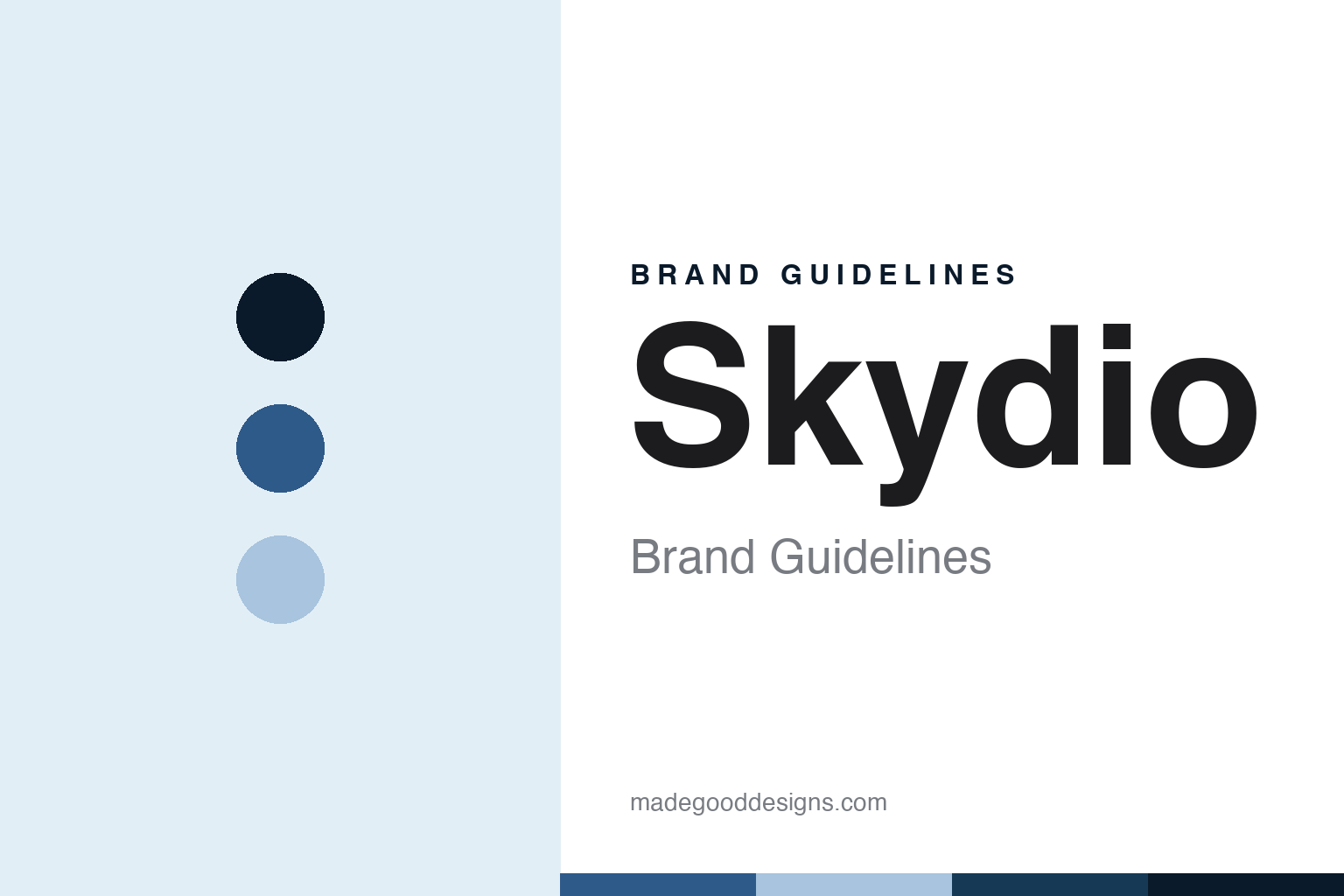
Skydio Brand Guidelines
The US autonomous drone.
Aa
Two constants: an autonomy-blue palette and an autonomy-sans register. Abstract homage — not a Skydio product or mark; no drone, propeller or logo is reproduced.
The US autonomous drone
Skydio is the US-made autonomous drone maker that taught a drone to fly itself, then left the consumer market for enterprise, public safety and defense.
Skydio opens the drone round as its US-autonomous node and one of the round’s clearest pivots — the drone that flies itself, made by the largest American drone company, which walked away from consumers to serve institutions. It was founded in 2014 by Adam Bry, who came from Google’s drone-delivery project and MIT, with Abe Bachrach and Matt Donahoe, and is based in San Mateo, California. Skydio makes and sells the drones, and its answer to a round about where drones are made and who owns them is a pointed one: genuinely US-made, privately held, and built to a non-China supply chain.
Its identity is the US autonomous drone. The self-flying autonomy, the US manufacture and the deliberate exit from consumer are the story here. A drone, autonomous. The US autonomous drone.
(Honest notes, so the manufacture and the pivot are framed accurately. Skydio sells drones as its heroes — the self-flying Skydio 2 and 2+, the X2, and the flagship X10 and X10D, all built on the Skydio Autonomy engine for 360-degree obstacle avoidance and GPS-denied navigation — and we report its performance language as the brand’s own. On where it is made, the point that carries the round: Skydio is genuinely US-made in California and has been NDAA-compliant since 2019, and we frame it as US-made and driving to a fully non-China supply chain rather than claiming it was always China-free — its batteries were the last China-sourced component, and after China sanctioned the company in late 2024 it moved that supply onshore, backed by a large US manufacturing expansion. On the pivot, the central story: in 2023 Skydio exited the consumer market entirely to focus on enterprise, public safety and defense. We report the defense dimension in neutral, technical terms — inspection, public safety, GPS-denied autonomy and supply-chain resilience. Its designs, the model names and the logo are IP we describe but do not reproduce; there is no official brand hex; these tones are an unofficial interpretation.)
Colour
Skydio lives in an autonomy blue. Click a swatch to copy the hex.
Skydio’s identity is autonomous, American and institutional — an autonomy blue, an ink, a pale sky, a deep marine, and a paper. The palette leans autonomy blue and pale sky: a cool, technical register that nods to flight software and open sky rather than a loud logo colour. It signals a US autonomous drone — self-flying, precise and made at home. The honest caveat: with no published brand hex, these values are an original, unofficial interpretation, not first-party colours.
The lesson is an autonomy blue signals an autonomous, American identity. Skydio’s world is a drone that navigates on its own, built in California. For designers, it is a reminder that a cool autonomy blue and a soft pale sky can carry a maker brand — a technical tone held as colour, not a product shot. Because these tones can fail as small text, keep type dark and let the colour live in the accents, palette and band. The takeaways: date it to 2014; credit Adam Bry and the founding team; name the US manufacture; frame the consumer exit; and treat any single hex as unofficial.
Typography
The register is an autonomy sans — technical, precise, self-directed.
Skydio’s identity carries a technical, precise, self-directed spirit — a flight-autonomy company, not a toy maker. An autonomy sans captures the mood: clean, exact and confident, the register of software that flies a machine. Set in an autonomy-blue palette, the autonomy sans feels technical and precise — exactly the personality Skydio carries. It behaves like an engineered, self-directed thing rather than a loud logo, mirroring sensors and carbon airframe. (Skydio’s real drones and the logo are things we describe but do not reproduce, and the exact typeface is not ours to use.) Because it is not ours to use, the honest description is “an autonomy-sans brand,” shown here in a stand-in. The type behaves like the brand: technical, precise and self-directed.
Aa
An autonomy-sans brand — technical and precise. (Specimen set in Space Grotesk, an autonomy-sans STAND-IN; NOT the Skydio logo or any drone.)
The drone
Skydio stands for the US autonomous drone.
Skydio opens the drone round as its US-autonomous node. An autonomy-blue palette, an autonomy sans and a 2014 founding make one thing — the US autonomous drone — the whole identity: autonomous, American and institutional. The self-flying autonomy is the pitch, and the US manufacture is the proof. The point is the drone that flies itself, built at home, in a round about where drones are made and who owns them.
Put to work, the identity is the brand told straight, manufacture named and the pivot framed. A maker in this spirit would date it to 2014, credit Adam Bry and the team, and name the US manufacture. A reader in this spirit would keep the facts right: Skydio sells drones as its heroes, led by the self-flying X10; it was founded in 2014 by Adam Bry with Abe Bachrach and Matt Donahoe in San Mateo; it is privately held and venture-backed; it is genuinely US-made and moving to a non-China supply chain; and in 2023 it exited the consumer market for enterprise, public safety and defense. Skydio opens the round, before Autel. The honest editorial moves are to date it to 2014, to name the US manufacture, to frame the consumer exit, to keep the defense dimension neutral, and to tell the China-sanctions episode as a supply-chain story.
For designers and brand-builders, Skydio opens the drone: let genuine US manufacture and a hard strategic pivot be the identity — and report a defense turn in neutral, technical terms. The lessons: build a brand on a real technical breakthrough, here flight autonomy; make in-country manufacture and supply-chain sovereignty part of the story; name a decisive market exit rather than blur it; keep sensitive markets factual, not celebratory; and never reproduce a logo. It is also a reminder to stay precise: Skydio is the US-made autonomous drone maker that taught a drone to fly itself, then left the consumer market for enterprise, public safety and defense — with the palette here an unofficial interpretation. The hook is that arc: Skydio taught a drone to fly itself, then walked away from the consumers who loved it for exactly that — betting the whole company that the future of autonomous flight is American-made and answers to utilities, first responders and public agencies rather than hobbyists. Read that way, Skydio is less a drone than a flying computer: technical, precise, self-directed. The lesson for a brand is that autonomy and honest sourcing reinforce each other, and building at home keeps the story earned. Skydio made the-US-autonomous-drone the identity — proof that a technical pivot can open a round.
Explore & save
Keep Skydio’s identity on hand — save it to a board in the Made Good inspiration library.
Skydio identity set
Pin the autonomy-blue palette and the autonomy-sans register to your own board.