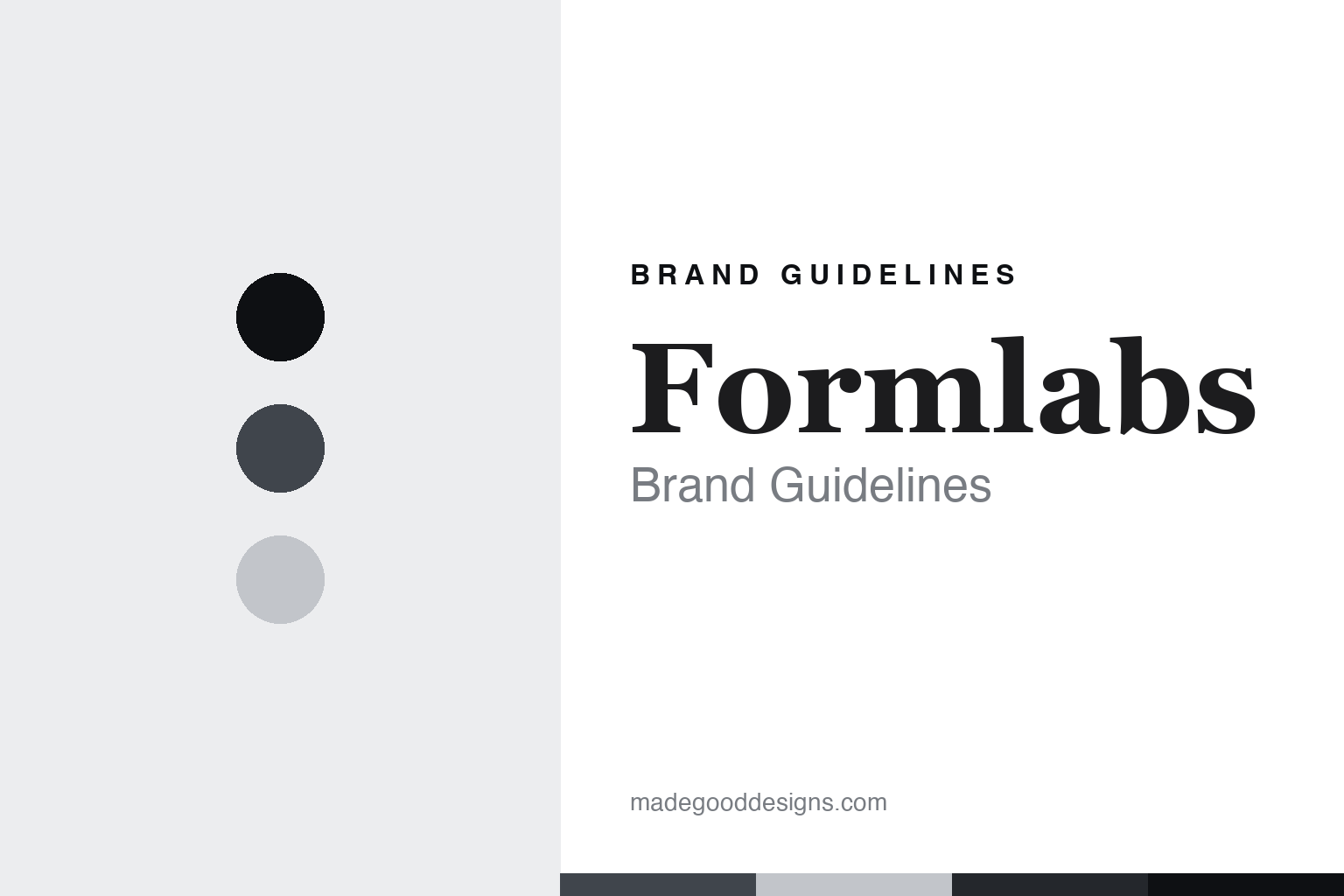
Formlabs Brand Guidelines
The MIT spinout that turned pro.
Aa
Two constants: a professional-graphite palette and a professional-serif register. Abstract homage — not a Formlabs product or mark; no printer, resin vat or logo is reproduced.
The MIT spinout that turned pro
Formlabs is the MIT Media Lab spinout that made desktop stereolithography a professional tool for engineering, dental and jewelry.
Formlabs brings the 3D-printer round its professional node — the American company that took resin printing upmarket, out of the hobby and into the workshop and the dental lab. It was founded in 2011, spun out of the MIT Media Lab, and is headquartered in Somerville, Massachusetts. Formlabs makes and sells the printers, and its answer to a round about who owns 3D printing and where it is made is a professional one: a private US company, designed in Massachusetts, with printers made in Asia and resins made in the US.
Its identity is the MIT spinout that turned pro. The MIT origin, the professional stereolithography and the engineering-and-dental focus are the story here. A maker, professional. The MIT spinout that turned pro.
(Honest notes, so the origin, the ownership and the manufacturing are framed accurately. Formlabs sells the printers as its heroes — the Form series of desktop stereolithography resin printers, now the Form 4, and the Fuse series of selective laser sintering printers — and we report its language as the brand’s own. On origin: it was founded in 2011 by three MIT Media Lab alumni and launched the Form 1 on Kickstarter in 2012; that campaign drew a patent-infringement suit from 3D Systems, which was settled in 2014 with a royalty-bearing license, so we say settled, not won. On ownership: it is private and venture-backed, reaching a billion-dollar “unicorn” valuation in 2018 and roughly double that after a later round, though the current exact figure is unverified. On the technology: it is professional and prosumer resin, stereolithography and laser sintering, not cheap hobbyist filament printing. On where it is made: designed in Massachusetts, with printers from the Form 3 onward made in China and its resins made in the US. On its focus: engineering, dental and jewelry. Its designs, the Formlabs name and the Form and Fuse names are IP we describe but do not reproduce; there is no official brand hex; these tones are an unofficial interpretation.)
Colour
Formlabs lives in a professional graphite. Click a swatch to copy the hex.
Formlabs’ identity is professional, precise and engineered — a professional graphite, an ink, a pale steel, a deep slate, and a paper. The palette leans professional graphite and pale steel: a serious, technical register that nods to engineering and the professional lab rather than a loud logo colour, and deliberately not to the brand’s own orange-and-black. It signals the MIT spinout that turned pro — professional, precise and engineered. The honest caveat: with no published brand hex, and with the orange-and-black treated as trade dress, these values are an original, unofficial interpretation, not first-party colours.
The lesson is a professional graphite signals a professional, engineered identity. Formlabs’ world is a dental lab and an engineering bench, not a hobby desk. For designers, it is a reminder that a serious professional graphite and a soft pale steel can carry a hardware brand — a technical tone held as colour, not a product shot. Because these tones can fail as small text, keep type dark and let the colour live in the accents, palette and band. The takeaways: credit the MIT origin and 2011; frame the 3D Systems case as settled; note the unicorn valuation with a date; place printers in Asia and resins in the US; and keep the professional-resin positioning.
Typography
The register is a professional serif — professional, precise, engineered.
Formlabs’ identity carries a professional, precise, engineered spirit — a professional tool maker, not a hobby brand. A professional serif captures the mood: refined, exact and confident, the register of resin printing built for engineers and dentists. Set in a professional-graphite palette, the professional serif feels professional and precise — exactly the personality Formlabs carries. It behaves like a made, engineered thing rather than a loud logo, mirroring a resin-vat ripple and a laser scan. (Formlabs’ real printers and the names are things we describe but do not reproduce, and the exact typeface is not ours to use.) Because it is not ours to use, the honest description is “a professional-serif brand,” shown here in a stand-in. The type behaves like the brand: professional, precise and engineered.
Aa
A professional-serif brand — professional and precise. (Specimen set in Playfair Display, a professional-serif STAND-IN; NOT the Formlabs logo or any product.)
The 3D printer
Formlabs stands for the MIT spinout that turned pro.
Formlabs brings the round its professional node. A professional-graphite palette, a professional serif and a 2011 MIT origin make one thing — the MIT spinout that turned pro — the whole identity: professional, precise and engineered. The MIT origin is the pitch, and the professional stereolithography is the proof. The point is the company that took resin printing upmarket into professional work, in a round about who owns 3D printing and where it is made.
Put to work, the identity is the brand told straight, the origin credited and the manufacturing split. A maker in this spirit would credit the MIT origin and 2011, frame the 3D Systems case as settled, and place printers in Asia and resins in the US. A reader in this spirit would keep the facts right: Formlabs sells the Form SLA and Fuse SLS lines as its heroes; it was founded in 2011 as an MIT Media Lab spinout in Somerville; its 2012 Kickstarter drew a 3D Systems suit settled with a royalty license; it is a private unicorn; and its printers are made in China while its resins are US-made. Formlabs sits sixth in the round, after Elegoo. The honest editorial moves are to credit MIT and 2011, to frame the lawsuit as settled, to date the unicorn valuation, to split the manufacturing, and to keep the professional positioning.
For designers and brand-builders, Formlabs continues the 3D printer: take a hobby technology professional — and frame a lawsuit and a split supply chain honestly. The lessons: move a consumer technology upmarket into professional verticals; turn an academic origin into brand credibility; describe a patent dispute as settled rather than won; be precise that printers and materials can be made in different countries; and never reproduce a logo or a signature colour. It is also a reminder to stay precise: Formlabs is the MIT Media Lab spinout that made desktop stereolithography a professional tool for engineering, dental and jewelry — with the palette here an unofficial interpretation. The hook is that upmarket turn: three MIT grads crowdfunded a desktop resin printer, fought and settled a patent suit with the industry incumbent, and built not a hobby brand but a professional one — the printer you find in a dental lab or an engineering studio, designed in Massachusetts with its resins still made in the US. Read that way, Formlabs is less a hobby printer than a professional tool: professional, precise, engineered. The lesson for a brand is that professional focus and honest framing reinforce each other, and describing the lawsuit and supply chain straight keeps the story earned. Formlabs made the-MIT-spinout-that-turned-pro the identity — proof that going professional carries a round.
Explore & save
Keep Formlabs’s identity on hand — save it to a board in the Made Good inspiration library.
Formlabs identity set
Pin the professional-graphite palette and the professional-serif register to your own board.