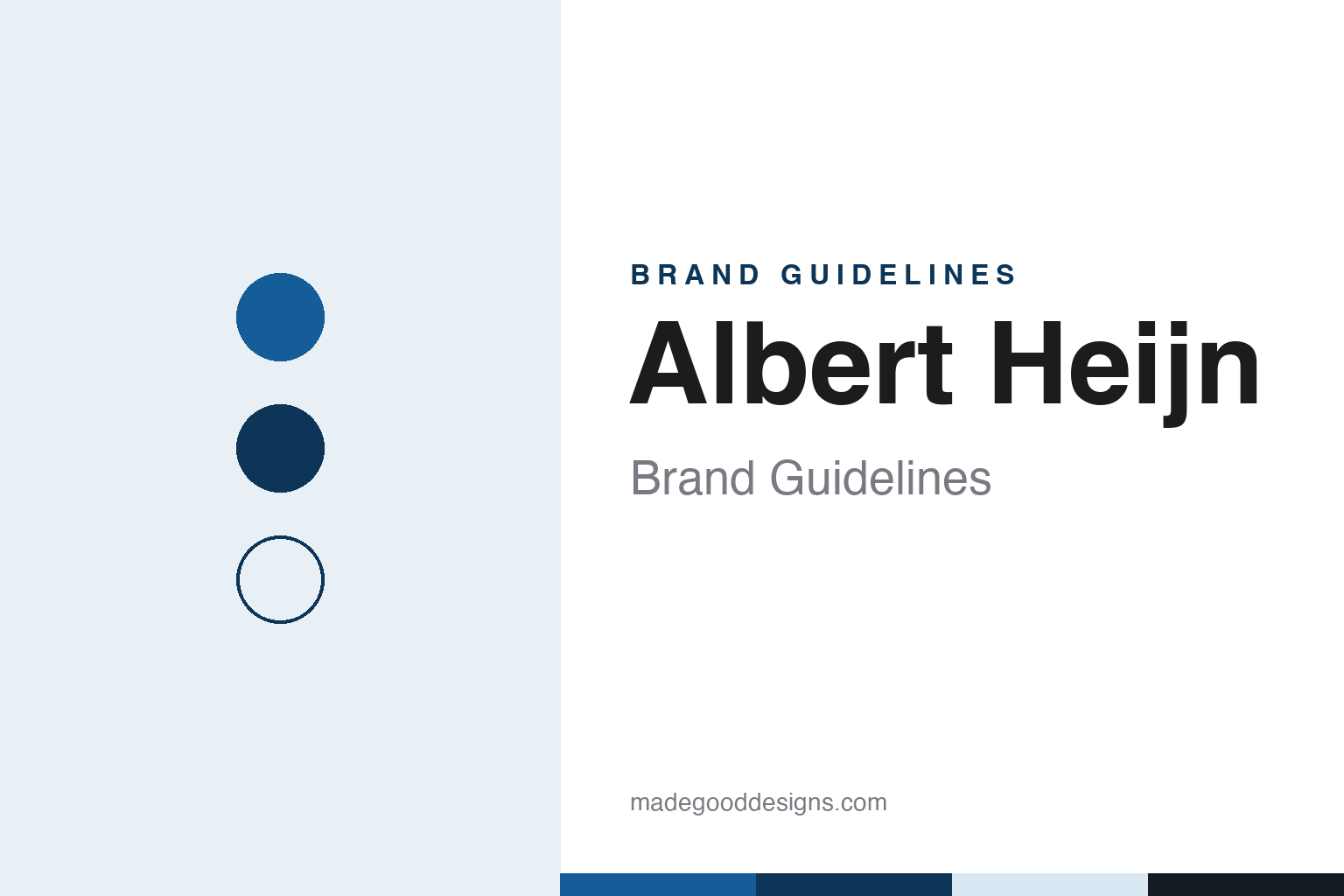
Albert Heijn Brand Guidelines
An 1887 Oostzaan grocery that grew into a Dutch supermarket chain.
Aa
Two constants: a Zaan blue, deep blue and sky wash palette and a lower-case grocery sans register. Abstract homage — not an Albert Heijn sign or mark; no monogram, pack or store fitting is reproduced.
The Oostzaan grocery
A village shop, coffee roasting and a Zaandam warehouse.
Albert Heijn dates itself to 27 May 1887, when Albert Heijn took over the grocery of his father, Jan Heijn, in Oostzaan, a village north of Amsterdam. English Wikipedia says he bought the shop; Dutch Wikipedia adds that the deed of transfer is dated 18 May and that 27 May became the company’s chosen starting date. Dutch Wikipedia describes how he narrowed his father’s general store into a grocery, cutting the range from about 500 articles to a little over 100, adding coffee and building up spices, flour and dried pulses. A second shop opened in Purmerend.
Growth brought the business to Zaandam. In 1899 Heijn opened a central warehouse there, both encyclopaedias say, and English Wikipedia says the chain has had its headquarters in the town ever since. Own products came early: from 1895 he roasted his own coffee in a laundry room at the Oostzaan shop, and from 1910 the company added its own confectionery, cakes and pastry, made in a town house in Zaandam until a purpose-built factory went up on the same site in 1913. Dutch Wikipedia says a chocolate factory for the Delicata brand opened in 1923, that the brand still exists, and that the company ran its own chocolate shops from 1924.
In 1920 the businesses were combined into one company, in which the margarine maker Anton Jurgens, one of the founders of Unilever, took half the shares; the Heijn family bought them back in 1927, English Wikipedia says. On 29 April 1920 Albert Heijn handed day-to-day control to his sons Gerrit and Jan and his son-in-law Johan Hille, staying on as chairman of the board. Dutch Wikipedia dates the first franchise-style “depot shop” to 1923.
The sources used for this guide do not say how Albert Heijn operated during the occupation of 1940–1945.
Colour
Self-service, a monogram and a set of formats.
The modern chain took shape from the late 1940s. Albert Heijn was listed on the stock exchange in 1948, opened its first self-service shop in 1952 and its first supermarket in 1955, English Wikipedia says. By the mid-1960s, Dutch Wikipedia says, the company had grown to 407 shops, from counter-service grocers to self-service stores, supermarkets and bakeries.
The mark that still identifies the chain arrived in 1966: the lower-case “ah” monogram. Sources differ on who drew it. Dutch Wikipedia credits Egbert Jonker; the typography archive Fonts In Use, in a December 2021 entry on an Albert Heijn own-label pack for frozen chips called Pret Patat, says the monogram was designed by James Pilditch of the London consultancy Allied Industrial Designers and introduced in 1966. That pack, from the visual archive of the Stichting Albert Heijn Erfgoed heritage foundation, is dated by the foundation to about 1966 and sets its product name in a heavy display script.
The chain has since spread across several formats, all under the Albert Heijn name. AH To Go began in 1999 as a convenience shop at Den Bosch railway station, developed at the request of the Dutch railway company NS, which became a franchisee; the name dates to 2001, English Wikipedia says. AH XL, a larger store with food and non-food ranges, opened in Arnhem in 2002; Dutch Wikipedia counts 40 in the Netherlands and two in Belgium in 2025. Home delivery, tested from 1999 and sold as Albert.nl from 2001, was folded into the Albert Heijn name in 2014. The Bonuskaart loyalty card dates to 1998, Dutch Wikipedia says, and the informal nickname for the chain is “Appie.”
Own labels sit alongside. English Wikipedia says organic and ecological products were grouped under the umbrella label Puur & Eerlijk in 2009, and that from 2018 stores were refitted under the Echt Vers (“really fresh”) concept with more space for fresh produce.
Typography
European supermarket and variety chains.
Europe’s supermarket, discount and variety chains show themselves first through the shop sign. A short name, a monogram or a block of colour has to work on a high-street fascia, a carrier bag, a trolley and a staff uniform at once. When Rewe renamed its Austrian Merkur stores Billa Plus in April 2021, the Austrian broadcaster ORF listed exactly those items — logos, shop fronts, bags and work clothing — as the things to be changed over. Albert Heijn’s lower-case “ah” monogram has been used since 1966.
Own-label packaging carries the identity onto the shelf. Chains name their ranges in their own words, from organic lines to entry labels and delicatessen ranges, and heritage archives such as the Stichting Albert Heijn Erfgoed foundation keep older packs that show how those labels looked decades ago. A change of colour or logo usually reaches packs, shelves, store interiors and campaigns in stages, as Billa’s yellow-and-white scheme did in the Czech Republic from 2024.
Formats and networks are part of the picture too. Many chains run several store types under one name — a neighbourhood supermarket, a larger flagship, a convenience shop at a station or filling station, and home delivery — and publish their store and country counts on their own corporate pages. Those counts change often, so this guide gives each one with the date of its source.
Ownership varies widely. Some chains still carry a founder’s name; others belong to listed retail groups, to family holdings or to co-operatives owned by their members or retailers, and several have been bought, merged or renamed over the decades. Corporate pages on founders, owners and retail groups set out those structures, and each guide here states them as dated facts, separating what independent sources record from what the companies say about themselves.
ah
A lower-case grocery sans after a two-letter monogram. (Specimen set in Figtree, a sans STAND-IN; NOT the Albert Heijn logo.)
Albert Heijn
The shop that named a holding company.
Albert Heijn grew partly by buying other grocers. English Wikipedia lists Van Amerongen in 1950, Simon de Wit in the early 1970s and C1000 stores in 2008 and 2012. Simon de Wit, another chain from the Zaan district, joined in 1972, Dutch Wikipedia says, and its stores were converted to the Albert Heijn format in 1980.
The company also gave its name to a group, then renamed it. On 27 August 1973 the holding Albert Heijn NV became Ahold NV: Dutch Wikipedia says the chain and its parent were too easily confused, other subsidiaries disliked the close link with the shop name, and “Ahold” was easier to say on international markets. In October 1973 Ahold took over the Etos drugstore chain. In 2016 Ahold merged with the Belgian group Delhaize to form Ahold Delhaize, which is also based in Zaandam.
Abroad, Albert Heijn opened a franchise store on Curaçao in 2007, which changed brand in 2016, and entered Belgium in 2011 with a store in Brasschaat; the AH To Go venture in Germany ended in 2018, English Wikipedia says. At home it kept adding stores. On 9 July 2021 the Dutch competition authority, the ACM, cleared Ahold Delhaize Nederland to take over 38 supermarkets of the Deen chain, together with Deen’s head office, a distribution centre in Hoorn and its flower centre, after the notification was amended to leave out the Deen store at Tuitjenhorn. Dutch Wikipedia says those stores now trade in the Albert Heijn style, and that in December 2023 the handover with Jan Linders was completed, adding 44 Albert Heijn stores in the south of the Netherlands. Ahold Delhaize’s brand page lists Albert Heijn in the Netherlands and Belgium, with 1,288 stores and 29 pick-up points.
For a design guide, Albert Heijn shows how a founder’s name can shrink to two lower-case letters and still carry a chain of supermarkets, convenience shops and home delivery. Compare Jumbo, another Dutch supermarket chain, and SPAR, which began in the Netherlands. For this guide we use a mid blue, a deep blue and a pale sky tone with a sans, an unofficial interpretation; no product or logo is reproduced.
Explore & save
Keep Albert Heijn’s identity on hand — save it to a board in the Made Good inspiration library.
Albert Heijn identity set
Pin the Albert Heijn Zaan blue, deep blue and sky wash palette and the lower-case grocery sans register to your own board.
Source & notes
Frequently Asked Questions
What font can I use to match the Albert Heijn look?
This guide describes Albert Heijn’s type as “A lower-case grocery sans after a two-letter monogram”. Its type specimen is set in Figtree from Google Fonts as a stand-in; Figtree is not Albert Heijn’s own lettering.
What colours are in the Albert Heijn palette?
This guide’s Albert Heijn palette is Zaan blue #155D99, Deep blue #0C3557, Sky wash #D9E7F2, Ink #151B22 and Paper #F6F9FB. The tones are the guide’s own unofficial interpretation, not official Albert Heijn hex codes.
When was Albert Heijn founded?
Albert Heijn was founded on 27 May 1887, in Oostzaan, Netherlands.
Who founded Albert Heijn?
Albert Heijn was founded by Albert Heijn on 27 May 1887.
Who owns Albert Heijn?
Albert Heijn is owned by Ahold Delhaize (since 2016). This guide dates Albert Heijn to 27 May 1887, in Oostzaan, Netherlands.
Where is Albert Heijn based?
Albert Heijn is based in Zaandam (since 1899). This guide dates Albert Heijn to 27 May 1887, in Oostzaan, Netherlands.