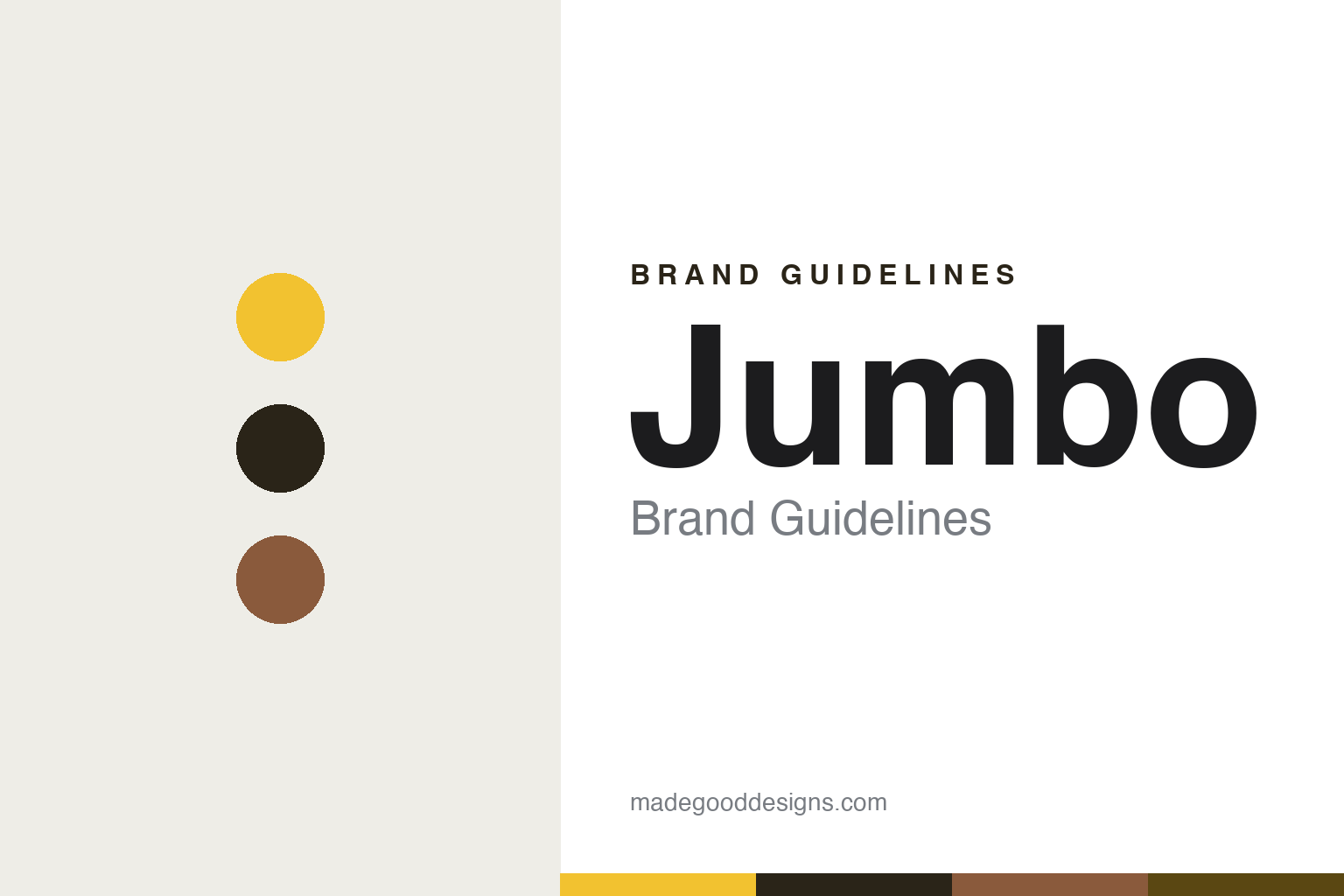
Jumbo Brand Guidelines
A Tilburg store named after an elephant, grown by a Veghel family firm.
Aa
Two constants: a yellow, brown and ink palette and a heavy grotesque register. Abstract homage — not a Jumbo product or mark; no logo, sign or pack is reproduced.
A church in Tilburg
One store, a rival called Torro and an elephant.
Jumbo began as a single supermarket. English Wikipedia says Jan and Anita Meurs opened the first Jumbo on 18 October 1979 in a former church building in Tilburg, in the southern province of North Brabant; Dutch Wikipedia places it on the Lourdesplein. The name was a joke at a rival’s expense. A competing Tilburg supermarket traded as Torro, the bull, and the founders wanted something more powerful than a bull, so they chose Jumbo, the elephant, Dutch Wikipedia says. English Wikipedia adds that Torro belonged to the Van Eerd business.
That business is the second half of the story. Van Eerd was a grocery wholesaler founded in Veghel in 1921, according to both English and Dutch Wikipedia. The sources used for this guide do not say how Van Eerd operated during the occupation of 1940–1945. In 1983 the wholesaler bought the Jumbo formula and the Lourdesplein store from the Meurs family, Dutch Wikipedia says, and quickly opened dozens of Jumbo stores in Zeeland, North Brabant and Limburg. So the brand was founded in 1979 and has been a Van Eerd brand since 1983; the family firm behind it is older than the name by almost six decades.
For more than twenty years Jumbo stayed a southern chain. Dutch Wikipedia counts 36 stores in 2002. When a store opened in Drenthe in October 2005, English Wikipedia says, there was a Jumbo in every Dutch province, although the chain was still thin in the Randstad, the urban belt of Amsterdam, Rotterdam, The Hague and Utrecht. The head office is still in Veghel, where the wholesaler began.
Colour
Konmar, Super de Boer, C1000 and La Place.
Jumbo’s national reach came through takeovers rather than slow store openings. In 2006 it bought 12 Konmar superstores from the retail group Laurus, English Wikipedia says, and Dutch Wikipedia records stores from Super de Boer following a year later. In October 2009 Jumbo won a contest for the whole Super de Boer chain against Sperwer, the co-operative behind Plus, according to Dutch Wikipedia; the converted stores began switching to the Jumbo name in February 2010.
The larger step followed. In November 2011 Jumbo announced that it would take over all C1000 stores from the investment firm CVC Capital Partners, and the Dutch competition regulator, then called the NMa, approved the deal on 21 February 2012, Dutch Wikipedia says. With it, a regional chain from Brabant became a national one.
Jumbo also bought outside groceries. On 26 January 2016, NL Times reported, Jumbo took over the La Place restaurant chain in a deal approved by the administrators of the bankrupt V&D department-store group, starting with 60 restaurants, the company’s assets and its headquarters; the value was not disclosed. La Place food later appeared inside the larger Jumbo stores.
The network now runs to several formats. Dutch Wikipedia describes the Jumbo Foodmarkt, a large store with restaurant counters, opened first in Breda in March 2013; Jumbo City, a smaller urban format first opened in Groningen in 2017; and Jumbo.com, the online shop with pick-up points and home delivery. Jumbo crossed the border at the end of 2019, opening its first Belgian store in Pelt, in Flanders, on 6 November that year; Dutch Wikipedia counts the 44th Flemish store in December 2025, alongside 691 Jumbo supermarkets in the Netherlands, 12 Jumbo City stores and 13 Foodmarkts as of 3 December 2025.
For about a decade the brand was also visible on bicycles, skates and racing cars. Jumbo sponsored a professional cycling team from 2014, according to English Wikipedia, and the racing driver Max Verstappen from 2013. On 2 June 2023, NL Times reported, Jumbo said it would stop sponsoring Verstappen and the Dutch Grand Prix at the end of that season and leave the Jumbo-Visma cycling and skating teams when their contract ended at the end of 2024, as part of a new strategy under a new chief executive.
Typography
Signs, own-label packs and store formats.
Europe’s supermarket, discount and variety chains show themselves first through the shop sign. A short name, a monogram or a block of colour has to work on a high-street fascia, a carrier bag, a trolley and a staff uniform at once. When Rewe renamed its Austrian Merkur stores Billa Plus in April 2021, the Austrian broadcaster ORF listed exactly those items — logos, shop fronts, bags and work clothing — as the things to be changed over. Albert Heijn’s lower-case “ah” monogram has been used since 1966.
Own-label packaging carries the identity onto the shelf. Chains name their ranges in their own words, from organic lines to entry labels and delicatessen ranges, and heritage archives such as the Stichting Albert Heijn Erfgoed foundation keep older packs that show how those labels looked decades ago. A change of colour or logo usually reaches packs, shelves, store interiors and campaigns in stages, as Billa’s yellow-and-white scheme did in the Czech Republic from 2024.
Formats and networks are part of the picture too. Many chains run several store types under one name — a neighbourhood supermarket, a larger flagship, a convenience shop at a station or filling station, and home delivery — and publish their store and country counts on their own corporate pages. Those counts change often, so this guide gives each one with the date of its source.
Ownership varies widely. Some chains still carry a founder’s name; others belong to listed retail groups, to family holdings or to co-operatives owned by their members or retailers, and several have been bought, merged or renamed over the decades. Corporate pages on founders, owners and retail groups set out those structures, and each guide here states them as dated facts, separating what independent sources record from what the companies say about themselves.
Aa
A heavy, upright grotesque in the spirit of a bold shop sign. (Specimen set in Archivo Black, a sans STAND-IN; NOT the Jumbo logo.)
Jumbo
White letters on yellow, and a family holding.
The visual side of the chain is documented mostly through its stores. Dutch Wikipedia says the supermarkets received a new house style in 2013 and are recognisable by white lettering on a yellow background and brown floor tiles; a 2010 version of the logo carried the word “supermarkten” beneath the name, English Wikipedia notes. Customer promises were part of the brand language too. In 1996 Karel van Eerd, of the owning family, introduced the Zeven Zekerheden, or “seven certainties,” a list of promises to shoppers that the company revised from 2024, Dutch Wikipedia says.
Own-label products carry the company’s names. Dutch Wikipedia records that Jumbo phased out the O’Lacy own label from August 2008 and continued with ranges called Jumbo, Jumbo Budget and Jumbo Exclusief, and that in autumn 2024 it launched a new label, Jumbo’s, developed largely within the company and sold in the Netherlands and Belgium alongside the basic Jumbo range. The chain also runs a loyalty scheme, Jumbo Extra’s, and in 2020 launched its own radio station, Jumbo Radio.
Ownership has stayed in the family. On 3 October 2021, the hundredth anniversary of the family business, the holding company was granted the royal title and became the Koninklijke Jumbo Food Groep, Dutch Wikipedia says; its shares are held through a Van Eerd family trust office. The same family completed the purchase of the variety-store chain HEMA in early 2021 through its investment vehicle and a partner, and took full control in December 2025, Dutch Wikipedia says, citing RTL Nieuws. A former Lidl executive, Jesper Højer, became chief executive on 1 January 2026, Dutch Wikipedia says.
For a design guide, Jumbo shows how a single store name can carry a regional wholesaler into a national chain, with the shopfront colour doing much of the work. Compare Albert Heijn, the other large Dutch chain, and Plus, the co-operative that bid against Jumbo for Super de Boer. For this guide we use a warm yellow, deep browns and an ink tone with a sans, an unofficial interpretation; no product or logo is reproduced.
Explore & save
Keep Jumbo’s identity on hand — save it to a board in the Made Good inspiration library.
Jumbo identity set
Pin the Jumbo yellow, brown and ink palette and the heavy grotesque register to your own board.
Source & notes
Frequently Asked Questions
What font can I use to match the Jumbo look?
This guide describes Jumbo’s type as “A heavy, upright grotesque in the spirit of a bold shop sign”. Its type specimen is set in Archivo Black from Google Fonts as a stand-in; Archivo Black is not Jumbo’s own lettering.
What colours are in the Jumbo palette?
This guide’s Jumbo palette is Shopfront yellow #F2C230, Ink brown #2A2418, Floor-tile brown #8A5A3C, Olive umber #5A4712 and Paper #FAF7EF. The tones are the guide’s own unofficial interpretation, not official Jumbo hex codes.
When was Jumbo founded?
Jumbo was founded on 18 October 1979, in Tilburg, Netherlands.
Who founded Jumbo?
Jumbo was founded by Jan and Anita Meurs on 18 October 1979.
Who owns Jumbo?
Jumbo is owned by Van Eerd family (Koninklijke Jumbo Food Groep) (since 1983).