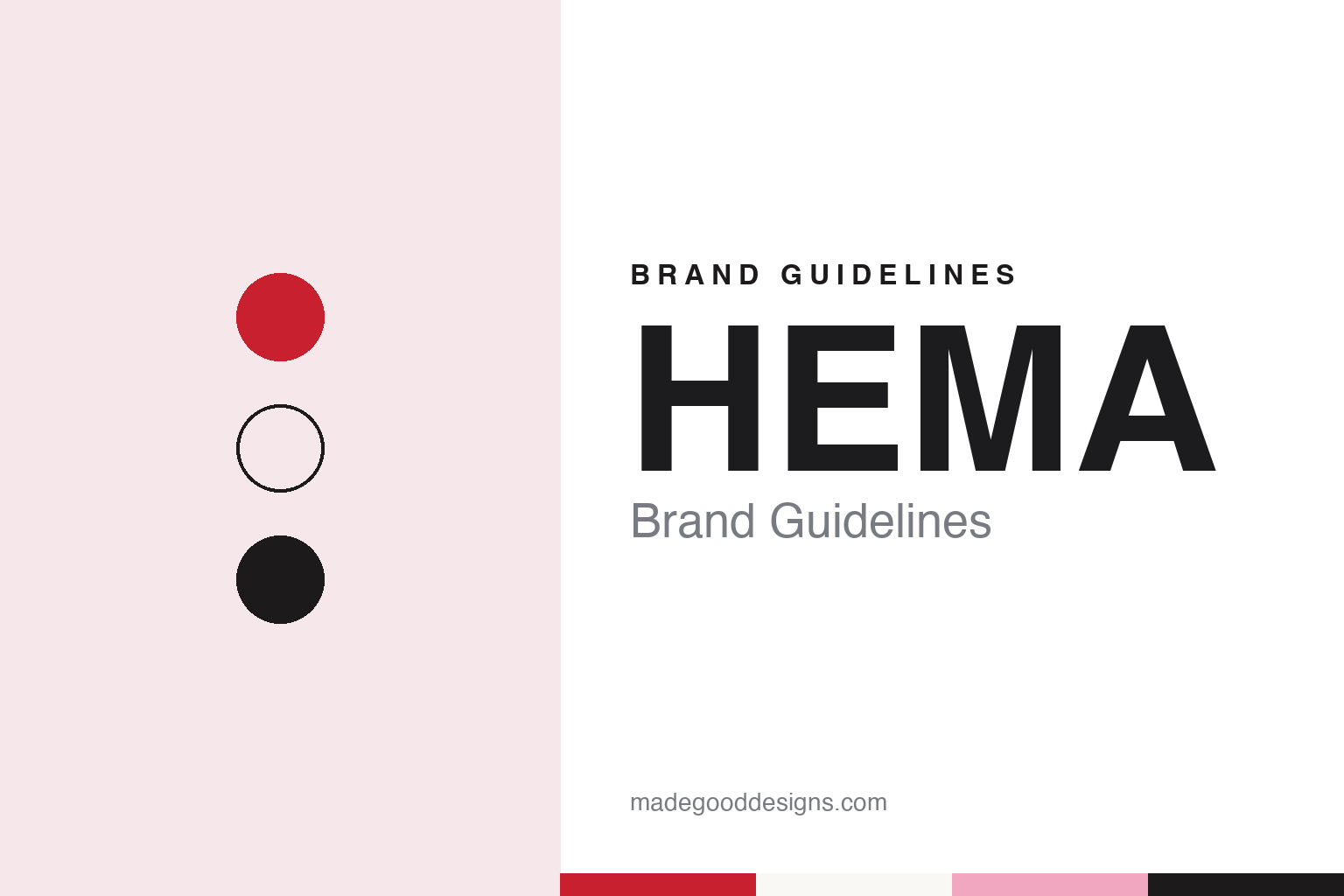
HEMA Brand Guidelines
The Amsterdam unit-price store that turned everyday goods into its own designs.
Aa
Two constants: a HEMA red, white and pastry pink palette and a plain grotesque register. Abstract homage — not a HEMA product or mark; no logo, packaging or store sign is reproduced.
Unit prices
A Woolworth-style store on Amsterdam’s Kalverstraat.
HEMA opened its first store in Amsterdam on 4 November 1926. The name is an acronym of Hollandsche Eenheidsprijzen Maatschappij Amsterdam, roughly “Holland Unit Price Company Amsterdam,” and Dutch Wikipedia names its founders as Leo Meyer and Arthur Isaac, the directors-general of the Amsterdam department store De Bijenkorf. The first branch stood in the Kalverstraat, the city’s main shopping street, and a second followed in the Oude Hoogstraat a few days later. The company still knows its Kalverstraat store as branch number one, Dutch Wikipedia says, even though that branch moved to the Reguliersbreestraat around 1970 and returned to the Kalverstraat, inside the Kalvertoren, in 1997.
The idea came from abroad. Dutch Wikipedia describes the early H.E.M.A. as a store on the model of the Woolworth variety stores of the United States and Britain: every article was sold at one of a small set of fixed unit prices, and there was only one choice of each item. The price ladder was widened in 1928. DutchNews.nl, writing in December 2025, described the first store as selling “everything you could possibly need” at a handful of fixed prices. The low prices gave the chain a long reputation as a shop for people of modest means, Dutch Wikipedia adds.
Food has been part of the format from the beginning. Dutch Wikipedia says the stores had a lunchroom from 1926, that larger branches added a self-service restaurant called “Wip-In” from 1956, and that the warm smoked sausage, the rookworst, began to be sold hot in 1936 at the Nieuwendijk branch in Amsterdam, after which other branches copied the idea. In November 2026 the news site nieuws.nl named the rookworst and the pink-iced tompouce pastry as two of the chain’s recognisable symbols.
The sources used for this guide do not say how HEMA operated during the occupation of 1940–1945. After 1945, Dutch Wikipedia says, the name was written as HEMA rather than H.E.M.A., and the unit-price system was dropped. In the 1950s the company began working with franchisees, and the store count grew from 42 in 1960 to 100 in 1970 and 173 in 1980, according to the same article.
Colour
Own-design goods, a kettle and a student contest.
HEMA sells its own products rather than other makers’ brands. Dutch Wikipedia says almost the whole range is produced specially for the chain, and that since the early 1990s the company has tried to set itself apart through its own use of colours, materials, shapes and patterns. On its Dutch Design Week page in 2026, HEMA says a team of 30 designers works on its products every day, and it points to examples from its past: a bicycle light powered by a candle for people who could not afford a dynamo, and a hot dog made not to leak from the bottom.
One route into that range is a student design competition. English Wikipedia says HEMA has run an annual contest since 1985, and that the 1990 winner, the Le Lapin whistling kettle by Nikolai Carels, has been sold in HEMA stores since 1991. In November 2022 TU Delft reported that one of its industrial-design master’s students had taken the jury award for the “DUO-fles,” a water bottle encased by a coffee cup. For the centenary in 2026 HEMA ran a jubilee edition: ten finalists were shown at the HEMA stand at Dutch Design Week in Eindhoven in October 2026, with a public vote alongside the jury, according to the festival’s programme page. nieuws.nl reported that the winning design, “Hak in de Bak,” is a tool for moving chopped ingredients from a board to a pan.
House brands have changed over time. Dutch Wikipedia says HEMA sold electrical appliances under the Reaktor name from 1969 to 1991, most of them made by the East German maker AKA Electric, before replacing that label with the HEMA name; in 2024 it began selling a collection of Philips kitchen appliances. Photo printing has been offered in its stores since 1979, the same source says.
The store layout has been redesigned around daily life. Dutch Wikipedia says an international store concept introduced in 2008 grouped products by themes such as living, sleeping, eating, cooking, studying and bathing, with theme boards over each department, and that the same presentation reached the Dutch and Belgian stores in 2017. For the centenary, nieuws.nl reported, HEMA began a national advertising campaign in February 2026 with an anniversary song by Guus Meeuwis and issued a commemorative coin with the Royal Dutch Mint showing a selection of HEMA products.
Typography
Design and documentation.
Europe’s supermarket, discount and variety chains show themselves first through the shop sign. A short name, a monogram or a block of colour has to work on a high-street fascia, a carrier bag, a trolley and a staff uniform at once. When Rewe renamed its Austrian Merkur stores Billa Plus in April 2021, the Austrian broadcaster ORF listed exactly those items — logos, shop fronts, bags and work clothing — as the things to be changed over. Albert Heijn’s lower-case “ah” monogram has been used since 1966.
Own-label packaging carries the identity onto the shelf. Chains name their ranges in their own words, from organic lines to entry labels and delicatessen ranges, and heritage archives such as the Stichting Albert Heijn Erfgoed foundation keep older packs that show how those labels looked decades ago. A change of colour or logo usually reaches packs, shelves, store interiors and campaigns in stages, as Billa’s yellow-and-white scheme did in the Czech Republic from 2024.
Formats and networks are part of the picture too. Many chains run several store types under one name — a neighbourhood supermarket, a larger flagship, a convenience shop at a station or filling station, and home delivery — and publish their store and country counts on their own corporate pages. Those counts change often, so this guide gives each one with the date of its source.
Ownership varies widely. Some chains still carry a founder’s name; others belong to listed retail groups, to family holdings or to co-operatives owned by their members or retailers, and several have been bought, merged or renamed over the decades. Corporate pages on founders, owners and retail groups set out those structures, and each guide here states them as dated facts, separating what independent sources record from what the companies say about themselves.
Aa
A plain grotesque for an everyday-goods store. (Specimen set in Archivo, a sans STAND-IN; NOT the HEMA logo.)
Owners
From De Bijenkorf to the Van Eerd family.
For most of its history HEMA sat inside a larger retail group. Dutch Wikipedia says the De Bijenkorf and HEMA businesses were restructured in 1966 as Bijenkorf Beheer, later known as KBB; in 1999 Vendex took over the group, forming Vendex KBB, which was renamed Maxeda in 2006. In 2007 Maxeda sold HEMA to the British investment firm Lion Capital in a leveraged buyout that left the chain carrying heavy debt until 2020, the same article says. In October 2018 the Dutch investor Marcel Boekhoorn took it over, and in June 2020 the bondholders received the shares in exchange for a reduction of the debt.
In December 2020 the Van Eerd family, owners of the Jumbo supermarkets, agreed with the bondholders to buy HEMA together with the Dutch investor Parcom, each taking half. Dutch Wikipedia dates completion to 1 February 2021, and DutchNews.nl also reported that the two each acquired a 50% stake in 2021.
Expansion abroad came in stages. Dutch Wikipedia says HEMA opened its first stores in Belgium in the early 1990s and twenty at once in 1997, many in former Sarma department stores, followed by Germany and Luxembourg; in France it worked with Auchan under the name Little Extra from 2006 and opened its own store at Créteil in 2009. English Wikipedia says stores opened in Madrid in April 2014 and at Victoria Place in London in June 2014; all the British stores had closed by the summer of 2021, and the Spanish stores closed during 2022. Dutch Wikipedia, citing the 2022 annual report, gives 558 stores in the Netherlands, 102 in Belgium and 63 in France, about 250 of them run by franchisees. When annual results were presented in May 2026, nieuws.nl reported, HEMA had about 770 branches, 300 of them already renovated.
On 2 December 2025 the two shareholders said in a joint statement that the Van Eerd family’s investment vehicle would buy Parcom’s half, DutchNews.nl reported, adding that HEMA, with a workforce of about 17,000, would keep trading under its own name. The Dutch competition authority, the ACM, decided on 22 January 2026 that the Van Eerd group could take sole control. The law firm Stibbe, which advised the family, says the deal was completed on 11 February 2026: HEMA now sits under a new holding, Van Eerd Retail, which also holds Jumbo, while the two chains remain separate businesses.
For a design guide, HEMA shows how a chain can make its own products the core of its identity, from a kettle chosen in a student contest to a commemorative coin. Compare Jumbo, now under the same family holding, and Albert Heijn, another Dutch retailer in the same high streets. For this guide we use a shop red, paper white and a pastry pink with a sans, an unofficial interpretation; no product or logo is reproduced.
Explore & save
Keep HEMA’s identity on hand — save it to a board in the Made Good inspiration library.
HEMA identity set
Pin the HEMA red, white and pastry pink palette and the plain grotesque register to your own board.
Source & notes
Frequently Asked Questions
What font can I use to match the HEMA look?
This guide describes HEMA’s type as “A plain grotesque for an everyday-goods store”. Its type specimen is set in Archivo from Google Fonts as a stand-in; Archivo is not HEMA’s own lettering.
What colours are in the HEMA palette?
This guide’s HEMA palette is Shop red #C8202F, Ink #1C1A1A, Paper white #FAF8F5, Pastry pink #F2A7C0 and Smoked brown #8A4B2A. The tones are the guide’s own unofficial interpretation, not official HEMA hex codes.
When was HEMA founded?
HEMA was founded on 4 November 1926, in Amsterdam, Netherlands.
Who founded HEMA?
HEMA was founded by Leo Meyer and Arthur Isaac (De Bijenkorf) on 4 November 1926.
Who owns HEMA?
HEMA is owned by Van Eerd family (Van Eerd Retail), since February 2026.