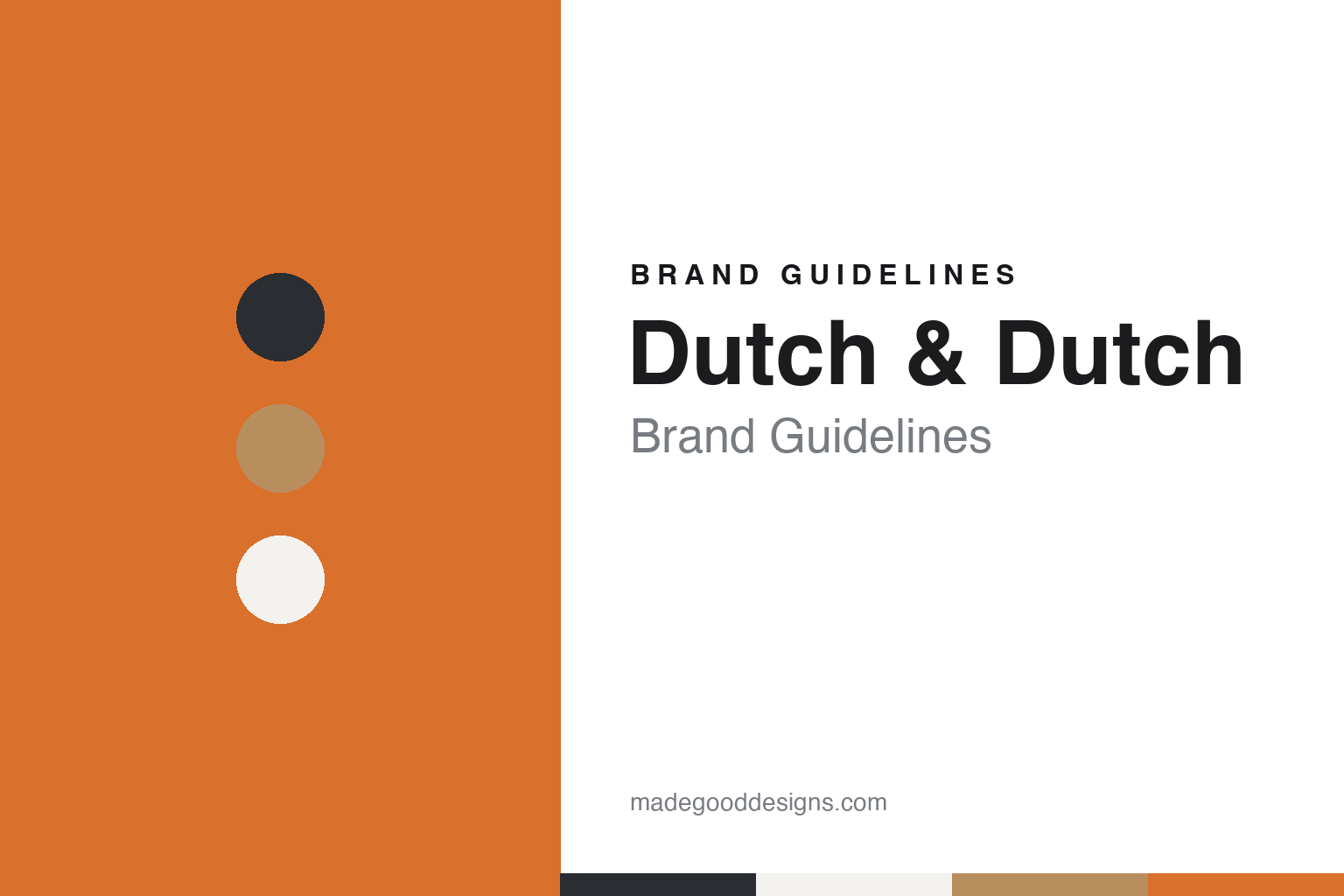
Dutch & Dutch Brand Guidelines
The Dutch speaker company that designed around the room.
Aa
Two constants: a Dutch & Dutch oak, white and graphite palette and an engineered sans register. Abstract homage — not a Dutch & Dutch product or mark; no speaker, logo or nameplate is reproduced.
A failure first
Five founders, one acoustic designer.
Dutch & Dutch was founded in the Netherlands in 2014. Stereonet, reviewing its speaker in March 2025, describes the company as founded “by a group of engineers and audio enthusiasts with backgrounds in hi-fi, pro audio, software development and industrial design,” and Stereophile, interviewing its co-founder, put the number of founders at five. The one consistently named is Martijn Mensink, the acoustic designer: Sound On Sound called him the designer of the 8c in 2019, and a 2025 company announcement quoted him as the founder. audioXpress, profiling the company in 2023, also named Kevin Kleine, a software engineer, as a co-founder. We could not find the other founders named in the sources we checked, so we do not name them.
The company’s story, as Mensink tells it, begins with a failure. In a question-and-answer piece for The Absolute Sound, he said he studied physics, took degrees in business administration and strategy, and worked part-time in a high-end hi-fi shop while at university. His first audio company, started with two friends, built a prototype system, but the firm it had partnered with for production “took all our savings, right before going bankrupt,” he said. Speaking to PMA Magazine in 2025, he described that earlier product as a cardioid design with a waveguide, digital signal processing and several separate subwoofers — too complicated, he said, for customers to understand.
The idea survived. Mensink told PMA that he was then approached by people who wanted to build a professional sound system around the cardioid design, to control where sound goes at concerts, and that when that venture lacked the scale to reach the market the technology was reworked into a single, integrated speaker under the Dutch & Dutch name. The Absolute Sound describes the company as “the 2014 offshoot of an engineering firm,” whose research produced room-analysis software and a line of pro-audio equipment before the consumer speaker. Mensink has said the team “originated from the Delft University of Technology,” and that almost half of it were software developers. The accounts differ in their detail, so we give them as told.
Colour
One box, cardioid to 100 hertz.
The 8c, the company’s first commercial product, was introduced in 2017, according to Stereonet; The Absolute Sound says it was first produced in 2018. The name, Stereonet says, refers to its eight-inch drivers and its cardioid radiation pattern. It is a three-way active stand-mount speaker: an eight-inch midrange driver and a one-inch tweeter in a deep waveguide at the front, and two eight-inch woofers facing backwards. Reviewing it in June 2019, Sound On Sound’s Phil Ward explained that apertures in the side walls let part of the midrange driver’s rear output escape and cancel sound behind the cabinet, a passive technique he compared with that of the German monitor maker Geithain. The company claims cardioid behaviour down to 100Hz, and recommends placing the speaker 10–50cm from the wall behind it — an arrangement it calls “Boundary-Coupled Bass.”
Everything else is inside the box. Each speaker carries three class-D amplifiers — 500 watts for the woofers and 250 each for the midrange and tweeter, by Sound On Sound’s figures — which The Absolute Sound says are sourced from the Danish firm Pascal, driving units it says are made by SEAS and Wavecor. There are converters, signal processing, network streaming and room equalisation, run through the company’s own software. The cabinet is 19mm solid oak over birch-plywood bracing, with an injection-moulded white plastic front baffle that also forms the waveguide; an 8c Studio version in MDF is sold for professional use. In 2024 The Absolute Sound reported that the 8c was the first loudspeaker to license a third-party plug-in: Edgar Choueiri’s BACCH crosstalk-cancellation filter.
The speaker has collected awards. The SoundStage! Network named it a Pioneering Design Achievement among its 2019 products of the year, citing Diego Estan’s review of April 2019. The Absolute Sound gave it a Golden Ear award in 2024 and named it its 2025 Integrated System of the Year, calling it “an exceptional speaker, an exceptional value.”
Typography
The Low Countries and the record.
The Low Countries have a long record in consumer audio. Philips, founded in Eindhoven in 1891 by Gerard Philips and his father Frederik to make light bulbs, introduced the Compact Cassette in August 1963 — developed, English Wikipedia says, by a team led by Lou Ottens in Hasselt, Belgium — and co-developed the compact disc with Sony; the first CDs went on sale in Japan in October 1982.
Philips is also part of the story of Dutch class-D amplification. The Belgian engineer Bruno Putzeys spent ten years at Philips’s Applied Technologies lab in Leuven, where he invented the “UcD” circuit, which Philips patented. Hypex, a Dutch company formed in 1996, began producing it in the early 2000s after Philips declined to use it, and in 2005 Putzeys left Philips to divide his time between Hypex and Grimm Audio, according to English Wikipedia.
The makers in this guide are spread across the Netherlands: Kharma in Breda; Grimm Audio in Veldhoven, beside Eindhoven; Siltech and Crystal Cable at the same address in Elst, in Gelderland; Hypex and Mola Mola at the same address in Groningen; and Dutch & Dutch in Capelle aan den IJssel, next to Rotterdam, according to their own websites.
A Dutch address does not always mean Dutch manufacture. Hypex has its own production facility in Malaysia, English Wikipedia says, and Dutch & Dutch buys its drivers and amplifiers from outside suppliers, The Absolute Sound reported in 2024.
This guide sets out what can be checked about each brand — who founded it, who owns it, and what it says about where its products are made — and marks clearly what rests only on the company’s own word.
Aa
An engineered sans for a speaker company that leads with acoustics. (Specimen set in Manrope, a sans STAND-IN; NOT the Dutch & Dutch logo.)
Dutch & Dutch
Designed and built in the Netherlands, it says.
Dutch & Dutch remains a small company and, as far as the sources we checked show, an independent one: we found no reported sale or outside owner. Its website names the trading company Dutch & Dutch Export B.V., at Sonarstraat in Capelle aan den IJssel, a town bordering Rotterdam to the east. In 2025 it announced a second model, the smaller 6c, built on the same software platform and previewed at that year’s Audio Video Show in Warsaw, with an optional bass module, the 6s, promised for 2026. The website now lists the 6c at about €9,950 a pair and the 8c at about €15,450.
On where its speakers are made, the company’s claim is plain. Its website says they are “Designed and built in the Netherlands,” its terms of sale say products are made once an order is placed rather than held in stock, and its warranty refers to “the Dutch & Dutch factory.” audioXpress reported in 2023 that assembly and testing are done in-house in Rotterdam. The components are another matter: the drivers come from outside suppliers — Sound On Sound described them as of “mixed European and Far Eastern origin” — and the amplifiers, by The Absolute Sound’s account, from Denmark. We give “built in the Netherlands” as the company’s description of where the speakers are designed and assembled, not of where every part comes from.
For a design guide, Dutch & Dutch shows how a speaker can be recognised by its form as much as its mark: a white moulded baffle on an oak box, with the logo in a small square cut-out that also holds the power light, as The Absolute Sound describes it. Compare Genelec, the Finnish maker of active monitors, and Lyngdorf, another company that builds its systems around the listening room. For this guide we use oak, white, graphite and an indicator orange with a sans, an unofficial interpretation; no product or logo is reproduced.
Explore & save
Keep Dutch & Dutch’s identity on hand — save it to a board in the Made Good inspiration library.
Dutch & Dutch identity set
Pin the Dutch & Dutch oak, white and graphite palette and the engineered sans register to your own board.