Abraham Bosse made prints that look like well-art-directed magazine spreads. A scene of shoppers or a family at dinner sits inside a decorative border, with a title in a cartouche and blocks of verse set in columns underneath. Everything is ruled, measured and legible. The Metropolitan Museum of Art records him as French, born in Tours in 1602 or 1604 and died in Paris in 1676, and its collection includes both his prints and later editions of his treatise on etching.
The prints shown here come from the Met and the Cleveland Museum of Art, which release them as public domain and CC0. For more cleared works, browse the MGD museum inspiration collection.
Who was Abraham Bosse?
The Met gives his birth as Tours, 1602 or 1604, and his death in Paris in 1676. The Cleveland Museum of Art gives 1602–1676, while the Melville’s Print Collection project, an online scholarly exhibition on the prints owned by Herman Melville, gives 1604 and also names Tours as his birthplace.
According to the Melville project, which quotes the print historian Harrison, Bosse settled in Paris in 1632 and from then on worked tirelessly as both engraver and writer. The same source records that he lectured on perspective at the Académie Royale from 1648, was made an honorary member, and was expelled in 1661 after bitter disputes with its members.
Paris in contemporary dress
The Melville project quotes Harrison’s observation that, whatever their subjects, Bosse’s prints almost always show the human figure in contemporary dress, so that even traditional themes such as the Five Senses or the Four Seasons become scenes of middle-class life with careful attention to costume and rooms. That is why historians of dress and interiors still use them.
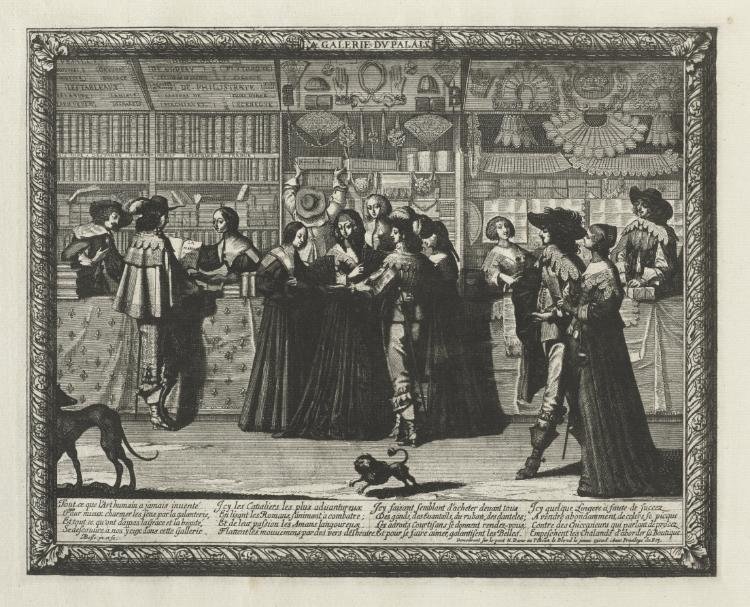
La Galerie du Palais, which Cleveland dates to 1640 with a query, shows shoppers browsing stalls of books, lace collars and fans in the arcade of the Palais de Justice; the plate itself is lettered “Galerie du Palais” in a small cartouche at the top. Every surface is filled with merchandise, yet the figures read clearly because they stand in a single band across the front of the stage. For costume as graphic subject in a later century, see our guide to fashion plates.
What to look at in Abraham Bosse’s prints
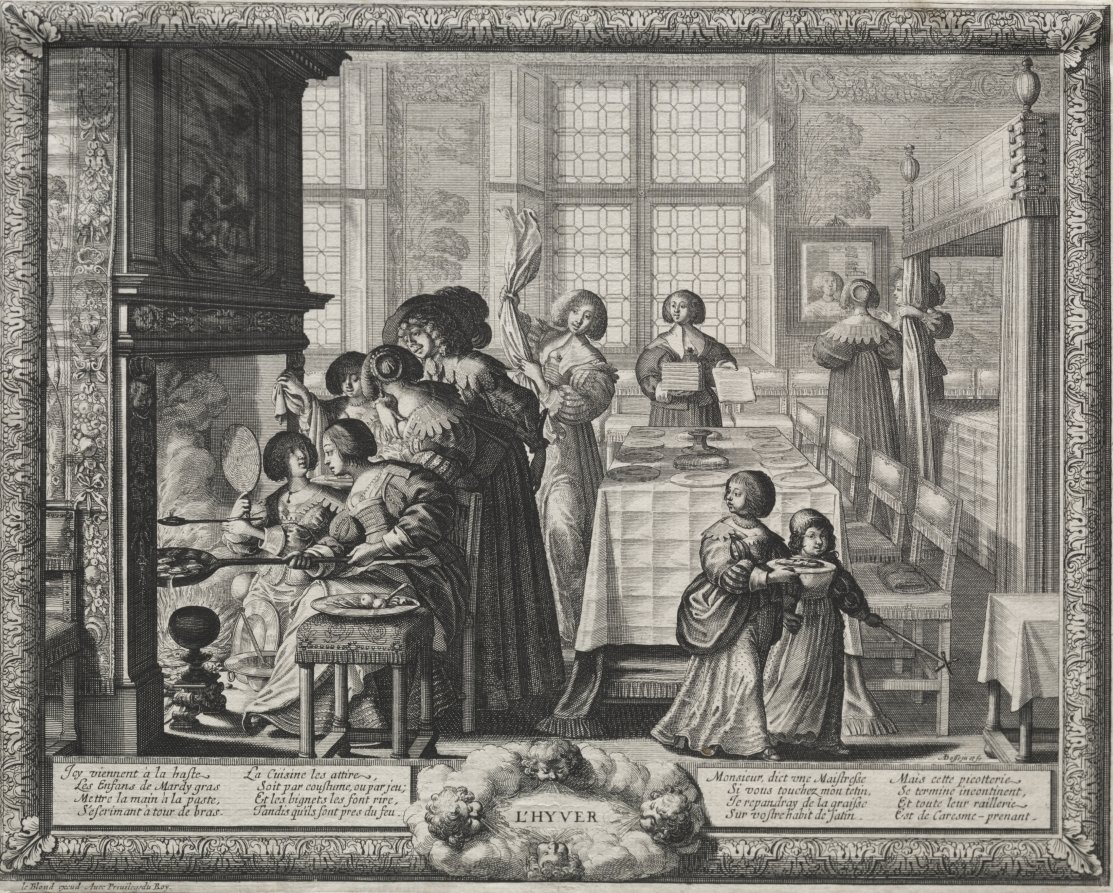
The frame as a system. In Winter from The Four Seasons and in the Prodigal Son series, both dated 1635 by Cleveland, each scene sits inside a printed frame of carved-looking ornament. The frame is the same across the set, so the series reads as one product. The Melville project dates The Four Seasons to around 1637, so the dates for that set vary between sources.
Perspective as stagecraft. His rooms are built like stage sets: a tiled or boarded floor recedes to a vanishing point, windows and fireplaces line the side walls, and figures stand in a shallow band in front. Given his lectures on perspective at the Académie, recorded by the Melville project, the construction is no accident.
Text under the image. Most of these plates carry verses engraved in neat columns below the picture, with a title set in a cartouche. In Winter, the season’s name sits in a small scrolled panel at the bottom centre. The picture and the verse share the sheet like a headline, image and body copy.
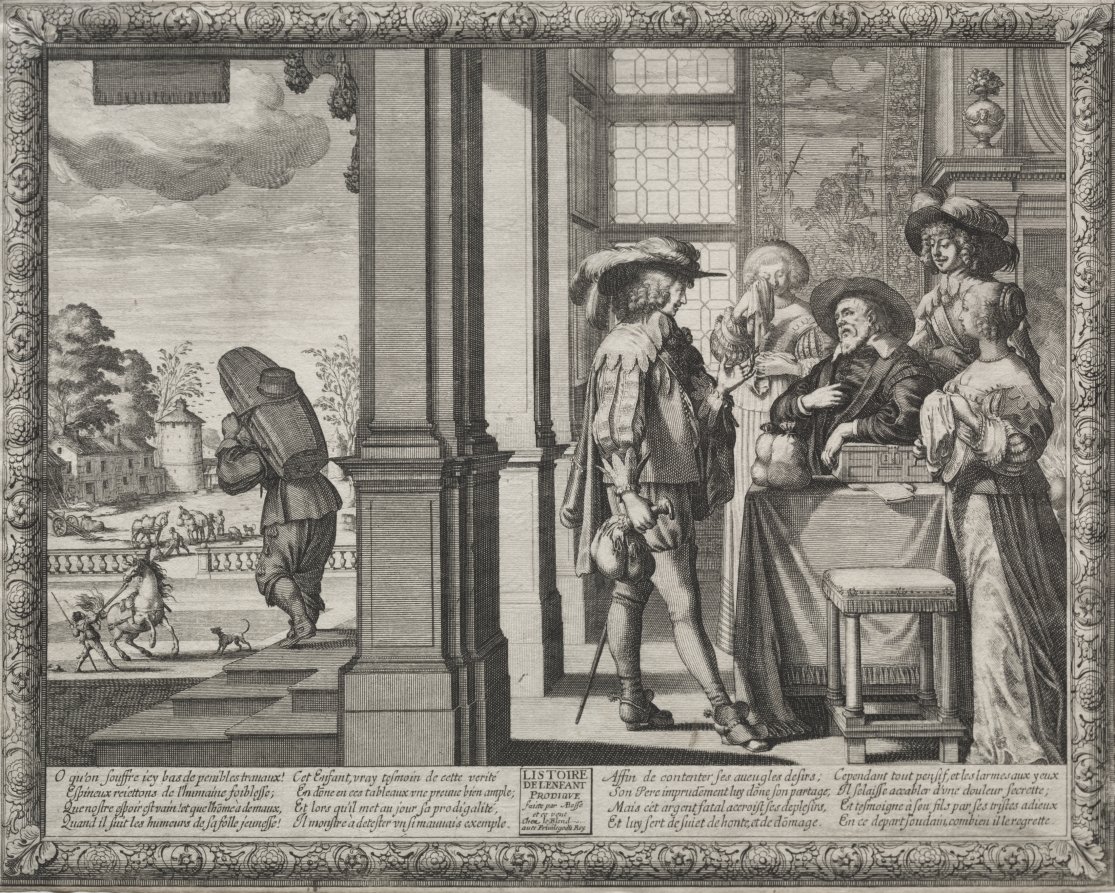
Contemporary clothes for old stories. In The Prodigal Bidding His Parents Farewell, the biblical son wears a plumed hat and boots of the 1630s and takes his leave in a French house with a formal garden behind. Updating the costume made the moral feel current to its buyers.
Technique: etching made to look like engraving
The Melville project quotes Harrison: Bosse combined etching and engraving in the manner of Jacques Callot, from whom he learned the Italian method of etching on a hard ground made from linseed oil and resin. That ground gave clear, fine etched lines, and for Bosse the aim was for etching to imitate engraving, finishing the plate with the engraver’s burin. Cleveland catalogues several of these plates as “engraving and etching” or “etching and engraving,” which reflects that mix. Read more about the older master in our guide to Jacques Callot.
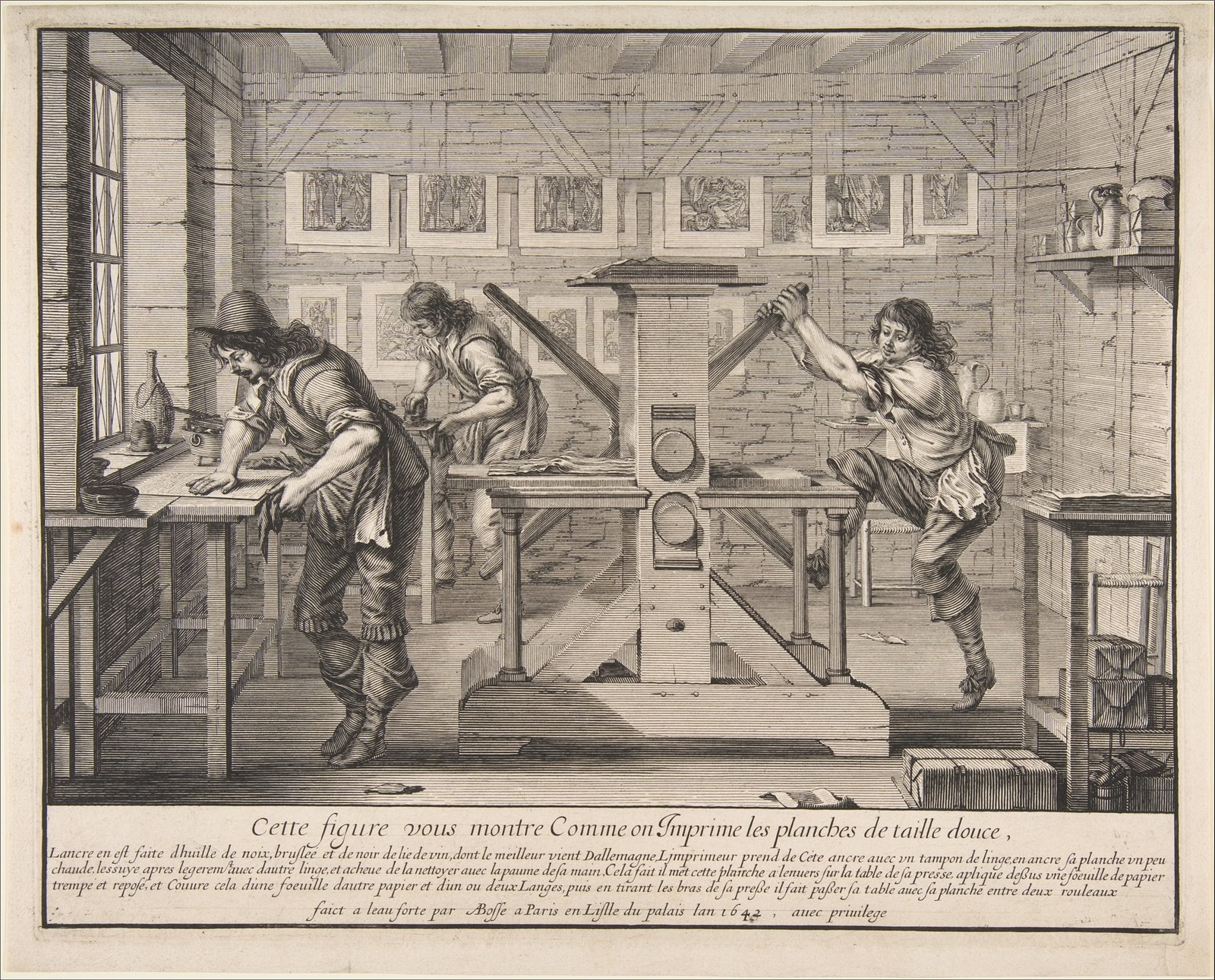
The Met’s print The Intaglio Printers, dated 1642, shows the other end of the process: a workshop where printers ink copper plates and pull sheets through a roller press, with finished prints pinned along the walls and an engraved caption explaining the steps. It is a useful picture of how prints like his were produced and sold.
Measured from the Cleveland Museum of Art’s scan of La Galerie du Palais, the main tones are a near-black ink (#3c3b35), a mid grey (#8b897c) and a pale grey-cream paper (#bab7aa). They describe a photograph of an aged impression, not the original ink. Sample your own tones with our image colour picker.
The 1645 treatise on etching
In 1645 Bosse wrote, illustrated and published in Paris a treatise on engraving and etching, the Traité des manières de graver en taille douce sur l’airin. HistoryofInformation.com describes it as the first treatise on engraving and etching techniques, and the Melville project calls it the first treatise published on printmaking. Its long life is visible at the Met, which holds a 1758 “new augmented edition” titled De la manière de graver à l’eau forte et au burin, et de la gravure en manière noire, an expanded version that added mezzotint. For a modern overview of the process he described, see our guide to etching.
A court occasion
Bosse also recorded official scenes. Cleveland holds Louis XIII Receiving a Deputation of Magistrates, which it dates broadly to 1617–43: a crowded hall of kneeling and standing officials, a window opening onto a distant landscape, and a long engraved caption beneath stating where the print could be bought in Paris. The composition again relies on a deep floor and a dense front row of figures.
How designers can borrow Abraham Bosse’s ideas
Build a series frame. Give a set of images one border, one title device and one caption block, as Bosse did with the Seasons and the Prodigal Son. It is the logic of a templated social series or a book of chapter openers.
Stage the scene in a shallow band. Keep the people in one clear row in front of a detailed but receding background. It keeps a busy illustration readable at a glance.
Pair image and text on one grid. His verse columns align with the picture above. Set captions to the image width and divide them into columns that echo its structure.
Dress the old story in today’s clothes. Updating costume and setting makes a familiar narrative feel current, a simple brief for campaign illustration. Compare more line work in the engraving theme.
Frequently asked questions
What is Abraham Bosse known for?
He is known for etchings of French life in contemporary dress, such as La Galerie du Palais and series like The Four Seasons, and for his 1645 treatise on etching and engraving.
When was Abraham Bosse born?
The Met gives 1602 or 1604, in Tours. Cleveland uses 1602, and the Melville’s Print Collection project uses 1604. He died in Paris in 1676.
Did Abraham Bosse learn from Jacques Callot?
According to the print historian Harrison, quoted by the Melville project, he learned Callot’s hard-ground etching method and combined etching with engraving in Callot’s manner.
Can I use Abraham Bosse’s prints in my work?
The prints shown here are flagged public domain by the Met or released under CC0 by the Cleveland Museum of Art. Check each museum’s own record before using any specific image.