Akademibokhandeln Brand Guidelines
A student-union bookshop that grew into a Swedish chain.
Aa
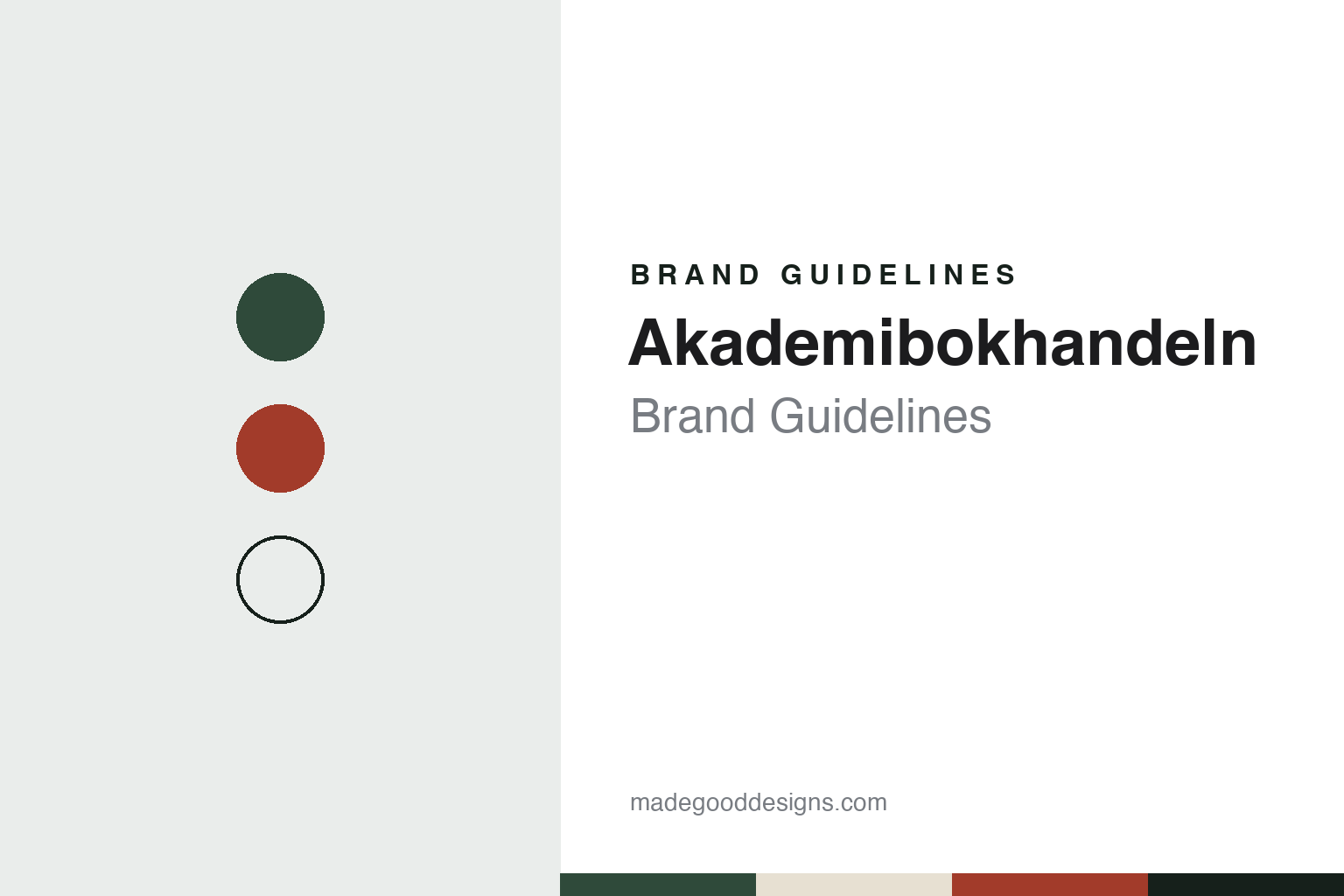
Two constants: a green, linen and red palette and a bookish serif register. Abstract homage — not an Akademibokhandeln shop sign, bag or mark; no logo is reproduced.
Course books
A student union, a shop at Odenplan and a merger in 1992.
Akademibokhandeln did not start as a chain. Swedish Wikipedia says it began in 1971, when the chair of the Stockholm University student union, Dag Klackenberg, set it up to bring order to the union’s sales of compendia and course literature. Its first bookshop aimed at the general public opened in 1975 at Odenplan in Stockholm.
The company in its present shape dates from 1992. Swedish Wikipedia says the group was formed that year by merging Academus AB and Esselte Bokhandel AB, which the consumer co-operative Konsumentföreningen Stockholm had bought in 1987 and 1990 respectively. For two years the combined business traded as Nordiska Bokhandelsgruppen, before taking the name Akademibokhandelsgruppen.
That earlier name carried a long history. Swedish Wikipedia describes Nordiska Bokhandeln as a Stockholm bookselling business founded in 1851 as Samson & Wallins bokhandel in Gamla stan, made a limited company in 1901 and bought by the office-products group Esselte in 1974; the business closed in 1986, and the name lived on in a publishing imprint and in the 1992 group.
From 1998 Akademibokhandeln was part of the Swedish co-operative movement’s Kooperativa Förbundet (KF), with 65 per cent held by KF Media, Swedish Wikipedia says. Over the years the group also took over two old university bookshops: Lundequistska bokhandeln in Uppsala, known as LundeQ, and Gleerupska universitetsbokhandeln in Lund.
Colour
Bokia, Bokus and a single name.
The chain’s biggest change of shape came at the turn of 2012 and 2013, when Akademibokhandeln and the Bokia chain combined their businesses and chose to trade under the Akademibokhandeln name. The local paper Lindenytt reported in September 2013 that the Bokia brand would disappear across Sweden, replaced by Akademibokhandeln, and that the combined chain would have about 130 shops.
That report also showed how the chain is built. In Lindesberg, the Blombergska Bokhandeln, founded in 1856, kept its local owners and staff while taking the new name; its owners told Lindenytt that new signs would go up from 7 October 2013, with some rebuilding inside, and that the larger chain’s better buying terms mattered to one of the smaller shops in the old Bokia network. Part of the network has long been run in this way: in May 2017 Realtid counted 108 shops, of which 80 were company-owned and 28 run by franchisees.
Online selling sat for many years with a sister brand. Swedish Wikipedia says the online bookshop Bokus was founded in Stockholm in August 1997, sold to KF Media the following year, took over Akademibokhandeln’s own internet sales in 2005, became part of Akademibokhandeln in 2009 and was wholly owned by it from 1 March 2014.
In October 2016 the trade site Ehandel.se reported that Akademibokhandeln would open its own web shop in the last quarter of that year. Customers had already been able to reserve books online and collect them in a shop; the new site would let them return web purchases in the shops, while Bokus continued as a separate brand.
The range goes beyond books. Swedish Wikipedia describes a broad stock of books together with paper and office goods, and says some of the larger shops regularly hold events and author evenings where writers meet their readers.
Typography
Design and documentation.
Bookshop chains in Europe and Asia tend to present themselves through places before products. Many keep one older or larger shop at the centre of their story, a flagship on a named street that appears in their histories, their photographs and often their anniversaries. In Lisbon, Bertrand’s Chiado shop on Rua Garrett plays that part; in Madrid, Casa del Libro’s building on the Gran Vía does the same. For a design reader, the flagship is where a chain’s colours, signs and lettering are seen at their largest.
Inside the shops, the companies describe spaces for reading and meeting as much as shelves. Chains publish details of rooms for book launches and talks, children’s sections and floors given over to single subjects, and some describe places where visitors can sit with a book. These spaces are part of how a bookseller explains what it is for, and they usually carry the same signs and colours as the shop floor.
Most large chains now run loyalty or members’ programmes and an online shop alongside the physical stores. Membership cards, members’ areas on a website and online marketplaces are described by the companies themselves, and the scale of such programmes is checked in these guides against dated press reports rather than marketing pages. Store and imprint naming is usually plain: many chains carry a founder’s surname, a city, or a simple description of a house of books, and a publishing imprint may sit under the same group as the shops.
Corporate pages fill in the rest: founders, owners, listings and the publishing groups that sit behind many chains. Ownership often changes more often than the shop signs do, so the guides in this series date each change of owner to an independent source, describe each name and colour as documented, and treat the palettes shown here as unofficial interpretations.
Aa
A bookish serif for a chain of bookshops. (Specimen set in Libre Caslon Text, a serif STAND-IN; NOT the Akademibokhandeln logo.)
Akademibokhandeln
From the co-operative movement to the stock market.
Ownership changed several times after 2015. In June 2015 SVT reported that KF was selling its 65 per cent of Akademibokhandeln to the investment fund Accent Equity, a move KF described as part of a focus on grocery retail; at the time the chain had 120 shops, with Bokus as its online subsidiary, and SVT said the change would bring no changes for staff or franchisees. The management was to be offered the chance to invest in the company, and KF said the proceeds would go back into its grocery chain, Coop Sverige.
In May 2017 Realtid and Dagens Handel reported that the Swedish industrial group Volati had agreed to buy Akademibokhandeln and Bokus from Accent Equity 2012, the bookseller J.P. Killberg and the foundation behind the publisher Natur & Kultur, with members of the management keeping a stake; the deal needed approval from the Swedish competition authority, and Realtid put the workforce at about 500 employees. Swedish Wikipedia records Volati as owner from 2017 to 2021.
In April 2021 the trade paper Svensk Bokhandel reported that Volati planned to spin the business off to its own shareholders and list it on Nasdaq First North Premier Growth Market, and that the company had been renamed Bokusgruppen, grouping Akademibokhandeln, Bokus and the audiobook streaming service Bokus Play. Swedish Wikipedia says the shares were listed on 4 June 2021.
Individual shops have also come and gone. In October 2026 Svensk Bokhandel reported that Akademibokhandeln had closed one of its larger Stockholm shops, at Odenplan, in January 2026 after the building received a demolition notice.
For a design guide, Akademibokhandeln shows how a chain built from student sales, co-operative purchases and mergers can bring many local shops under one name. Compare Adlibris, the Bonnier-owned Stockholm bookseller, and Waterstones, another national bookshop chain. For this guide we use a green, linen and a red with a serif, an unofficial interpretation; no product or logo is reproduced.
Explore & save
Keep Akademibokhandeln’s identity on hand — save it to a board in the Made Good inspiration library.
Akademibokhandeln identity set
Pin the Akademibokhandeln green, linen and red palette and the bookish serif register to your own board.