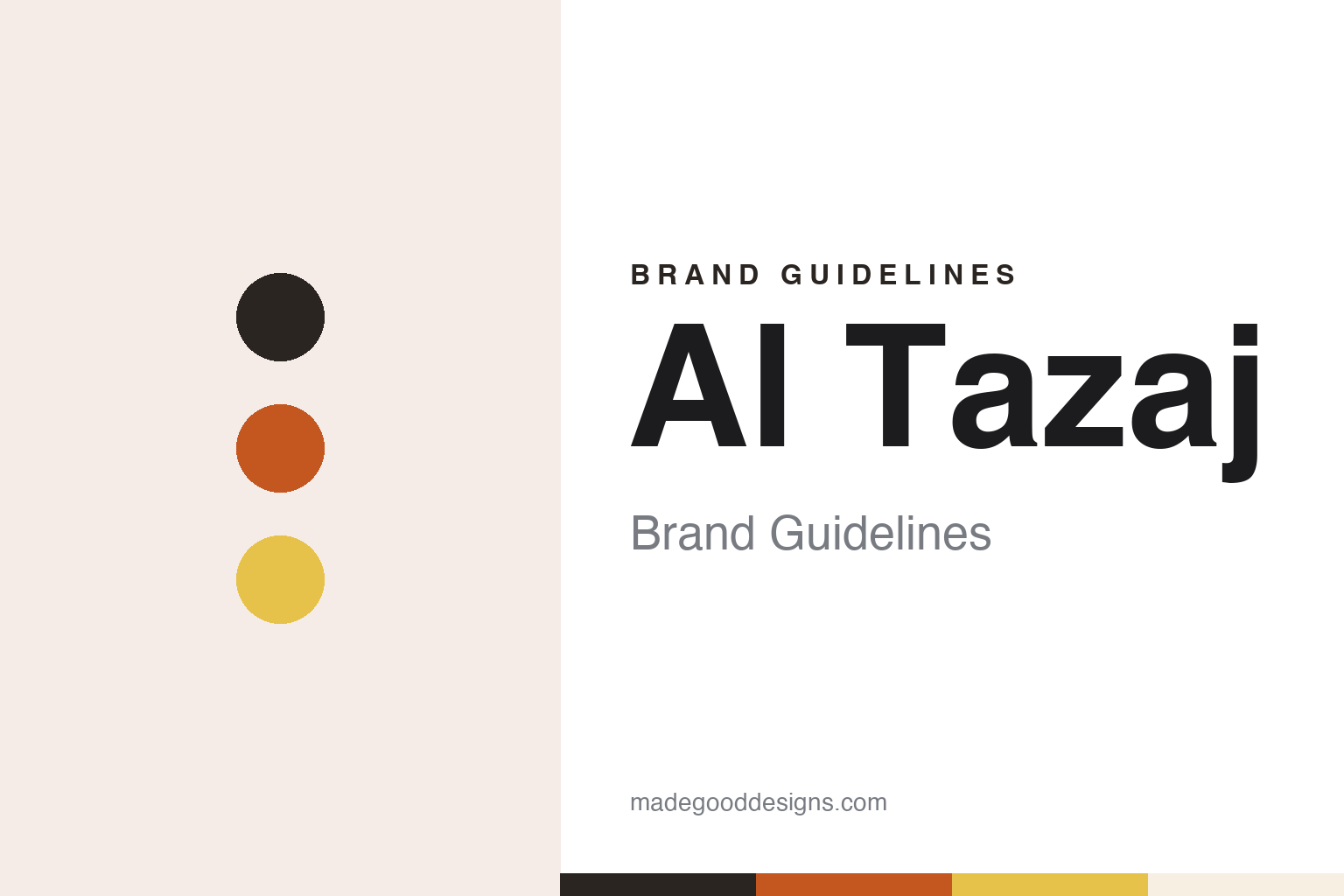
Al Tazaj Brand Guidelines
The grilled-chicken chain that began in Mecca in 1989.
Aa
Two constants: a charcoal, ember and lemon palette and a rounded grill sans register. Abstract homage — not an Al Tazaj product or mark; no logo, sign or pack is reproduced.
From the poultry farm
A Mecca family, a poultry business and a grill.
Al Tazaj is a Saudi grilled-chicken chain based in Jeddah. The company says its first restaurant opened in 1989 in Mecca, on the main road of the Al Aziziyah district, and the Saudi business daily Al Eqtisadiah gave the same founding year and the same Jeddah headquarters when it reported on the company in February 2025. English Wikipedia names Abdul Rahman Fakieh as the founder.
In November 2001 the Beirut business magazine Le Commerce du Levant described the chain as belonging to a Saudi company owned by Sheikh Abdelrahman Fakih (the magazine’s spelling), a member of a family from Mecca, with his son Tarek Fakih as chief executive. The magazine wrote that the idea of a chicken fast-food restaurant came from the family’s poultry farm, and that the name itself pointed to what the restaurants promised: fresh food.
The link to the farm is still part of the brand. The company says the founding idea was to serve a small, young chicken supplied fresh from Fakieh Poultry Farms, and its website gives the restaurants the fuller name Al Tazaj Fakieh BBQ Chicken, which keeps the family name next to the Arabic word for “the fresh one.” The company sets that name in Arabic and in Latin letters side by side, as “Al Tazaj الطازج,” at the head of its site.
The chain went abroad early. By 2001, Le Commerce du Levant counted about 45 restaurants in Saudi Arabia, nine in Egypt, nine in the United Arab Emirates, six in Malaysia and three in the United States. It said the network was organised in four zones: the Gulf; Africa, the Middle East and Europe; the United States; and the Far East, notably Malaysia.
Lebanon came through a franchise. The magazine reported that a local franchisee had launched the brand in the country before the parent company took over the business directly. The Beirut restaurant it described was a fast-food dining room of about sixty tables on the Corniche at Manara, and its local manager told the magazine that the chain wanted to be seen as fast food made from fresh ingredients.
Colour
Garlic, lemon and charcoal.
The menu is built around one product: grilled chicken. The company says its birds are marinated in a natural blend of garlic, tomato, lemon, ginger and spices and then grilled over charcoal, and it states plainly that there is no secret recipe. Its Arabic “Our story” text gives the age of the young chickens it uses as 21 days in one passage and 23 days in another.
Freshness was the theme from the start. Le Commerce du Levant summed up the Beirut operation in 2001 with the phrase “from the farm to the barbecue”: the chicken, the salad, the garlic, the sauce and even the bread were prepared fresh, and the chicken went onto the grill in view of the customer. The restaurant worked on what the magazine called a “zero stock” rule, and its set meal was sold as the “Taza Meal.”
The chain has also adjusted its menu abroad. In July 2016 the Moroccan consumer news site Consonews reported that Al Tazaj, after about three years in Morocco, had added a beef burger called the Arabia burger, served in Lebanese bread, from 1 July that year. The site read the launch as a step towards local tastes in a market where fast-food burgers were more often beef than chicken, and as the start of further changes to suit Moroccan customers.
At home the network is dense. The branch list on the company’s website, as of November 2026, is grouped by city, with more than thirty restaurants listed in Jeddah alone, from the Corniche to the Red Sea Mall and the Obhur district, and a further list for Mecca, including Al Aziziyah. The company’s own figures for the size of the chain differ from page to page, from more than 100 to more than 130 restaurants across the Middle East; Al Eqtisadiah put the total at more than 125 branches in the Middle East and North Africa in February 2025.
Typography
Chicken, bread and the grill.
The fast-food chains of Saudi Arabia, the United Arab Emirates and Lebanon include several that began as a single restaurant in one city. ALBAIK dates itself to a Jeddah chicken shop opened in 1974 and took its present name in 1986; Kudu opened its first sandwich counter in Riyadh in April 1988. Their histories are told in two places: the companies’ own “our story” pages, and the business press of the Gulf and beyond.
What the companies publish about themselves is often bilingual: ALBAIK’s and Kudu’s websites, for example, run in English and Arabic, with the name set in Latin capitals. Menus are presented by named dishes and meals rather than by price lists: fried-chicken meals and garlic sauce, made-to-order sandwiches and burgers, shawarma wraps, falafel, man’oushe flatbreads and mixed grills, depending on the chain. Open kitchens, drive-throughs, food-court counters and petrol-station units appear as formats in their own right.
Restaurant networks are often counted by the companies themselves, so the numbers change with the date of the page. Expansion abroad often runs through partners: ALBAIK entered the UAE in 2021 with an Abu Dhabi operator, and Kudu opened its first franchise outside Saudi Arabia, in Kuwait, in 2026. Ownership can change too: Kudu passed from family ownership to private-equity investors in 2015 and to a regional investment group in 2022.
This guide sets out what can be checked about each chain — who founded it, who owns it, where it trades and which dishes it names — and attributes what rests only on the company’s word. The palettes and typefaces shown are unofficial interpretations, and no logo, sign or packaging is reproduced.
Aa
A rounded, sturdy sans for a grill-house menu board. (Specimen set in Rubik, a sans STAND-IN; NOT the Al Tazaj logo.)
Al Tazaj
A family name on a chicken chain.
The ownership of the chain changed at the start of 2025. On 5 February 2025 Al Eqtisadiah reported that 30 percent of Al Tazaj Fakieh BBQ Chicken Company had been sold through a private placement to a group of investors led by Alrajhi Partners, citing a statement from anb capital, the exclusive financial adviser on the deal. The chief executive of Fakieh Farms told the paper that the transaction had been completed within eight weeks of its launch, and the head of Alrajhi Partners described the stake as a strategic one. No price was given in the report.
That deal makes Al Tazaj a family brand with an outside shareholder, more than three decades after the first restaurant opened in Mecca. The chain’s story, as the company tells it and as the press has reported it since 2001, has stayed close to the same few elements: a family poultry business, a small chicken, a garlic and lemon marinade, and a charcoal grill.
The brand’s visual cues come from that product. The company’s site places the Arabic and Latin forms of the name together and pairs them with the “Fakieh BBQ Chicken” line, so that the family name, the cooking method and the brand sit in one block. For a design system, that suggests a warm, direct register: dark charcoal for type, an ember tone for emphasis, a lemon accent and the pale cream of flatbread as the ground.
For a design guide, Al Tazaj shows how a chain can carry a family poultry business into its name and keep one grilled product at the centre of its menu from Mecca to Morocco. Compare Al Baik, another chicken chain from Jeddah, and KFC, the American fried-chicken chain. For this guide we use charcoal, ember orange, lemon yellow, herb green and a flatbread cream with a sans, an unofficial interpretation; no product or logo is reproduced.
Explore & save
Keep Al Tazaj’s identity on hand — save it to a board in the Made Good inspiration library.
Al Tazaj identity set
Pin the Al Tazaj charcoal, ember and lemon palette and the rounded grill sans register to your own board.
Source & notes
Frequently Asked Questions
What font can I use to match the Al Tazaj look?
This guide describes Al Tazaj’s type as “A rounded, sturdy sans for a grill-house menu board”. Its type specimen is set in Rubik from Google Fonts as a stand-in; Rubik is not Al Tazaj’s own lettering.
What colours are in the Al Tazaj palette?
This guide’s Al Tazaj palette is Charcoal #2B2522, Ember orange #C4571F, Lemon yellow #E7C24A, Herb green #4E6B3A and Flatbread cream #F6EFE2. The tones are the guide’s own unofficial interpretation, not official Al Tazaj hex codes.
When was Al Tazaj founded?
Al Tazaj was founded in 1989, in Mecca, Saudi Arabia.
Who founded Al Tazaj?
Al Tazaj was founded by Abdul Rahman Fakieh in 1989.


