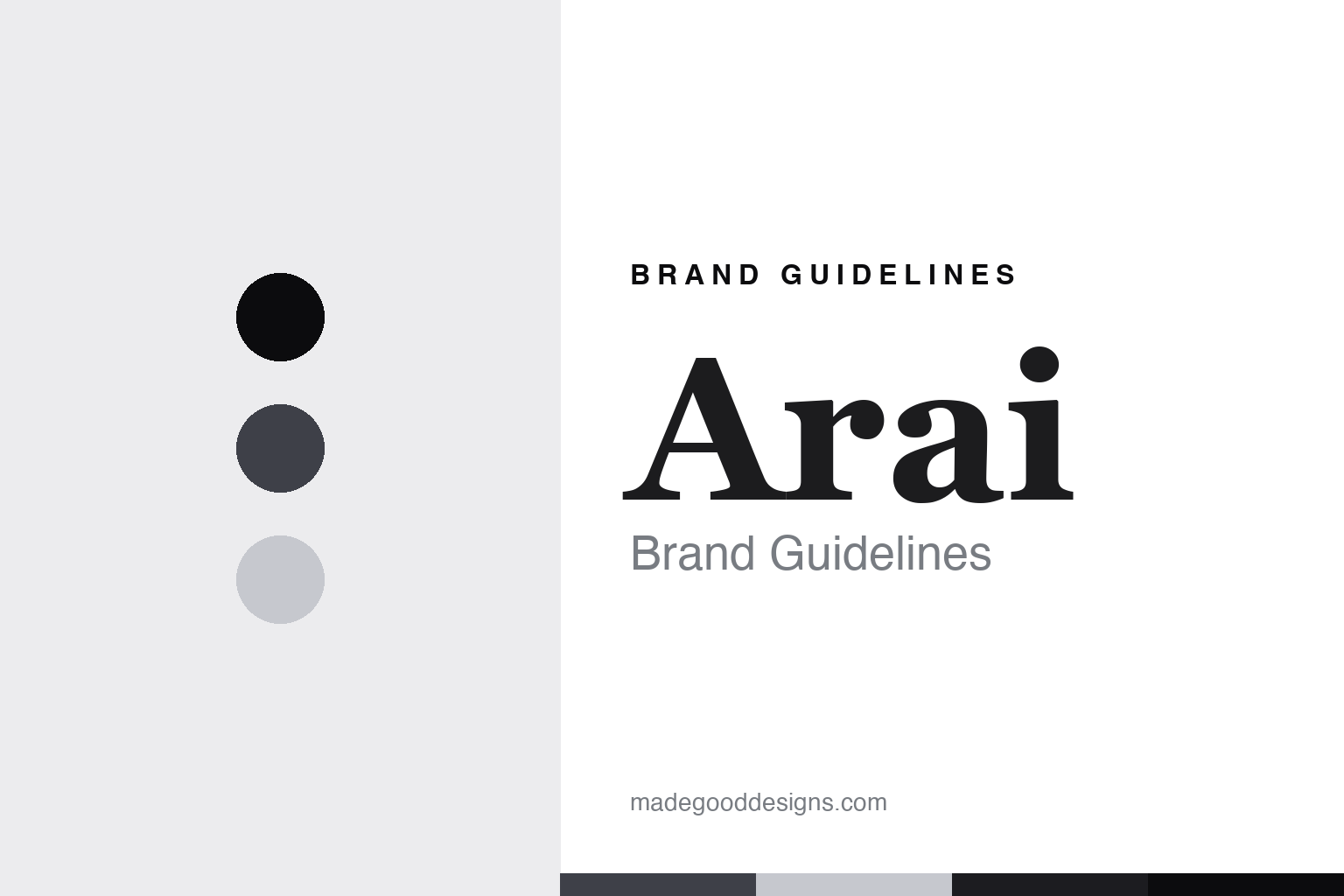
Arai Brand Guidelines
The hand-laid Japanese helmet maker.
Aa
Two constants: a carbon palette and a hand-laid-helmet-serif register. Abstract homage — not an Arai product or mark; no helmet, visor, or livery is reproduced.
The hand-laid Japanese helmet maker
Arai is the family-owned Japanese helmet maker whose shells are hand-laid in Japan.
Arai opens a fresh vein — the full face — as its craft anchor: the Japanese helmet maker that still hand-lays every shell in Japan, a family firm built on a round-shell philosophy meant to glance off rather than catch. Arai makes motorcycle helmets, and its answer to a round about riding gear is craft and consistency — a helmet hand-built, one shell at a time, by a company that has resisted automating the thing it is famous for. A brand, hand-laid.
Its identity is the hand-laid Japanese helmet maker. The craft, the Japanese making and the family ownership are the story here. A brand, hand-laid. The hand-laid Japanese helmet maker.
(Honest notes, so the story stays precise, and the claims stay the brand’s own. Arai, at its official regional sites, makes premium full-face and other motorcycle helmets, with its race and touring helmets as heroes, and we report its safety and protection language as the brand’s own marketing and a regulated safety positioning, not safety advice. It was founded in 1926 by the Arai family in the Saitama area of Japan, moving into helmets around the middle of the century. On where it is made, the star theme of this round, its shells are hand-laid in Japan, laid into a mould and kiln-cured, a genuine and unusually hands-on domestic-made credential. On who owns it, a theme of this round, it is family-owned and independent, still run by the Arai family. Its round-shell design philosophy is its signature; its helmet shapes, graphics and any rider liveries are IP we describe but do not reproduce. There is no official brand hex; these tones are an unofficial interpretation.)
Colour
Arai lives in a carbon. Click a swatch to copy the hex.
Arai’s identity is hand-laid, precise and made, and our stand-in palette is a carbon — a carbon, an ink, a pale grey, a deep carbon, and a paper. The palette leans carbon and pale grey: a composite, shell register that nods to carbon fibre and a hand-laid shell rather than a rider’s bright livery. It signals a craft helmet maker. The honest caveat: with no usable brand hex, these values are an original, unofficial interpretation, chosen to stay clear of any mark or livery.
The lesson is a carbon signals a hand-laid, made identity. Arai’s world is a hand-built, composite object. For designers, it is a reminder that a carbon and a soft pale grey can carry a safety-gear brand — the tone of composite and shell. Because these tones can fail as small text, keep type dark and let the colour live in the accents, palette and band. The takeaways: hand-lay the shell; keep the making in Japan; report claims as regulated positioning; and treat any single hex as unofficial.
Typography
The register is a hand-laid-helmet serif — hand-laid, editorial, precise.
Arai’s identity carries a hand-laid, editorial, precise spirit — a craft maker, not a graphics brand. A hand-laid-helmet serif captures the mood: refined, quiet and confident, the register of a hand-built shell. Set in a carbon palette, the hand-laid-helmet serif feels hand-laid and precise — exactly the personality Arai carries. It is a made object rather than a logo, mirroring composite and shell. (Arai’s real helmets and liveries are things we describe but do not reproduce, and the exact typeface is not ours to use.) Because it is not ours to use, the honest description is “a hand-laid-helmet-serif maker,” shown here in a stand-in. The type behaves like the brand: hand-laid, editorial and precise.
Aa
A hand-laid-helmet-serif maker — hand-laid and precise. (Specimen set in Cormorant Garamond, a hand-laid-helmet-serif STAND-IN; NOT the Arai logo, any helmet, or any livery.)
The full face
Arai stands for the hand-laid Japanese helmet maker.
Arai opens the moto-gear vein as its craft anchor. A carbon palette, a hand-laid-helmet serif and a Japanese workshop make one thing — the hand-laid Japanese helmet maker — the whole identity: hand-laid, precise and made. The craft is the pitch, and the Japanese hand-laying is the proof. The point is a company that hand-builds every shell and has resisted automating its signature.
Put to work, the identity is a craft told straight, as making — with the making stated and the family named. A maker in this spirit would hand-lay the shell, keep the making in Japan, and report claims as regulated positioning. A reader in this spirit would keep the facts right: Arai makes premium motorcycle helmets, its race and touring helmets the heroes; it was founded in 1926 by the Arai family in the Saitama area of Japan, moving into helmets around mid-century; its shells are hand-laid in Japan, laid into a mould and kiln-cured; and it is family-owned and independent. Arai opens the round’s craft-geography thread with Japanese hand-making, joins Shoei on the Japan side, and anchors the family-independent side of the who-owns thread against the conglomerate-owned AGV and Bell. The honest editorial moves are to date it to 1926, to describe the hand-laid shell, to say it is made in Japan, and to describe it as an independent family firm. The lesson Arai teaches is that hand-craft can be the whole identity, and stating the Japanese hand-making keeps it credible.
For designers and brand-builders, Arai opens the full face: hand-lay the shell — and keep the making in Japan. The lessons: let a hands-on method be the brand; resist automating your signature; report safety and protection language as regulated positioning, not advice; treat family ownership as part of the identity; and never reproduce a helmet, graphic, or rider livery. It is also a reminder to stay precise: Arai is the family-owned Japanese helmet maker whose shells are hand-laid in Japan — with the palette here a deliberate non-brand interpretation. Read that way, Arai is less a helmet than a craft: hand-laid, in Japan. The lesson for a brand is that craft and honest making reinforce each other, and stating the Japanese hand-laying keeps the story earned. Arai made the-hand-laid-Japanese-helmet-maker the identity — proof that craft can open a round. And it sets the round’s craft baseline, that a maker which still lays every shell by hand has the most literal possible answer to where a thing is made, which is here, in these hands, in this country, one shell at a time.
Explore & save
Keep Arai’s identity on hand — save it to a board in the Made Good inspiration library.
Arai identity set
Pin the carbon palette and the hand-laid-helmet-serif register to your own board.