Aurobindo Brand Guidelines
From one penicillin plant in Pondicherry to a global generics group.
Aa
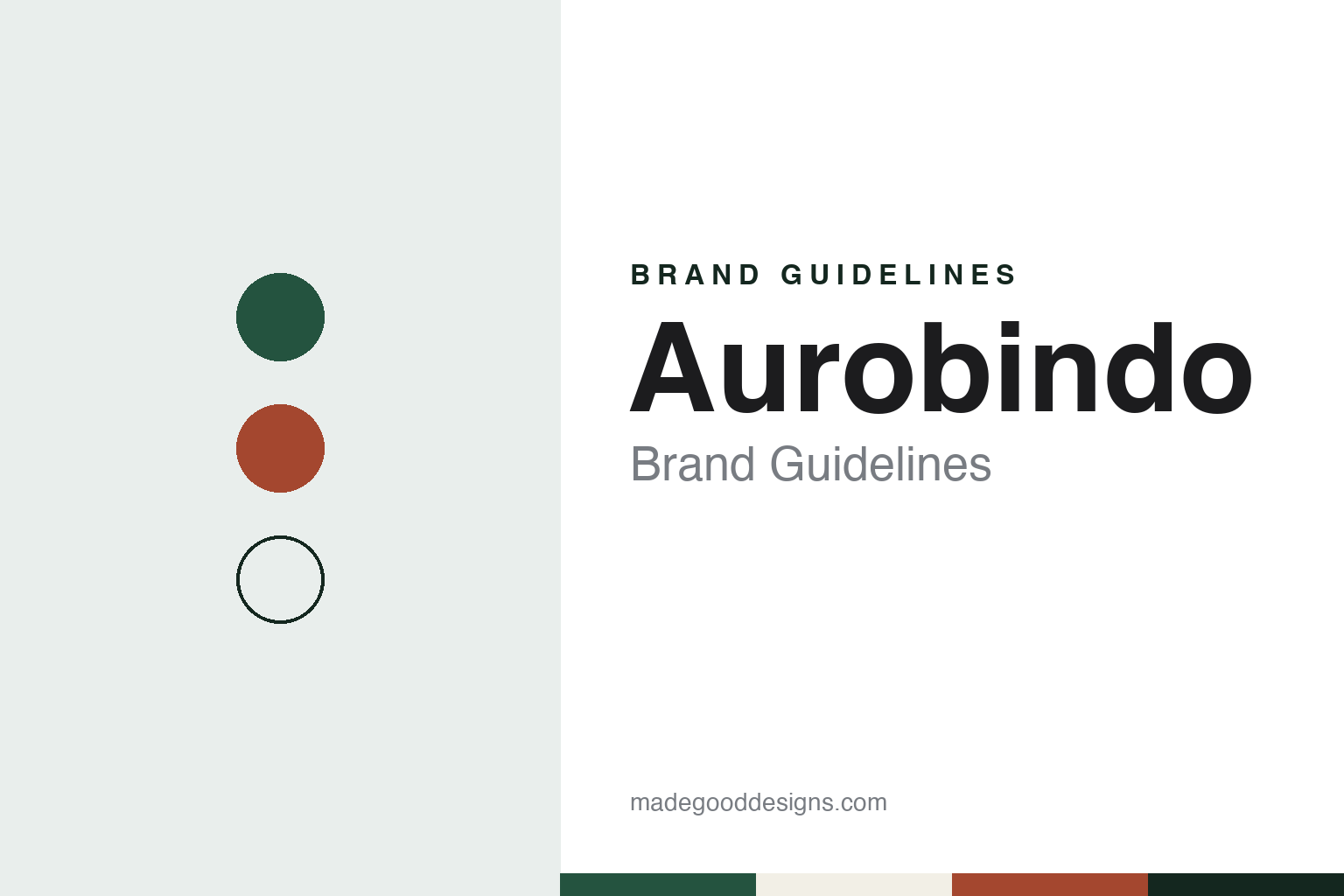
Two constants: a green, bone and brick palette and a sober corporate serif register. Abstract homage — not an Aurobindo product or mark; no pack, logo or tablet is reproduced.
A penicillin plant
Two founders and a single unit in Pondicherry.
Aurobindo Pharma was founded in Hyderabad in 1986. The company says it was incorporated as a private limited company in December of that year by P.V. Ramprasad Reddy and K. Nithyananda Reddy, together with a small group of professionals, with the aim of making medicines affordable and accessible. It began production in 1988 with a single unit making semi-synthetic penicillins in Pondicherry, now Puducherry, a starting point English Wikipedia also gives, dating the start of operations to 1988–89.
The early growth came from ingredients rather than finished medicines. Aurobindo says it began exporting active pharmaceutical ingredients in 1992, the year it became a public company, and that it held its public offering and began making finished formulations in the mid-1990s, listing its shares on the Indian stock exchanges in 1995. At the turn of the century it widened its range to cephalosporins, antivirals, macrolides and other classes, and set up joint ventures for the US formulations business.
Its own timeline puts the step into the world’s large regulated markets in the middle of the 2000s. It says the US Food and Drug Administration approved one of its plants and cleared it to supply AIDS medicines, and that it entered the US and European markets with generic formulations while taking part in PEPFAR, the US government programme for HIV treatment abroad. In the same period it bought Milpharm, a UK company marketing generics, and soon after a formulations plant in the United States, AuroLife, and another in the Netherlands, Pharmacin. Today both founders remain on the board: Ramprasad Reddy as a non-executive director and Nithyananda Reddy as vice chairman and managing director, the company says.
Colour
Built through acquisitions.
Much of Aurobindo’s shape today comes from buying businesses. In 2014 it took over the commercial operations of Actavis in several Western European countries; in 2017 it agreed to buy Generis, a Portuguese generics company; and around 2019–20 it bought the businesses of the Canadian generic maker Apotex in Poland, the Czech Republic, the Netherlands, Spain and Belgium, English Wikipedia and the company’s timeline say. It also bought a portfolio of branded cancer injectables from the US company Spectrum Pharmaceuticals, entered the Indian domestic market in 2022 by acquiring Veritaz Healthcare, and in 2022 and 2024 took full control of the Hyderabad cancer-medicine maker GLS Pharma.
The range also moved beyond tablets. The company says it began marketing specialty injectables in the United States in 2013 through Auromedics, entered biosimilars and vaccines in 2016, and received European good-manufacturing-practice approval for its biosimilars arm in 2024. That year India’s prime minister, Narendra Modi, inaugurated what the company calls its flagship penicillin-G facility, at Kakinada in Andhra Pradesh, and its subsidiary TheraNym Biologics signed an agreement with Merck to expand biologics manufacturing, English Wikipedia says.
The largest recent step came in the United States. Aurobindo’s US arm, Aurobindo Pharma USA, bought Lannett Company, a Pennsylvania generic maker founded in 1942. The US Federal Trade Commission approved the deal on 18 June 2026 and it closed on 29 June 2026, the law firm Honigman, which advised Lannett, reported in July 2026; Sullivan & Cromwell, which advised Aurobindo, also announced the completion.
The group is organised around several named businesses: Apitoria for active ingredients, Eugia for specialty products such as injectables, and CuraTeQ for biosimilars. The company says it has 29 manufacturing facilities worldwide, sells in more than 150 markets and has filed about 830 applications for generic medicines in the United States, and its corporate line is “Committed to Healthier Life.” It also says it unveiled a new logo and corporate identity at a ceremony in Hyderabad in 2007–08, describing it as a reflection of its pace of innovation.
Typography
How generic-medicine makers present themselves.
Generic-medicine makers sell products that are, by design, meant to match medicines already on the market. That leaves their visual identity with an unusual job: it has to signal reliability and scale rather than novelty, and it often has to work on thousands of packs at once.
The pictures these companies publish tend to repeat a small set of scenes. There are close-ups of blister packs and plain white tablets, shot clean and bright against pale backgrounds. There are pharmacists at a counter handing a box across to a customer, a moment that puts a person between the product and the patient. And there are wide views of large production sites, with long corridors, stainless steel and staff in white coats and hairnets, used to suggest capacity and control.
Packaging is where the system shows most clearly. Because one company may carry a very large range of molecules and strengths, its packs usually rely on a fixed layout with colour bands, stripes or blocks that separate one product or dose from another, while the company name stays in the same place on every box. Corporate material then widens the frame: maps, globes and lines linking continents, meant to picture supply reaching many countries.
The same language appears on the trade-show floor. At industry fairs such as CPHI, where ingredient suppliers, contract manufacturers and generics companies meet, stands lean on large logos, simple colour fields and photographs of laboratories and plants. For a designer, the category is a study in restraint: a clear name, a disciplined colour system and imagery that keeps attention on trust and access.
Aa
A sober corporate serif for a maker that grew from a single plant. (Specimen set in Source Serif 4, a serif STAND-IN; NOT the Aurobindo logo.)
Aurobindo
Regulators’ letters on the public record.
As a large supplier to the United States, Aurobindo’s plants are inspected by the US Food and Drug Administration, and some of those inspections are on the public record. On 20 June 2019 the FDA issued a warning letter to Aurobindo Pharma Limited about its Unit XI ingredients plant at Pydibhimavaram in Andhra Pradesh, inspected in February 2019, citing significant deviations from current good manufacturing practice for active pharmaceutical ingredients. In November 2019 Aurobindo Pharma USA announced a voluntary recall of 38 lots of ranitidine tablets, capsules and syrup after an impurity, NDMA, was detected, according to the notice posted by the FDA on 6 November 2019.
The injectables arm drew a warning letter of its own. On 15 August 2024 the FDA wrote to Eugia Pharma Specialities about its Unit III plant near Hyderabad in Telangana, which makes sterile injectable medicines and had been inspected from 22 January to 2 February 2024. The letter cited significant violations of current good manufacturing practice, including failures to ensure the accuracy of records for production and for process simulations.
For a design guide, Aurobindo shows how a generic maker’s identity is carried less by a single product than by a family of named businesses under one corporate line. Compare Dr. Reddy’s, another Hyderabad medicine maker, and Cipla, a Mumbai generic maker with a longer history. For this guide we use a deep green, bone and a brick red with a serif, an unofficial interpretation; no product or logo is reproduced.
Explore & save
Keep Aurobindo’s identity on hand — save it to a board in the Made Good inspiration library.
Aurobindo identity set
Pin the Aurobindo green, bone and brick palette and the sober corporate serif register to your own board.