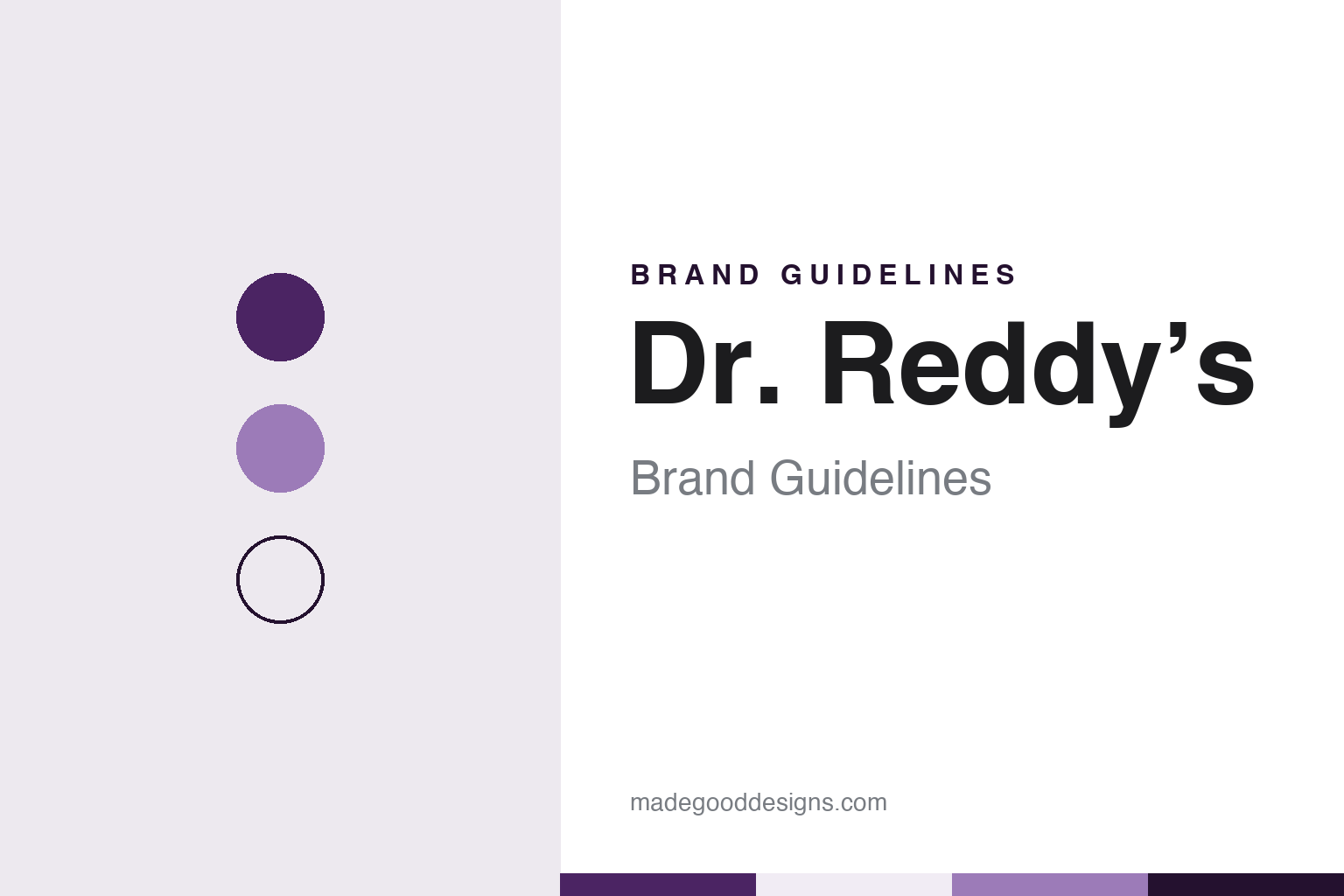
Dr. Reddy’s Brand Guidelines
A founder’s name, a bulk-drug plant and a New York listing.
Aa
Two constants: a plum and lilac palette and a transitional serif register. Abstract homage — not a Dr. Reddy’s product or mark; no pack, logo or label is reproduced.
From bulk drugs
A chemist’s 1984 start in active ingredients.
Dr. Reddy’s Laboratories was founded in 1984 by Kallam Anji Reddy, a chemist who, English Wikipedia says, had earlier worked at the state-owned Indian Drugs and Pharmaceuticals Limited. He studied pharmaceuticals and fine chemicals at the University of Mumbai’s Department of Chemical Technology and took a PhD at the National Chemical Laboratory in Pune in 1969, the same source says. The company is based in Hyderabad, and its name is its founder’s own.
The business began by making active pharmaceutical ingredients — the bulk chemical substances that other drug makers turn into tablets and capsules — and supplying them to Indian manufacturers. English Wikipedia says it moved into branded formulations in 1986, launched Norilet as its first recognised brand in India, and then Omez, a branded omeprazole that it priced at about half the level of other brands on the Indian market. Within a year, the same source says, it became the first Indian company to export active ingredients to Europe.
Exports first went to markets with lighter regulation. By the early 1990s, English Wikipedia says, the scale and profits from those markets let the company seek approval from regulators such as the US Food and Drug Administration for its plants, opening the way to the United States and Europe. Its first international move was a 1992 joint venture in Russia, and the same year it set up the Dr. Reddy’s Research Foundation for new drug discovery, which in 2000 opened a laboratory in Atlanta.
In 1999 Dr. Reddy’s bought American Remedies, which English Wikipedia says made it India’s third-largest drug maker at the time, after Ranbaxy and Glaxo India. It also merged with Cheminor Drugs, a related company set up to supply active ingredients to the demanding markets of North America and Europe, which gave it a foothold in regulated generic markets.
Colour
Fluoxetine, the NYSE and Germany.
The American generics business opened with a first commercial launch in December 2000. In 2001, English Wikipedia says, Dr. Reddy’s became the first Indian company to launch a generic fluoxetine — the drug Eli Lilly sold as Prozac — with 180-day market exclusivity in the United States, for the 40 mg strength, after the case was heard twice by the Federal Circuit. In January 2003 it launched ibuprofen tablets in the US under its own name, its first step toward a US distribution network of its own.
In 2001 it also listed American Depositary Receipts on the New York Stock Exchange. In May 2026 the company rang the NYSE closing bell to mark 25 years since its April 2001 listing, the Press Trust of India reported in Outlook Business on May 30, 2026, adding that the company’s release called it the first pharmaceutical company in Asia outside Japan to list on the exchange. Chairman Satish Reddy said there that the founder’s vision had been to bring affordable, innovative medicines to patients everywhere.
Europe followed through purchase. In March 2002 Dr. Reddy’s bought BMS Laboratories of Beverley in England, with its subsidiary Meridian Healthcare, which brought plants in London and Beverley; in 2004 it acquired the US dermatology firm Trigenesis Therapeutics; and in March 2006 it bought betapharm Arzneimittel, a German generics maker, from the private-equity firm 3i, English Wikipedia says. In 2015 it bought the established brands of Belgium’s UCB in South Asia.
From September 2020 Dr. Reddy’s worked with the Russian Direct Investment Fund to run late-stage trials of the Sputnik V vaccine in India and to distribute it there; English Wikipedia says the vaccine was approved for emergency use in India on April 12, 2021. In September 2016 the company launched Purple Health, a programme that, according to English Wikipedia, began with redesigned packaging for 25 of its top-selling brands in India: blister packs with more room for the brand name, a tab with the expiry date and pictures showing when a medicine is to be taken, and bottles with easier-to-read measuring cups.
Typography
The Indian generics industry.
Generic-medicine makers sell products that are, by design, meant to match medicines already on the market. That leaves their visual identity with an unusual job: it has to signal reliability and scale rather than novelty, and it often has to work on thousands of packs at once.
The pictures these companies publish tend to repeat a small set of scenes. There are close-ups of blister packs and plain white tablets, shot clean and bright against pale backgrounds. There are pharmacists at a counter handing a box across to a customer, a moment that puts a person between the product and the patient. And there are wide views of large production sites, with long corridors, stainless steel and staff in white coats and hairnets, used to suggest capacity and control.
Packaging is where the system shows most clearly. Because one company may carry a very large range of molecules and strengths, its packs usually rely on a fixed layout with colour bands, stripes or blocks that separate one product or dose from another, while the company name stays in the same place on every box. Corporate material then widens the frame: maps, globes and lines linking continents, meant to picture supply reaching many countries.
The same language appears on the trade-show floor. At industry fairs such as CPHI, where ingredient suppliers, contract manufacturers and generics companies meet, stands lean on large logos, simple colour fields and photographs of laboratories and plants. For a designer, the category is a study in restraint: a clear name, a disciplined colour system and imagery that keeps attention on trust and access.
Aa
A transitional serif for a laboratory named after its founder. (Specimen set in Source Serif 4, a serif STAND-IN; NOT the Dr. Reddy’s logo.)
Dr. Reddy’s
A warning letter, and its closure.
The company’s plants have been the subject of US regulatory action. In November 2015 Dr. Reddy’s said it had received a warning letter from the US FDA covering three sites — active-ingredient plants at Srikakulam in Andhra Pradesh and Miryalaguda in Telangana, and an oncology formulation plant at Duvvada in Visakhapatnam. In August 2020 the company said in a regulatory filing that the FDA had closed the letter after evaluating its corrective actions, Medical Dialogues reported on August 30, 2020.
The founder was honoured with the Padma Shri in 2001 and the Padma Bhushan in 2011, English Wikipedia says, and he also chaired the Dr. Reddy’s Foundation, the group’s social arm, set up in 1996. In 2026 the company was led by chairman Satish Reddy and chief executive Erez Israeli, according to the Press Trust of India report on the NYSE anniversary, at which the chairman closed with the company’s purpose line, “good health can’t wait”.
For a design guide, Dr. Reddy’s shows a founder’s surname carried from a bulk-drug business to a New York listing, and a packaging programme that put legibility of the brand name, expiry date and dosing time at the centre of the pack. Compare it with Sun Pharma, founded a year earlier, and Aurobindo, also based in Hyderabad. For this guide we use plum ink, lilac and mist with a serif, an unofficial interpretation; no product or logo is reproduced.
Explore & save
Keep Dr. Reddy’s’s identity on hand — save it to a board in the Made Good inspiration library.
Dr. Reddy’s identity set
Pin the Dr. Reddy’s plum and lilac palette and the transitional serif register to your own board.