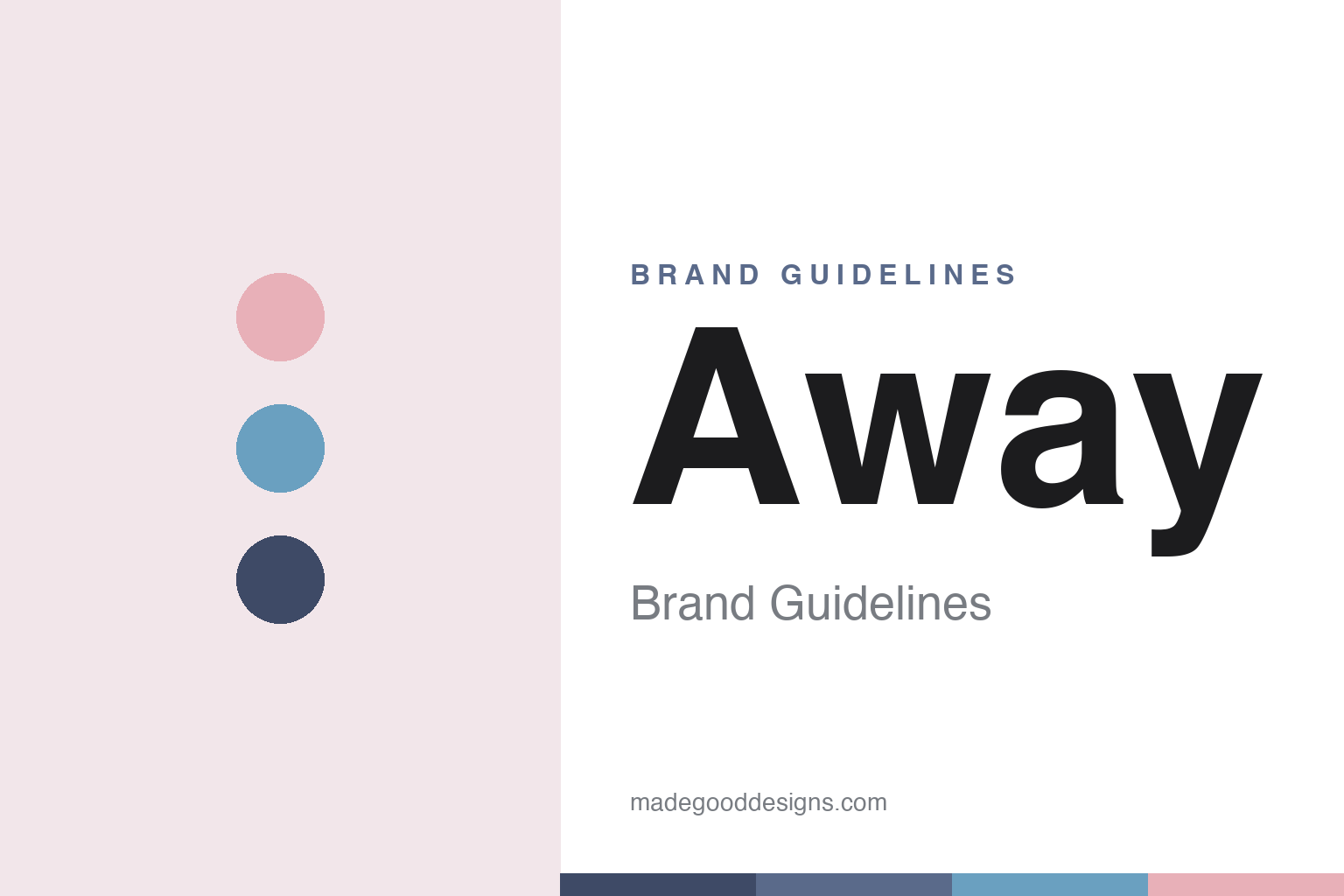
Away Brand Guidelines
Thoughtful things for modern travel — a DTC suitcase, a built-in battery, and marketing as a lifestyle.
Aa
Two constants: a muted, millennial pastel palette and a clean, modern sans. Abstract homage — not the Away wordmark.
The suitcase that sold a book first
Away turned luggage into a brand.
Away is a lesson in brand-building around a commodity. It was founded in 2015 by Steph Korey and Jen Rubio, who had met as early colleagues at Warby Parker (though Away is independent, not a spin-off), and is based in New York City. The pitch: take a boring, overpriced category — luggage — and reinvent it as an affordable-luxury, direct-to-consumer, design-led brand. (Two honest notes: no official brand hex is published, and the wordmark typeface is undocumented.)
The product is a design-forward, hard-shell polycarbonate suitcase, and its most famous feature was a built-in, ejectable battery to charge your phone. When US airlines banned “smart luggage” with non-removable lithium batteries in early 2018, Away’s design already complied — the battery popped out — and it later added battery-free options too. (An honest note: the battery was made removable to meet the rules, not simply “banned/removed.”) The flagship is the polycarbonate “The Carry-On” (aluminium is a separate premium line), with a compression system, 360° wheels and a lifetime warranty.
Away’s real innovation was marketing and story. A famous scrappy launch: having missed the 2015 holiday production window, the founders reportedly released a travel book bundled with a voucher for a future suitcase, so they could still “launch” in time (the exact title is best hedged). They built a full in-house media operation — the Here magazine and the Airplane Mode podcast (both 2017) — treating content as marketing, and scaled to a ~$1.4B valuation by 2019. (An honest, neutral note belongs in the history: a December 2019 exposé described a toxic workplace culture; CEO Steph Korey resigned, then briefly returned as co-CEO, then transitioned out in 2020.) The suitcase that sold a book first.
Colour
Away lives in muted millennial pastels. Click a swatch to copy the hex.
Away’s identity leans on a muted, millennial pastel palette — blush pinks, sage/mint greens, a signature coast/sky blue, and navy — soft, tasteful, of-the-2010s tones that made luggage feel like a lifestyle object rather than utilitarian gear. The palette reads as calm, aspirational and Instagram-ready, matching a brand that sold travel as an aesthetic and reached a design-conscious millennial audience. The colours (and their evocative product-finish names) are central to the appeal. The honest caveat: Away publishes no official brand hex, so the blush, coast-blue and navy here are an original, unofficial interpretation of its finishes, not first-party values.
The lesson is a muted, on-trend palette can reframe a commodity as a lifestyle brand. Away’s soft pastels made luggage aspirational. For designers, it’s a reminder that colour and taste can move a utilitarian product into the lifestyle space. The takeaways: use muted, of-the-moment colour to make a commodity aspirational; name finishes evocatively; and treat specific hexes as unofficial when the palette is finish-based.
Typography
The wordmark is a clean modern sans — approachable and design-led.
Away’s identity carries a clean, modern, approachable spirit — a simple lowercase-feeling sans-serif “away” wordmark whose even, contemporary letterforms read as friendly, design-led and of-the-moment. The clean type matches a DTC brand built on tasteful design and lifestyle marketing, and the simplicity keeps the focus on the product and the pastel palette. Set against muted pastels, the type feels modern and aspirational — exactly the design-conscious, millennial-travel personality Away cultivates. It’s clean and approachable rather than ornate or heritage, mirroring the minimalist suitcases. Because the exact wordmark face isn’t publicly documented, the honest description is “a clean modern sans spirit,” not a named font. The type behaves like the brand: approachable, modern and design-led.
Aa
A clean modern sans spirit — approachable and design-led. (Specimen set in Mulish, a clean modern sans in the spirit of the Away identity; the real face is undocumented.)
Marketing as the product
Away sold a way to travel.
Away is a lesson in marketing and brand as the real product in a commodity category. The suitcase itself was good but not revolutionary — polycarbonate hard-shells existed. What Away actually built was a brand: a tasteful design language, a muted lifestyle aesthetic, a clever feature (the ejectable battery) to talk about, an in-house media operation (a magazine, a podcast), and relentless, aspirational storytelling that made buying luggage feel like joining a modern-travel movement. That brand-first approach let a commodity command an affordable-luxury premium and reach a $1.4B valuation in four years. The honest counterpoint is that brand and hype have limits: the 2019 culture exposé and the battery-rule scramble showed the gap between the polished image and the operational reality. The lesson is that in a commoditised category, brand, story and marketing can be the true differentiator and the real product — but they have to be backed by a healthy company and an honest one, or the narrative cracks. Sell the travel, not just the suitcase.
For designers and brand-builders, Away offers a clear takeaway: in a commodity category, brand and story can be the differentiator — if the substance holds up. The lessons: reframe a commodity with taste, design and lifestyle marketing (the pastel aesthetic, content-as-marketing); give people something to talk about (the ejectable battery, the book-first launch); and remember that image must be matched by a healthy reality (the culture chapter). It’s also a reminder to keep the facts precise — Away was founded in 2015 by Korey and Rubio, made a polycarbonate carry-on with a removable battery, and reached a ~$1.4B valuation. Away sold a way to travel — proof that brand can be the product, when the substance backs it.
Explore & save
Keep Away’s identity on hand — save it to a board in the Made Good inspiration library.
Away identity set
Pin the muted-pastel palette and the modern-sans spirit to your own board.