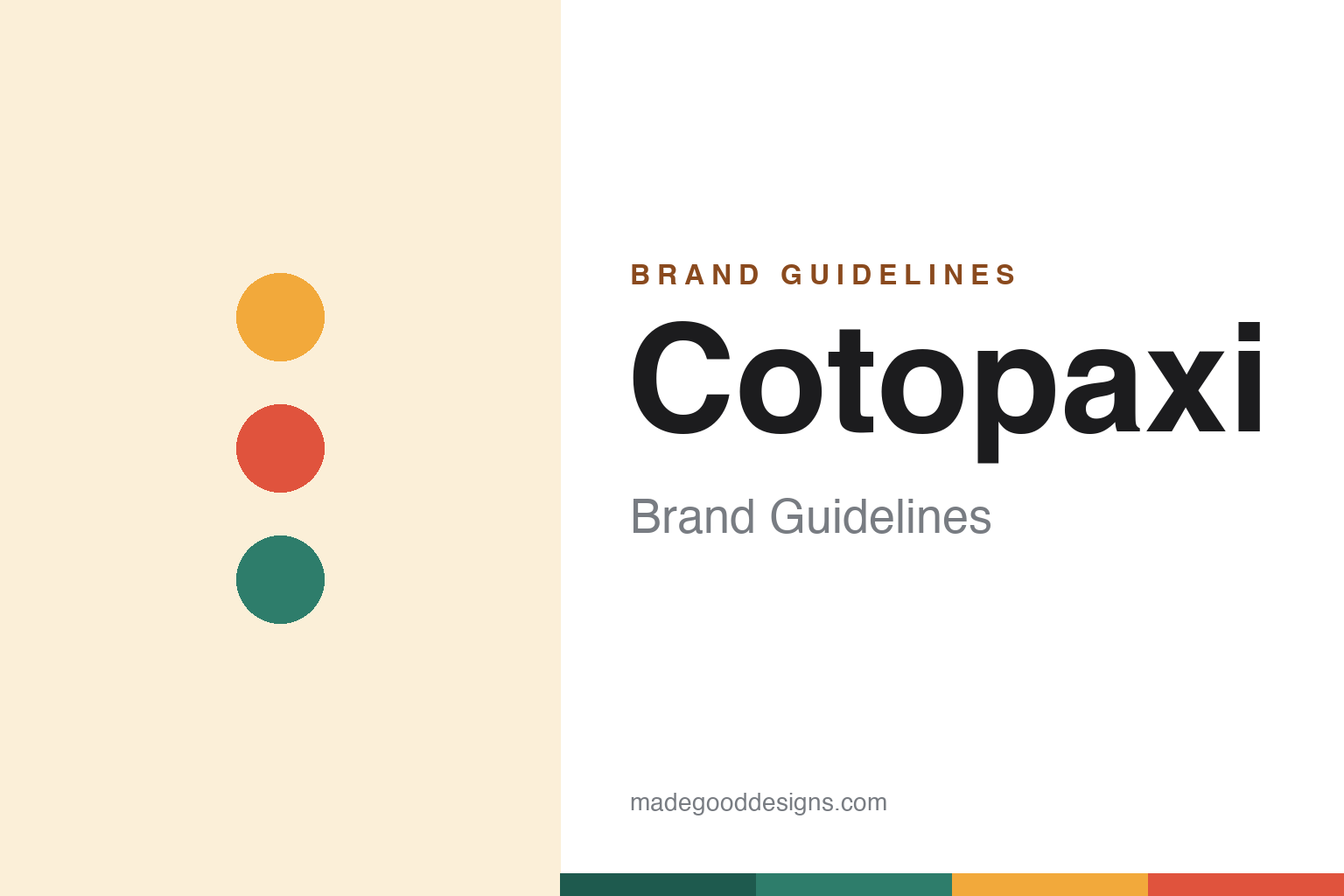
Cotopaxi Brand Guidelines
Gear for Good — joyfully bright, one-of-a-kind remnant packs from a mission-driven B Corp.
Aa
Two constants: a joyful, vibrant colour-block palette and a friendly, rounded sans. Abstract homage — not the Cotopaxi wordmark.
Gear for Good
Cotopaxi built a mission into color.
Cotopaxi is a lesson in a social mission expressed through design. It was founded in 2014 in Salt Lake City, Utah by Davis Smith (with co-founders) as a mission-driven outdoor brand built around the ethos “Gear for Good.” The name comes from Mount Cotopaxi, an active volcano in Ecuador — a nod to founder Davis Smith’s childhood in Latin America and the brand’s poverty-alleviation focus. (Two honest notes: no official brand hex is published, and the wordmark typeface is undocumented.)
Cotopaxi is structured as a Public Benefit Corporation and is Certified B Corp. Its “Gear for Good” model commits 1% of annual revenue to its foundation, funding grants that target extreme poverty (an honest correction: it’s 1% of revenue, not “2%”). The mission — using an outdoor brand to fight global poverty — is the point, and the joyful, optimistic aesthetic is deliberately part of it.
The signature product is the Del Día collection — packs (like the Allpa travel pack and the Batac daypack) made from remnant/surplus fabric left over from other companies’ production. Because the leftover materials vary, each Del Día bag is one-of-a-kind: the seamstress who sews it chooses the colourway, so no two are exactly alike, and the approach reduces waste. The bags are made in the Philippines. Cotopaxi’s mascot is a llama. In 2021 it took growth investment led by Bain Capital’s Double Impact fund; founder Davis Smith stepped down as CEO in 2023, with Damaris Coulter and later leadership continuing the mission (leadership specifics are best hedged). Gear for Good.
Colour
Cotopaxi lives in joyful, vibrant colour-blocking. Click a swatch to copy the hex.
Cotopaxi’s identity is its joyful, vibrant, colour-blocked palette — sunburst yellows, corals and reds, teals and greens, bright blues and purples, mixed in unexpected, playful combinations. Born partly from the Del Día remnant-fabric model (where surplus colours are combined into one-of-a-kind bags), the bright, optimistic colour is a deliberate expression of the brand’s hopeful, do-good spirit. It reads as fun, energetic and human — the opposite of muted technical gear — and it makes each bag feel individual. The honest caveat: Cotopaxi publishes no official brand hex, so the sunburst, coral and teal here are an original, unofficial interpretation, not first-party values.
The lesson is vibrant colour can carry a mission. Cotopaxi’s joyful colour-blocking expresses optimism and do-good energy. For designers, it’s a reminder that bright, unexpected colour combinations can differentiate in a muted category and reinforce a hopeful brand story. The takeaways: use joyful, vibrant colour to signal optimism; let a production model (remnant fabric) shape a one-of-a-kind aesthetic; and treat specific hexes as unofficial when the palette is a spirit, not a spec.
Typography
The wordmark is a friendly, rounded sans — optimistic and human.
Cotopaxi’s identity carries a friendly, optimistic, human spirit — a warm “Cotopaxi” wordmark (paired with the llama mark) whose approachable, rounded letterforms read as joyful, adventurous and hopeful. The friendly type matches a mission-driven brand built on “Gear for Good” and joyful colour, and it keeps the personality warm and inclusive rather than technical or elite. Set against vibrant colour-blocking, the type feels optimistic and human — exactly the do-good, adventurous personality Cotopaxi cultivates. It’s friendly and rounded rather than austere, mirroring the playful bags. Because the exact wordmark face isn’t publicly documented, the honest description is “a friendly rounded sans spirit,” not a named font. The type behaves like the brand: friendly, optimistic and human.
Aa
A friendly rounded sans spirit — optimistic and human. (Specimen set in Fredoka, a friendly rounded sans in the spirit of the Cotopaxi identity; the real face is undocumented.)
Mission as the differentiator
Cotopaxi made doing good the brand.
Cotopaxi is a lesson in a genuine social mission as the core differentiator. In a crowded outdoor market, Cotopaxi didn’t win primarily on technical specs; it won on purpose — a Public Benefit Corporation and B Corp built around “Gear for Good,” committing 1% of revenue to fighting extreme poverty, and expressing that hopeful mission through joyful colour and a waste-reducing, one-of-a-kind product (the Del Día remnant packs). That coherence is the whole brand: the mission, the vibrant aesthetic, the llama, and the remnant-fabric model all reinforce one story — optimistic, human, do-good adventure. Because the substance is real (the B Corp certification, the foundation grants, the actual surplus-fabric bags), the brand earns credibility that pure marketing can’t buy, and it attracts customers who want their purchase to mean something. The lesson is that an authentic, structurally-committed mission — backed by real design and product choices — can be the sharpest differentiator of all. Build the good in, and let the design express it.
For designers and brand-builders, Cotopaxi offers a clear takeaway: a genuine, structural mission expressed through design can differentiate a commodity. The lessons: commit to the mission structurally (a Public Benefit Corporation, B Corp, 1% of revenue); let a values-driven production model shape the product (Del Día remnant fabric, one-of-a-kind bags); and express the mission through a joyful, human aesthetic. It’s also a reminder to keep the facts precise — Cotopaxi was founded in 2014 in Salt Lake City by Davis Smith, is named for the Ecuadorian volcano, is a B Corp giving 1% of revenue, and makes one-of-a-kind Del Día packs from remnant fabric. Cotopaxi made doing good the brand — proof that mission can be the differentiator.
Explore & save
Keep Cotopaxi’s identity on hand — save it to a board in the Made Good inspiration library.
Cotopaxi identity set
Pin the vibrant colour-block palette and the rounded-sans spirit to your own board.