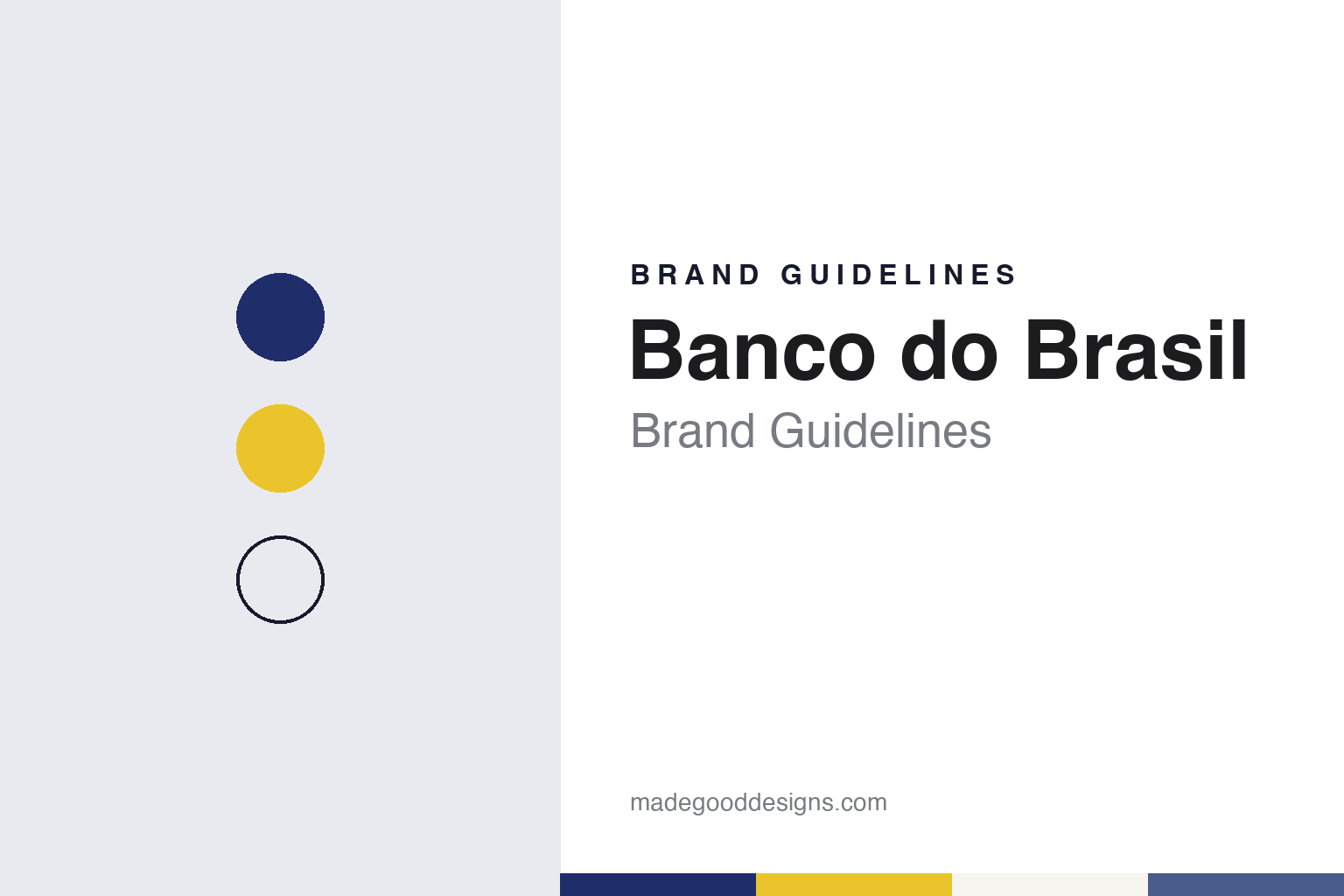
Banco do Brasil Brand Guidelines
The 1808 bank that kept a national colour pair.
Aa
Two constants: a navy, slate and yellow palette and a sturdy grotesque register. Abstract homage — not a Banco do Brasil asset; no logo, card or branch sign is reproduced.
Founded 1808
A royal charter, a liquidation and a second start.
Banco do Brasil dates itself to 12 October 1808, when the Prince Regent Dom João, later King João VI of Portugal, signed the charter creating a public bank in Rio de Janeiro, soon after the Portuguese court had moved to Brazil. English Wikipedia calls it the oldest bank in Brazil. It opened on 11 December 1809 on Rua Direita in Rio, Portuguese Wikipedia says, as a mixed bank of deposits, discounts and note issue that also handled the sale of goods under royal monopoly, such as brazilwood and diamonds.
The history is not a straight line. Portuguese Wikipedia stresses that this first Banco do Brasil differed in form, statutes and continuity from today’s bank. Weakened when the court returned to Lisbon in 1821 and by note issues after independence, it was ordered into liquidation by a law of 23 September 1829. A new Banco do Brasil was set up in 1851 by Irineu Evangelista de Sousa, later the Viscount of Mauá, and in 1853 a law merged it with the Banco Comercial do Rio de Janeiro to form the bank that continues today; Portuguese Wikipedia names the minister behind that law, the Viscount of Itaboraí, as the founder of the present bank.
Mergers and state involvement followed. In 1893 the bank merged into the Banco da República do Brasil; after a banking crisis the federal government bought about a third of its shares in 1905, a decree of 30 December 1905 restored the Banco do Brasil name, and it reopened on 3 July 1906. The government became majority shareholder in 1923, Portuguese Wikipedia says. Until the Central Bank of Brazil was created in 1964, Banco do Brasil also acted as the government’s bank, at times issuing currency and handling foreign exchange; English Wikipedia adds that its separation from the National Treasury came in 1987, and that from 1992 it was restructured as a commercial bank.
Colour
Blue-grey and yellow since the 1960s.
English Wikipedia says the current logo has been in use since the 1960s, when the bank’s standard colours changed from brown and yellow to blue-grey and yellow, and it links the blue and yellow to the colours of the Brazilian flag. The name is widely shortened to BB, the form Portuguese Wikipedia gives alongside the full name.
On its own website the bank frames its purpose as being “close and relevant in people’s lives at every moment” and speaks of more than 200 years of relationship with Brazilians. It also says it has invested in national sport for more than 30 years.
Sport has carried the colours for decades. Since the early 1980s, English Wikipedia says, the bank has sponsored competitions in beach soccer, volleyball, tennis, table tennis, futsal, sailing, motorsport and beach volleyball, and it has backed the Brazilian national volleyball, beach soccer and futsal teams. It also supports amateur sport through the Associação Atlética Banco do Brasil, known as AABB.
Culture is the other pillar. The Centro Cultural Banco do Brasil, or CCBB, opened its first space in Rio de Janeiro 37 years before October 2026, Tribuna Hoje reported that month. The same report said the bank was due to open the first physical CCBB in the Northeast, its fifth unit, on 21 November 2026 in the historic Palácio da Aclamação in Salvador, under an agreement announced in 2024 with the Bahia state government, which owns the building. The opening exhibition, “Nação Ilê”, is devoted to Ilê Aiyê, which the report calls Brazil’s first bloco afro, and the full centre is planned to include a theatre, a cinema and exhibition galleries.
Typography
How Latin American banks present themselves.
Latin American banks tend to present themselves through a few strong signals rather than many small ones. A bold wordmark or a simple symbol, set in one dominant colour, does most of the work: reds, blues, oranges and yellows recur across the region, sometimes chosen to echo a national flag, as English Wikipedia says of Banco do Brasil’s blue and yellow. Some banks go further and commission their own typefaces, as Bradesco did with Bradesco Sans in 2020, according to the Brazilian site B9.
The copy is written in Spanish or Portuguese first, and the photography is local: branches, city streets, customers at work and families at home. Product pages are built around the same practical headings almost everywhere — accounts, cards, credit, insurance and the bank’s own digital apps.
Banks in the region also present a public side that goes beyond banking products. Financial-inclusion programmes, foundations and cultural institutes appear alongside the commercial pages; Fundação Bradesco has worked in education since 1956, and the Centro Cultural Banco do Brasil runs cultural centres in several Brazilian cities. Sport sponsorship, from national teams to motor racing, carries the colours further still.
Many of these banks are listed companies, so annual and integrated reports are part of the identity too, setting out history, ownership and governance in a consistent house style. This guide sets out what can be checked about each bank — when and where it was founded, who owns it and how it presents itself — and treats its palette as our own interpretation rather than an official specification.
Aa
A sturdy grotesque for a bank that leads with its colours. (Specimen set in Archivo, a sans STAND-IN; NOT the Banco do Brasil logo.)
Banco do Brasil today
A listed bank under state control.
Banco do Brasil is headquartered in Brasília and listed on the B3 exchange in São Paulo. It is controlled by the Brazilian federal government: Portuguese Wikipedia describes it as one of the government’s five state banks, with a stake of about half of its shares, and English Wikipedia notes that, by tradition, its chief executive is appointed by the country’s president, usually from a list of career directors. As a state-controlled bank it recruits staff through public examinations, the concurso público.
Its role in public programmes shapes what it offers. English Wikipedia says it runs a number of federal funding schemes, including Pronaf for family farming, and that it is the bank of choice for most state and municipal governments. Portuguese Wikipedia dates its first rural credit lines to the 1890s.
The group has grown by acquisition too. It absorbed the state banks of Santa Catarina and Piauí in 2008 and São Paulo’s Nossa Caixa in 2009, announced a stake of just under half of Banco Votorantim in January 2009 and a majority of Argentina’s Banco Patagonia in April 2010, won the tender in May 2011 to run Banco Postal, the banking service of the national post office, from January 2012, and bought Eurobank in Florida, renamed Banco do Brasil Americas in October 2012, Portuguese Wikipedia says. Its insurance, pension and savings-bond businesses sit under BB Seguridade. In 2011 it created the Elo card brand with Bradesco and Caixa Econômica Federal.
For a design guide, Banco do Brasil shows how a national colour pair can carry a bank through two centuries of reinvention — a blue and yellow kept since the 1960s, extended into sport sponsorship and a network of cultural centres. Compare Bradesco, its partner in Elo, and Itaú, another of Brazil’s large banks. For this guide we use a deep navy, a slate blue and a warm yellow with a sans, an unofficial interpretation; no product or logo is reproduced.
Explore & save
Keep Banco do Brasil’s identity on hand — save it to a board in the Made Good inspiration library.
Banco do Brasil identity set
Pin the navy, slate and yellow palette and the sturdy grotesque register to your own board.