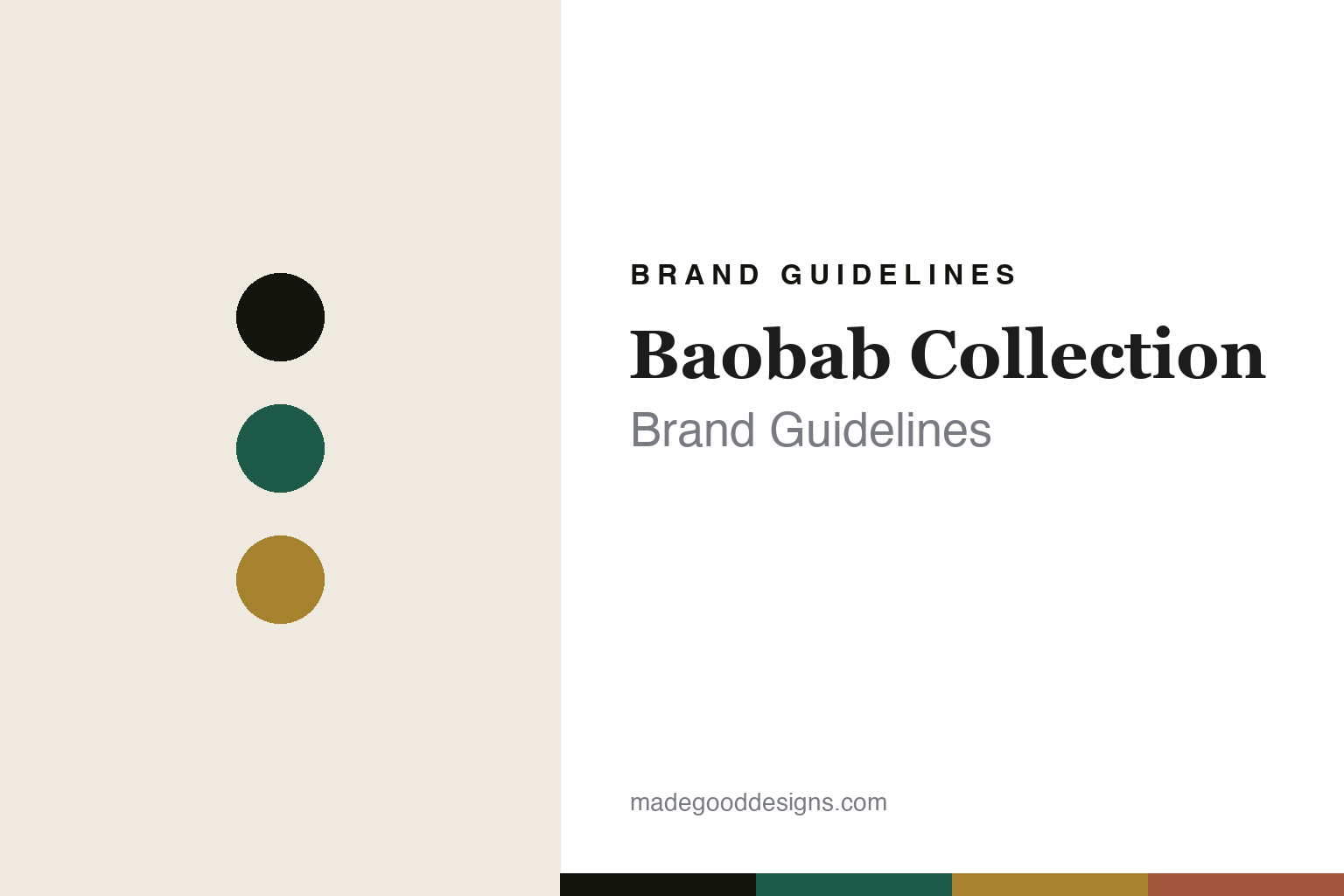
Baobab Collection Brand Guidelines
The sculptural vessel.
Aa
Two constants: a luxe-jewel palette and a luxury serif register. Abstract homage — not the Baobab vessels, decoration or ribbon mark.
The sculptural vessel
Baobab pours candles into hand-blown glass.
Baobab Collection is a lesson in the vessel as the identity. Founded by the Belgian designer Valérie Bietlot — with roots in Tanzania around 2002 and operations established in Belgium in 2004 — it makes luxury scented candles poured into sculptural, hand-blown glass.
Its identity is the sculptural vessel. Baobab pours decorative scented candles into hand-blown glass vessels — glossy, colourful, and often oversized (its large “Max” format is the flagship, burning for hundreds of hours) — alongside diffusers and home fragrance. Glass as sculpture. A candle that is a centrepiece.
(Honest notes: Baobab Collection was founded by Valérie Bietlot, a Belgian designer; its origin traces to Tanzania around 2002, where she was inspired by the landscape, with operations established in Belgium in 2004 (its HQ is in Wavre, with a flagship in Brussels) — so we say “roots in Tanzania 2002, Belgium from 2004” rather than “founded in Brussels.” Its signature is the oversized, decorated hand-blown glass candle. Importantly, it is multi-country in the making: designed in Belgium, with glass hand-blown in Poland, wax from Germany and fragrances from Grasse — so we don’t say “made in Belgium.” It is an independent, founder-led brand (we don’t assert “family-owned”). There’s no official brand hex, and we reproduce no vessel, decoration or ribbon mark — these tones are an unofficial interpretation. This is design commentary and does not promote any product.)
Colour
Baobab lives in a luxe-jewel palette. Click a swatch to copy the hex.
Baobab’s identity is luxurious, sculptural and bold — an emerald, an ink, a gold, a terracotta, and a cream. The palette pairs an emerald with a gold — the register of a glossy, hand-blown glass vessel. It signals luxury and craft rather than novelty. The honest caveat: with no published brand hex, these tones are an original, unofficial interpretation, not first-party values.
The lesson is a luxe-jewel palette signals a sculptural-vessel brand. Baobab’s world is a glossy, oversized glass object. For designers, it is a reminder that the container can be the whole product — a hand-blown, decorated, oversized vessel is a piece of decor that happens to hold a candle. Because an emerald can fail as small text, keep type dark and let the colour live in the accents, palette and band. The takeaways: make the vessel sculptural; go oversized; treat it as decor; and treat any single hex as unofficial.
Typography
The register is a luxury serif — high-contrast, elegant, bold.
Baobab’s identity carries a high-contrast, elegant, bold spirit — a sculptural, glossy object. A dramatic display serif captures the mood: it is luxurious and confident, the register of a decorative glass house. Set in a luxe-jewel palette, the luxury serif feels high-contrast and elegant — exactly the personality Baobab carries. It is bold rather than quiet, mirroring an oversized vessel. (Baobab’s real vessels, decoration, ribbon mark and wordmark are works we describe but do not reproduce, and the exact typeface is not ours to use.) Because it is not ours to use, the honest description is “a luxury serif spirit,” shown here in a stand-in. The type behaves like the brand: high-contrast, elegant and bold.
Aa
A luxury serif spirit — high-contrast and elegant. (Specimen set in DM Serif Display, a dramatic display serif STAND-IN; NOT the Baobab packaging.)
The vessel as identity
Baobab stands for the sculptural vessel.
Baobab Collection is a lesson in making the vessel the identity. A luxe-jewel palette, a luxury serif and a hand-blown glass object make the sculptural vessel the whole brand — luxurious, sculptural, bold. The vessel is the differentiator. The differentiator is an oversized, decorated, hand-blown glass that is decor first and candle second.
Put to work, the identity is the container as the centrepiece. A designer building in this spirit would invest everything in the vessel — its scale, its hand-blown surface, its decoration — so that the object commands a room and outlives its wax, becoming something you keep and refill rather than discard. The lesson Baobab teaches is that at the luxury end, the vessel is the product: an oversized, glossy hand-blown glass is impossible to ignore and justifies its price on presence alone. Being honest that the craft is multi-country — glass from Poland, fragrance from Grasse — is more credible than a blanket “made in Belgium,” and it reflects how luxury objects are genuinely made.
For designers and brand-builders, Baobab offers a clear takeaway: make the vessel the centrepiece. The lessons: make the vessel sculptural; go oversized; treat it as decor; and be honest about the story. It is also a reminder to stay accurate: it was founded by Valérie Bietlot with roots in Tanzania (2002) and Belgian operations from 2004, its signature is the oversized hand-blown glass candle, and its glass is blown in Poland — the palette here is an unofficial interpretation. And it is a reminder that scale is a strategy: by making the vessel far larger than a candle needs to be, the brand turns a consumable into furniture, which is what justifies both the price and the refill model that keeps the object in the room long after the first wax is gone. Baobab made the sculptural vessel the brand — proof that the vessel can be the difference.
Explore & save
Keep Baobab Collection’s identity on hand — save it to a board in the Made Good inspiration library.
Baobab Collection identity set
Pin the luxe-jewel palette and the luxury-serif register to your own board.