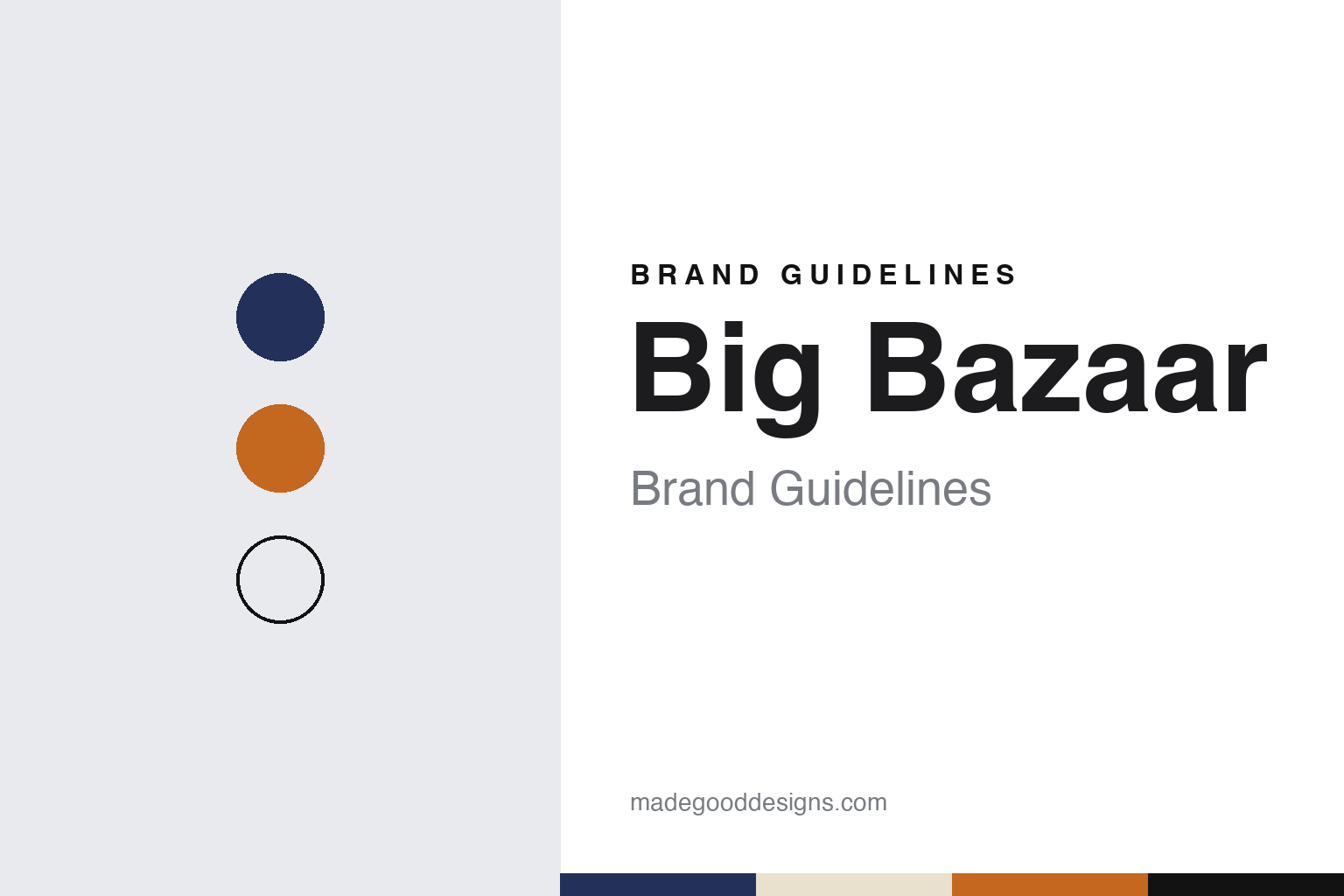
Big Bazaar Brand Guidelines
Kishore Biyani’s bazaar-style hypermarket, 2001 to 2022.
Aa
Two constants: a saffron, deep indigo and jute palette and a heavy grotesque register. Abstract homage — not a Big Bazaar product or mark; no store, logo or signage is reproduced.
A bazaar, on purpose
From Pantaloon trousers to a hypermarket.
Big Bazaar was a chain of Indian hypermarkets built by Kishore Biyani. Its roots lie in his clothing business. In 1987 he started a garment maker, Manz Wear, whose trousers were sold under the brand Pantaloon — a name he chose, he told The National in October 2009, because it had the feel of an Italian fashion house but was close to the Urdu word for trousers. A franchise chain of Pantaloon shops followed, starting in Goa in 1991, and the company turned to the stock market in 1992, the paper reported.
In August 1997 Biyani opened his first large Pantaloon family store, at Gariahat in Kolkata, according to Business Today in March 2005 and The National. The next year, he told The National, he began working on Big Bazaar: a hypermarket with “a dose of chaos,” in the paper’s words, with stores that were crowded, noisy and a bit messy on purpose. “I think the familiarity of an Indian bazaar is something we wanted to create in a modern environment,” he said.
The first Big Bazaar opened in Kolkata in 2001, and two more followed within 22 days, The National reported. Business Today wrote that in October 2001 three Big Bazaars were rolled out in that space of 22 days, each of about 50,000 square feet and stocking between 80,000 and 90,000 product lines. The chain was run by Pantaloon Retail, which later sat under Biyani’s wider Future Group, based in Mumbai.
Colour
Loose rice, narrow aisles and fast growth.
Business Today described the idea in 2005 as resting on one attribute: the Indian shopper’s eye for a bargain. In its reading, the company wagered that in-store ambience mattered less than discounting, which is why Big Bazaar could stack everything from plastic containers to loose rice in gunny bags and narrow its aisles until they barely fitted a trolley. Groceries also had their own name, Food Bazaar, a format the company ran alongside Big Bazaar, the magazine reported.
The chain grew quickly. By October 2009 there were about 100 Big Bazaars across India, The National reported, while Pantaloon Retail had roughly 1,000 stores of all kinds, covering more than 12 million square feet in 71 cities and employing about 30,000 people. By 2016 the chain had about 250 stores, Biyani told Outlook Business, and was also the outlet for fbb, the group’s value-fashion label, sold inside the hypermarkets. English Wikipedia describes Food Bazaar, fbb and the electronics shop eZone as housed under one roof in many Big Bazaar locations.
The company behind the stores changed shape along the way. In 2012 the group agreed to sell a majority stake in its Pantaloons fashion chain to the Aditya Birla Group; the Pantaloons business was demerged, and what remained of Pantaloon Retail was merged into a subsidiary later renamed Future Retail, English Wikipedia says. In 2015 the group took over Bharti Retail and its Easyday stores. Future Retail went on to run Big Bazaar, Food Bazaar, Central and Brand Factory, among other formats, English Wikipedia says.
Typography
Hypermarkets and department stores.
India’s large store chains present themselves in quite different ways, and the differences start with where the stores stand. Department-store groups have long followed the shopping mall: afaqs! reported in 2019 that Shoppers Stop had opened a 50,000-square-foot store in Gurugram stocked with premium labels. DMart took the opposite route, Outlook Business reported in 2022, owning the land under its standalone supermarkets rather than leasing space in malls.
The festival calendar shapes the year for these retailers. Shoppers Stop’s first general manager writes in his memoir that the team hurried to name and open the original Andheri store in 1991 so that it could trade before Diwali. Advertising matters as much as the calendar: when Shoppers Stop changed its logo in 2008, afaqs! reported, the new identity arrived with seven commercials, a press campaign and outdoor posters, with creative work by Contract Advertising.
Own labels are a second thread. In August 2025 Indian Retailer reported that Shoppers Stop’s private brands and its value-fashion format, Intune, were growing alongside the third-party brands in its department stores; Forbes India wrote in 2017 that DMart meant to work harder on private labels of its own. Names are often simple phrases: Shoppers Stop’s, the same memoir says, was suggested by a supermarket name seen in Boston.
Most of the larger chains also keep corporate pages that set out their founders, parent groups and stock-exchange listings, since several trade on the BSE and NSE in Mumbai. This guide uses those pages alongside dated press, and marks clearly where a fact rests on the company’s own word.
Aa
A heavy, market-stall grotesque. (Specimen set in Archivo, a sans STAND-IN; NOT the Big Bazaar logo.)
Big Bazaar
A failed sale, then liquidation.
In August 2019 Amazon bought 49% of Future Coupons, a promoter company of Future Retail, and in August 2020 Reliance Retail agreed to buy the Future Group’s retail, wholesale, logistics and warehousing businesses, English Wikipedia says. Amazon opposed the sale, arguing that it went against its 2019 agreements, and the dispute ran through arbitration in Singapore and the Indian courts, Business Today reported in April 2022.
The sale was never completed. In late February 2022 Reliance began taking over the rental leases of hundreds of stores once run by Future Retail and its fashion sister company, Business Today reported. In April 2022 the scheme failed a creditor vote: according to a regulatory filing, 69.29% of Future Retail’s secured creditors voted against it, short of the 75% approval it needed, although most shareholders and unsecured creditors backed it. English Wikipedia says the deal was called off on 23 April 2022, and that Reliance rebranded the stores it had taken over as its own Smart Bazaar format while the rest closed.
Insolvency followed. The National Company Law Tribunal in Mumbai admitted Bank of India’s petition and began an insolvency process for Future Retail on 20 July 2022, LiveLaw reported. The process drew 49 expressions of interest and six resolution plans, but none won the creditors’ approval. The creditors’ committee chose liquidation, and on 29 July 2024 the tribunal ordered Future Retail to be liquidated, directing the liquidator to try first to sell the company as a going concern. Retail Insight Network, reporting the order the next day, noted that Future Retail had run Big Bazaar and Food Bazaar.
Big Bazaar therefore no longer trades as a chain: its operator has been in liquidation since July 2024, and, by English Wikipedia’s account, the stores that stayed open passed to Reliance in 2022.
For a design guide, Big Bazaar shows how a retailer made a deliberately busy, bazaar-like store into a modern format, and how a well-known name can disappear when its operator fails. Compare Reliance, whose retail arm took over many of its stores, and Pantaloons, the fashion chain that grew out of the same company. For this guide we use a saffron, a deep indigo and jute with a heavy sans, an unofficial interpretation; no product or logo is reproduced.
Explore & save
Keep Big Bazaar’s identity on hand — save it to a board in the Made Good inspiration library.
Big Bazaar identity set
Pin the Big Bazaar saffron, deep indigo and jute palette and the heavy grotesque register to your own board.