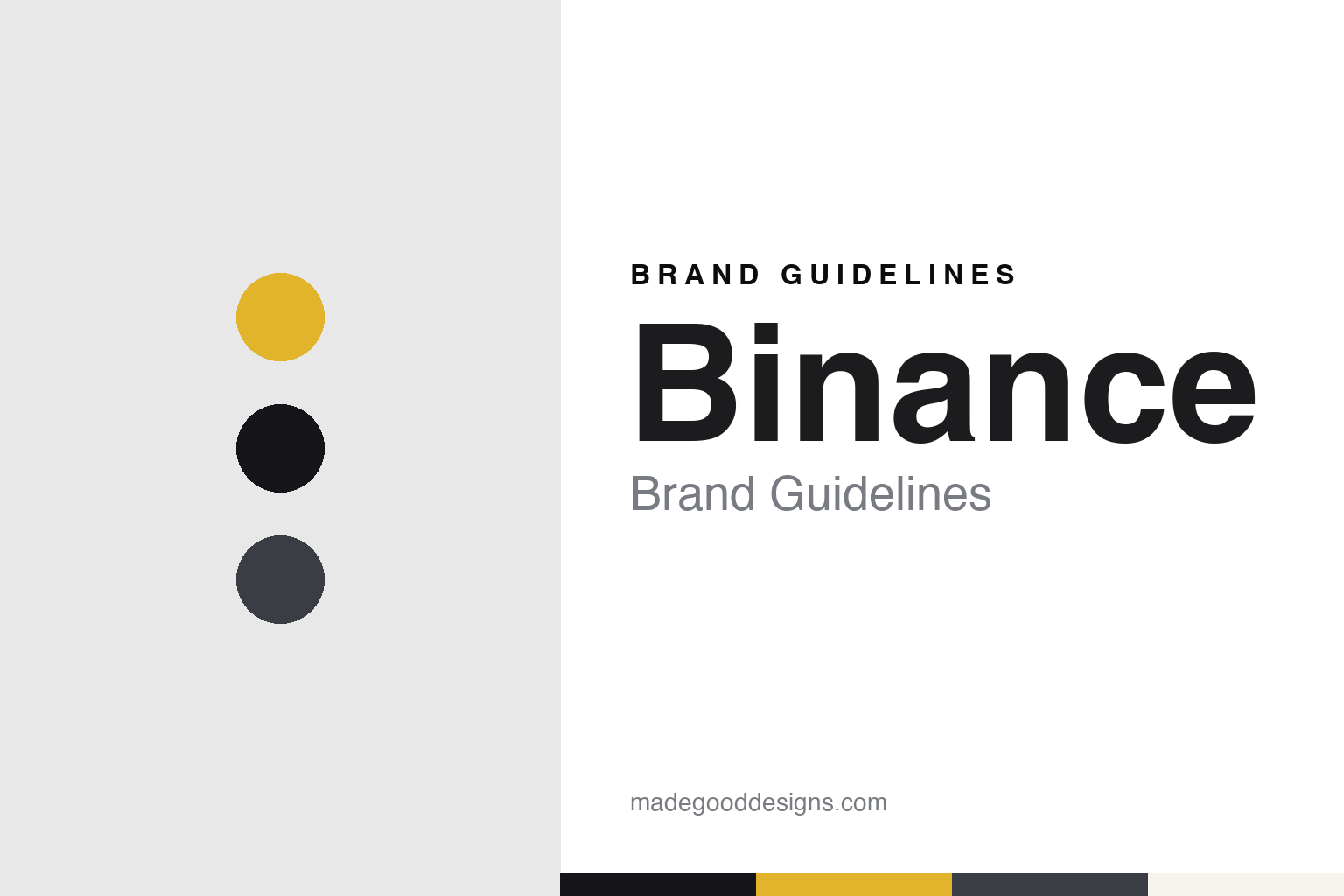
Binance Brand Guidelines
The 2017 exchange that grew up with its own coin.
Aa
Two constants: an unofficial black, yellow and grey palette and a geometric sans register. Abstract homage — not a Binance product or mark; no logo, coin or app screen is reproduced.
Binance.com, 2017
An exchange launched with a coin of its own.
Binance was founded in 2017. English Wikipedia dates the start to July of that year and names Changpeng Zhao and Yi He as its founders; it says the company raised money through an initial coin offering in 2017 to fund the launch of the exchange. The US Treasury’s findings of November 2023 refer to trades on the Binance.com platform from August 2017, which places the exchange in operation that summer. The company is Binance Holdings Ltd., and the brand is simply Binance.
Its base has moved more than once. English Wikipedia says Binance was first based in China and moved its operations out of mainland China in 2017; it then went to Japan, announced plans for an office in Malta in March 2018, and today has no official company headquarters. In November 2022 it bought Sakura Exchange, which took it back into the Japanese market, the same source says.
From the start the exchange had a coin of its own. BNB launched in July 2017 as Binance Coin, a token users could spend on fees on the company’s platform, English Wikipedia says. It began as a token on the Ethereum network and moved to the company’s own chain when that chain launched in September 2020; in February 2022 the token was renamed Build’N’Build and Binance Smart Chain became BNB Chain. In July 2018 Binance acquired Trust Wallet, a cryptocurrency wallet app, for an undisclosed mix of cash, shares and tokens.
The exchange also had an early security test. On 7 May 2019 Binance disclosed what it called a “large scale security breach” in which hackers took bitcoin from the platform; it halted all transactions for a week while it investigated and pledged to reimburse customers from an emergency fund, English Wikipedia says. In September 2019 it began offering perpetual futures contracts. Since December 2025 the company has been led by two co-chief executives, Richard Teng and Yi He, according to the same source.
Colour
Markets opened and closed country by country.
Binance’s map has been drawn by regulators as much as by marketing. In June 2019 it said it would stop serving people living in the United States and set up a separate entity, Binance.US, for those customers, English Wikipedia says. In June 2021 the UK’s Financial Conduct Authority ordered Binance to stop all regulated activity in the UK, the same source says.
The largest legal outcome came on 21 November 2023. That day the US Department of the Treasury announced that Binance Holdings Ltd. and its affiliates had settled with its Financial Crimes Enforcement Network and its Office of Foreign Assets Control over violations of the Bank Secrecy Act. The settlements were part of a global agreement that also resolved related matters with the Department of Justice and the Commodity Futures Trading Commission. According to the Treasury, Binance admitted that it had wilfully operated as an unregistered money services business and had failed to maintain an effective anti-money-laundering programme. The settlement imposed a five-year monitorship and required Binance’s complete exit from the United States. In the same release the Treasury described Binance as the largest virtual currency exchange, responsible for an estimated 60% of centralised spot trading.
Europe followed under new rules. In November 2026 crypto.news reported that Binance would close affected customer accounts in France, Spain, Italy and Poland with effect from 31 December 2026, after it had not obtained authorisation under the EU’s Markets in Crypto-Assets Regulation before the transition period ended. Services in those countries had been restricted since July, and withdrawals remained available during the wind-down, the report said.
Typography
How exchanges present themselves.
Crypto exchanges sell access to something customers never hold in their hands, so their brands are carried by screens, numbers and paperwork. Across the category, wordmarks appear in black, yellow, blue and bright neon tones, and the app screens that exchanges publish in stores and on their own sites put price charts, order books and coin icons at the centre of the picture.
Listing pages form a second layer. Each coin or token an exchange supports gets a page of its own, with a ticker symbol, a chart and a short description, and new listings are announced as news. Alongside them sit proof-of-reserves pages, where an exchange publishes snapshots comparing the assets it holds with what it owes customers, and security pages that explain how funds are stored, for example in internet-connected hot wallets and offline cold storage. The Journal of Accountancy noted in November 2026 that such a proof is a self-prepared, point-in-time comparison rather than an audit.
Regulation shapes the look as much as marketing does. Footers and legal pages list licences and registrations country by country, and the same brand can offer different products, or none, depending on where a visitor lives. Under the EU’s Markets in Crypto-Assets rules, exchanges name the national supervisor that authorised them, and a market exit reaches customers as a dated notice with deadlines for withdrawals.
Two more channels carry the names further. Sports sponsorships put exchange logos on football shirts, tournament boards and arena signs, far from any trading screen. Help centres do the quieter work: guides to identity checks, deposits, fees and withdrawals, written for people new to the product. The guides in this collection look at how individual exchanges put those parts together.
Aa
A geometric sans for a screen-first brand. (Specimen set in Manrope, a sans STAND-IN; NOT the Binance logo.)
Binance
Football sponsorships, a hack and reserves snapshots.
Binance’s public face is built from its products and its sponsorships. English Wikipedia lists sponsorships of the Africa Cup of Nations, the Italian club Lazio, FC Porto and the Argentina national football team, which carried the name to audiences far from trading screens.
Its hardest recent test came in 2026. On 29 October 2026 attackers took assets from Binance’s hot wallets, the internet-connected wallets exchanges use to handle withdrawals, across several blockchains, the Journal of Accountancy reported in November 2026. Binance’s own findings, the journal said, describe a months-long campaign aimed at its staff, including an engineer on its wallet team. Published reports indicate that Binance covered client assets from corporate and emergency resources and reopened withdrawals in stages, according to the journal. Binance then published proof-of-reserves snapshots, covering 10 tokens as of 31 October and 44 tokens on 4 November; the journal points out that such a proof is a self-prepared comparison of holdings against customer balances, not an audit.
For a design guide, Binance shows how an exchange’s identity is shaped as much by disclosures, reserves pages and country-by-country notices as by its logo. The yellow does the rest of the work, from the app icon to the coin it named. Compare Coinbase and OKX, two other crypto exchanges. For this guide we use near-black, a warm yellow and a chart grey with a sans, an unofficial interpretation; no product or logo is reproduced.
Explore & save
Keep Binance’s identity on hand — save it to a board in the Made Good inspiration library.
Binance identity set
Pin the black, yellow and grey palette and the geometric sans register to your own board.