TAL International Brand Guidelines
A container and chassis lessor with roots in 1963, absorbed into Triton International in 2016.
Aa
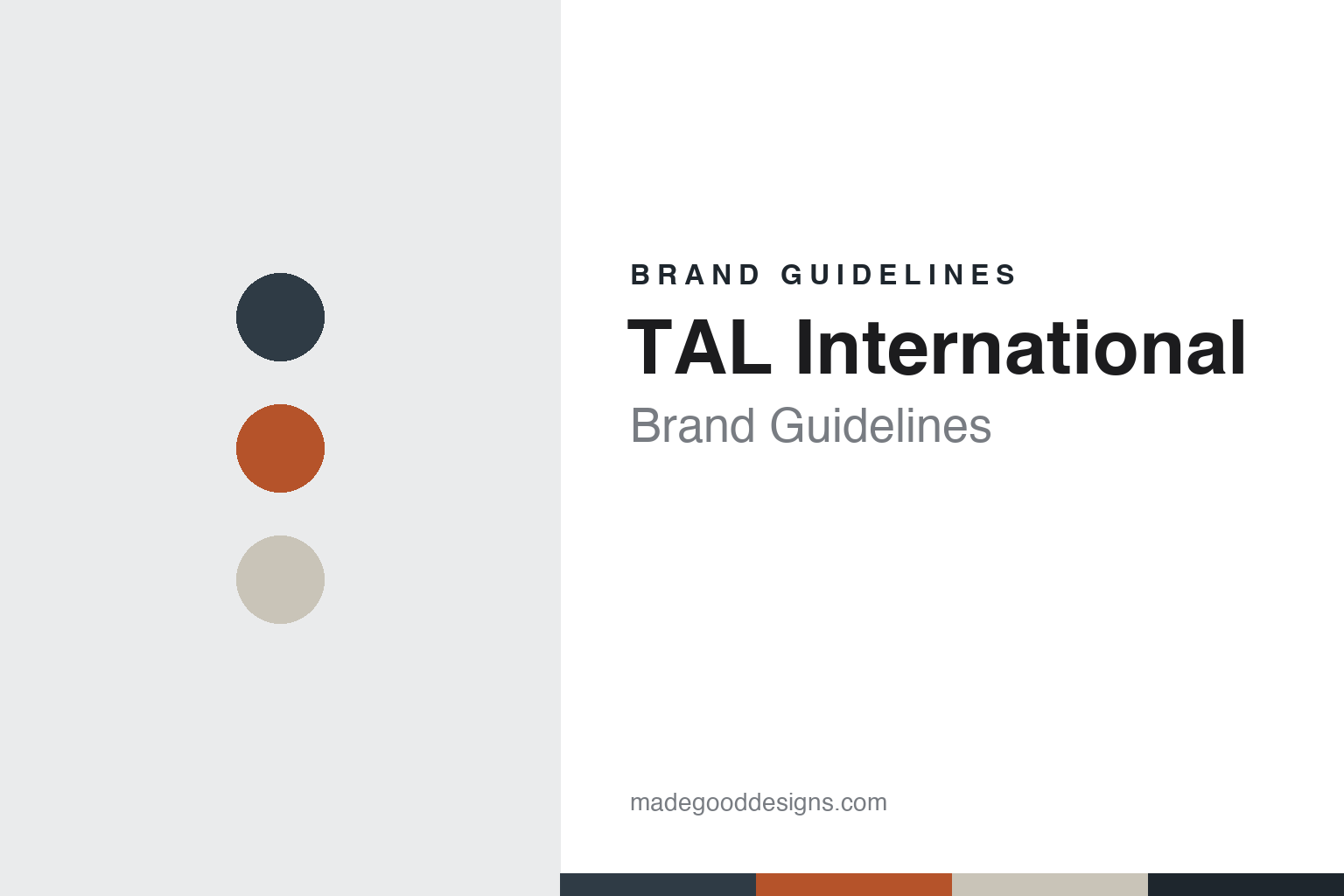
Two constants: a chassis slate, rust orange and concrete palette and a condensed industrial sans register. Abstract homage — not a TAL International container or mark; no box, logo or livery is reproduced.
Integrated Container Service
From a 1963 Pennsylvania lessor to Transamerica.
TAL International’s roots go back to 1963. According to the history kept by its successor, Triton International, the business began that year as Integrated Container Service, Inc., a Pennsylvania corporation that leased international marine containers and chassis, the wheeled frames on which containers travel by road. In 1971 it was renamed the Interway Corporation.
In 1979 Interway was acquired by Transamerica Corporation, which Triton describes as a large conglomerate with interests in finance, insurance, real estate, leasing and entertainment, and it began doing business as Transamerica Interway, Inc. In 1988 the name changed again, to Transamerica Leasing Inc., and under that name, Triton says, it grew into a prominent maritime container lessor with a large fleet operating around the world.
The TAL name arrived with a change of owner. In 2004 Transamerica sold the container leasing business, and it was rebranded TAL International Group, Inc., according to Triton’s history; a year later, in 2005, the company went public. By 2007 it was based in Purchase, New York, FreightWaves reported that July, adding that TAL had said in June it had retained Citigroup to review strategic alternatives such as a possible sale, acquisition or merger. The same report listed that review among a busy summer of deals in the container and chassis trade, from a new listing for CAI International to talk of a sale of Triton Container International.
Colour
Containers and chassis.
TAL’s business had two halves from the start: marine containers and the chassis that carry them on land. Those two halves still define the TAL name in the pages Triton keeps for it, which invite customers to “lease containers and chassis with TAL.”
Those pages describe the services around the equipment rather than the equipment alone. Lessees can track and trace their units and receive direct messages about their containers and shipments; the business also offers management of containers and chassis, information on leasing and an online database for customers to manage their rentals, with a customer access page for documents. Separate pages give the identifying specifications and the current status of any TAL or Triton unit, and a tracking page shows where a given box is.
The equipment itself is the familiar range of the trade. Triton, which now owns the fleet, lists dry containers, refrigerated containers, flat racks and open tops, alongside pallet-wide containers, chassis, generator sets and roll trailers. The Royal Gazette of Bermuda described the merged company’s operations in 2016 as the acquisition, leasing, re-leasing and eventual sale of many types of intermodal containers and chassis, the same cycle on which TAL had built its business. Triton notes that its TRITON and TAL containers “are frequently in transit.”
Typography
Design and documentation.
Container lessors own the steel boxes that shipping lines fill and move. A carrier that does not want to buy every box it needs can lease them for a few months or many years, return them at a depot and lease again somewhere else. The lessors earn their names on the boxes themselves: a company wordmark, often in a strong blue, orange or green, painted on the doors and sides of containers that travel the world’s ports and railways for years.
Their websites are built around that fleet. Most sort it by box type: standard and high-cube dry containers for general cargo; refrigerated containers, or reefers, for chilled and frozen goods; tank containers for liquids; and specials such as flat racks, open tops and palletwide boxes for cargo that does not fit a standard van. Photographs of stacked dry, reefer and tank containers, as the companies publish them, do much of the visual work, together with technical sheets that give each box’s dimensions and standards.
The next layer is the network. Lessors publish depot maps and depot finders, lists of regional offices and customer portals where shipping lines can book, return and track their units. Many also sell boxes: pages for the sale of used containers offer units at the end of their marine life for storage, conversion or one more trip, and some lessors invite outside investors to own container portfolios that the lessor manages.
Behind the boxes sits finance. Container leasing is a business of long-lived assets and long contracts, so ownership matters, and many of the companies in this series have been merged, listed, taken private or folded into larger groups. Their investor pages and press releases are where those changes are recorded, and this guide sets out what each company’s own pages and dated reports show.
Aa
A condensed industrial sans for a three-letter name. (Specimen set in Barlow Condensed, a sans STAND-IN; NOT the TAL International logo.)
TAL International
Absorbed into Triton International in 2016.
TAL International stopped being a separate listed company in 2016. Its merger with Triton Container International Limited, a Bermuda-based lessor formed in 1980, was announced in 2015 and closed on 12 July 2016, the Royal Gazette reported. The deal joined a Delaware-based listed company and a Bermudian one through two separate mergers, one in the US and one in Bermuda, under a newly formed Bermuda parent, Triton International Limited, which was listed on the New York Stock Exchange. The paper described the combined company as the largest lessor of intermodal freight containers and chassis, with a fleet of nearly five million TEU.
TAL’s partner had its own line of owners. Triton Container International, which FreightWaves described in 2007 as owned by the Pritzker family, was sold in 2011 to Warburg Pincus and Vestar, a consortium of private equity investors, according to Triton’s history; it specialised in dry, refrigerated, open-top and flat-rack containers, chassis and tanks.
TAL’s management carried on in the new group. English Wikipedia records that Brian Sondey, then TAL’s chief executive, went on to head Triton International; in April 2023 he spoke, as Triton’s chief executive, of the years “since the 2016 merger of Triton and TAL International,” FreightWaves reported. That month Brookfield Infrastructure agreed to take Triton private, and Triton’s own history says the purchase was completed in 2023, through Brookfield Infrastructure Corporation; English Wikipedia dates it to September 2023, when the shares left the New York Stock Exchange. The fuller story of the merged company is told in the Triton International brand guide.
The name has not disappeared. Triton lists TAL among the registered or unregistered service marks that belong to Triton International Limited and its subsidiaries, keeps a TAL International page for customers, and still refers to TAL units in its tracking and unit-inquiry tools. TAL itself, though, no longer trades as a company of its own.
For a design guide, TAL International shows how an equipment brand can outlive the company behind it: three letters still used for units in its new owner’s tools, a string of names from Integrated Container Service to Transamerica Leasing, and a mark kept alive by its new owner. Compare it with Triton International and with CAI International, another lessor that went public in the 2000s. For this guide we use a chassis slate, a rust orange and a concrete grey with a condensed sans, an unofficial interpretation; no product or logo is reproduced.
Explore & save
Keep TAL International’s identity on hand — save it to a board in the Made Good inspiration library.
TAL International identity set
Pin the TAL International chassis slate, rust orange and concrete palette and the condensed industrial sans register to your own board.