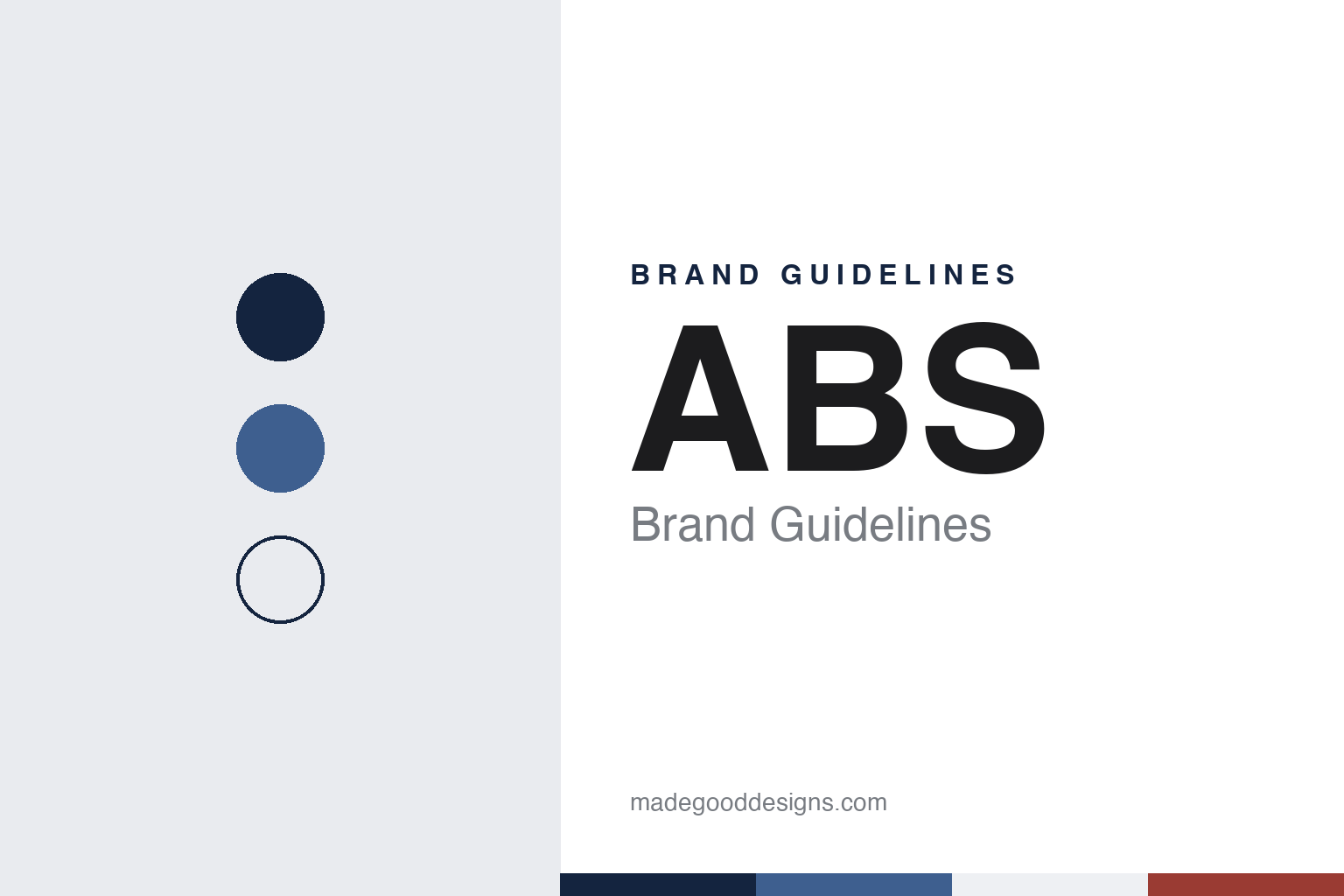
ABS Brand Guidelines
A shipmasters’ society that became a rule book with an eagle.
Aa
Two constants: a navy and brick palette and a civic serif register. Abstract homage — not an ABS mark; no logo, eagle or certificate is reproduced.
The Shipmasters’ Association
Certificates for captains, then rules for hulls.
ABS began as a register of people rather than ships. English Wikipedia says it was chartered in the state of New York in 1862 as the American Shipmasters’ Association, to certify qualified ship captains during the American Civil War. The certificates were not an official requirement, but they served as a recommendation to shipowners, and a ship sailing under a certified master was more likely to find favourable insurance terms.
Technical standards followed. The association published its first Rules for Survey and Classing Wooden Vessels in 1870, rules for iron vessels in 1877 and, as steel replaced iron, its Rules for Building and Classing Steel Vessels in 1890. Those steel-vessel rules, Wikipedia says, are still revised and published every year, and the word “Rules” remains the society’s own name for its body of standards: the company describes them as standards for the design, construction and survey of marine and offshore assets, from design to decommissioning.
As federal law came to require that the United States government license most sea officers, the association’s work moved from people to ships. It renamed itself the American Bureau of Shipping in 1898, according to Wikipedia, and kept certifying shipmasters until May 1900. The company itself puts the date plainly on its website: “Founded in 1862,” followed by a description of classification, certification and verification services for marine and offshore assets.
From the start the organisation was set up as a not-for-profit. Wikipedia says that status has held since 1862, and that United States law requires ABS to keep it in order to act as the government’s agent on the classification of government vessels.
Colour
Two wars, a New York tower and a move to Texas.
Growth came in surges. By 1916, Wikipedia says, ABS classed 21 percent of the American-flag fleet. During the First World War that fleet expanded with purchased, newly built and refitted ships, and the tonnage classed by ABS rose from about 230,000 tons in 1916 to more than three million in 1919. The Second World War brought a similar jump, from 1.53 million gross tons in 1940 to 5.49 million in 1941, according to the same article.
After 1945, as shipbuilding and trade recovered, ABS opened offices in Western Europe, Africa, Asia and South America. It also built close links with American public bodies; Wikipedia lists the U.S. Navy, the Coast Guard, Military Sealift Command, the Maritime Administration, the Army Corps of Engineers and the National Oceanic and Atmospheric Administration among them, and says ABS acts as a Recognized Organization on behalf of more than 100 governments, carrying out plan review and statutory surveys for their flags.
For a time its headquarters was a landmark in Lower Manhattan. Wikipedia says ABS owned 65 Broadway as its headquarters from 1977 to 1986, and that the building still carries a large ABS eagle and anchor on top of its front. The same bird appears in the society’s web address, eagle.org.
The society is now Texan. Its world headquarters is in Spring, Texas, according to both the company’s 2026 overview sheet and Wikipedia. The company says it has worked for “more than 160 years,” and organises itself around marine, offshore and government work; its consulting arm, ABS Group, was established in 1971 as a wholly owned subsidiary, Wikipedia says.
Typography
How classification societies present themselves.
A classification society’s output is mostly rules, surveys and certificates, and its identity tends to draw on marks of approval, dates and documents. Lloyd’s Register says its surveyors have stamped an LR mark into steel since 1884 and that its 2021 logo is a reading of that stamp in a colour it calls marine green; the American Bureau of Shipping’s eagle and anchor still sit on top of 65 Broadway in New York, its headquarters from 1977 to 1986, according to Wikipedia. Founding years — 1760, 1862 — appear prominently on both societies’ websites.
The websites themselves are working tools as much as shop windows. Lloyd’s Register lists its rules and regulations, an “LR Ships in Class” search, an office and port finder and an e-certificate verification portal; ABS offers a Rule Manager, the ABS Record database of classed vessels and certificates, and databases of type-approved products and service suppliers.
Much of the work now reaches beyond ships. Lloyd’s Register says it first inspected refrigerated cold stores in 1911 and later worked in nuclear power, oil and gas; ABS describes independent certification for marine and offshore products, materials, equipment and containers. Both societies have set up or spun off separate businesses for training, software, management systems and consulting.
They also publish heavily. Lloyd’s Register lists research reports, regulatory updates, podcasts and webinars; ABS lists regulatory news, advisories and an annual review. This guide sets out what can be checked about each society — when it was founded, how it is owned and how it presents itself — and marks clearly what rests on the society’s own word.
Aa
A civic serif — the register of a rule book and a public charter. (Specimen set in Source Serif 4, a serif STAND-IN; NOT the ABS logo.)
ABS
Rules, registers and new fuels.
Day to day, ABS describes its work in plain categories: surveys during and after construction, compliance audits, the development of its Rules, technical plan review and design analysis, and independent certification of products, materials, equipment and containers. Its public website is built around those tools — a Rule Manager, the ABS Record database of classed vessels and certificates, type-approval and supplier databases, and a client portal called ABS MyFreedom. A software affiliate, ABS Wavesight, was launched in 2022, according to Wikipedia.
Recent work has leaned towards new fuels and new power. In July 2023 The Maritime Executive reported that ABS had completed a study for the U.S. Department of Energy with an engineering partner, modelling nuclear propulsion for a 14,000 TEU containership and a Suezmax tanker. In July 2026 the same publication reported that ABS had granted an approval in principle to a Korean design for a 15,000 TEU containership with molten-salt reactors, developed by the Korea Atomic Energy Research Institute, the Korea Research Institute of Ships and Ocean Engineering and Samsung Heavy Industries.
Governance has also been on the agenda. In September 2026 The Maritime Executive reported that ABS, DNV and RINA had become the first classification societies to join the Maritime Anti-Corruption Network, after the network’s general assembly voted in April to admit class societies.
The public identity leans on a few constants: the initials ABS, the full name American Bureau of Shipping in its copyright lines, the eagle on 65 Broadway and in the web address, and product names built around Rules, records and certificates.
For a design guide, ABS shows how a not-for-profit standards body can build a brand from a charter date, a rule book and a single emblem. Compare Lloyd’s Register, the London society with an older register, and Bureau Veritas. For this guide we use a navy and a brick red with a serif, an unofficial interpretation; no product or logo is reproduced.
Explore & save
Keep ABS’s identity on hand — save it to a board in the Made Good inspiration library.
ABS identity set
Pin the ABS navy and brick palette and the civic serif register to your own board.