Lloyd’s Register Brand Guidelines
A coffee-house register that became a stamp in steel.
Aa
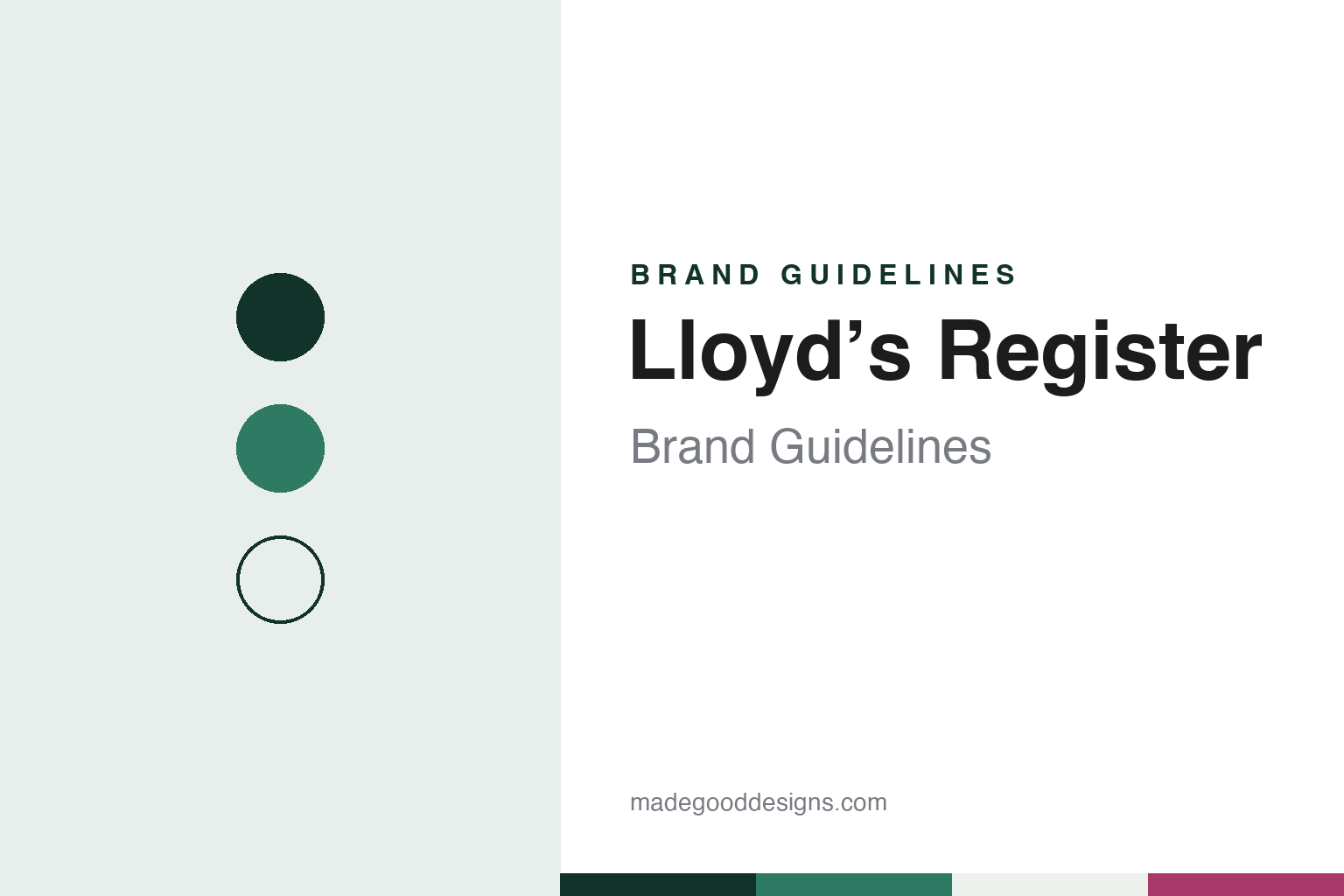
Two constants: a deep green and magenta palette and a stamped sans register. Abstract homage — not a Lloyd’s Register mark; no logo, stamp or certificate is reproduced.
The Register Book
Subscriptions, surveyors and a coffee house in the City.
Lloyd’s Register dates itself to 1760. Its own history says it began at Edward Lloyd’s coffee house on Lombard Street in the City of London, and that subscriptions to the Society’s annual Register Book, first published in 1764, paid for surveyors to list, rate and class the condition of ships.
The early Society was not alone. In 1834, the company says, it settled a dispute with a rival shipping register by uniting with it to form Lloyd’s Register of British and Foreign Shipping. As steam replaced sail and iron and then steel replaced timber, it drew up guidance for ships in service and for those still on the stocks.
Its reach abroad grew slowly at first. According to the company, its General Committee held off appointing surveyors overseas until its network of British outports was settled, and only repeated requests from the Quebec Board of Trade led it to send Thomas Menzies as resident surveyor for Quebec and the St Lawrence in 1852. Menzies, it says, proposed in 1853 that a Maltese Cross be used in the Register Book and on certificates to mark a ship built under special survey.
Appointments in continental Europe followed in the 1860s, at Antwerp in 1866 and Rotterdam in 1868, and a first surveyor went to Shanghai in 1869, followed by posts in Calcutta, Hong Kong, Melbourne, Sydney and Hobart. By the early 1880s, Lloyd’s Register says, it classed almost half of the world’s shipping. In 1914 the name was shortened to Lloyd’s Register of Shipping, and from 1916 it set up national and area committees around the world.
Colour
Cold stores, shell steel and the North Sea.
The work spread beyond hulls early. By the early 1800s, the company says, its surveyors were already testing anchors, cables and iron on shore, and its first non-marine inspection, of refrigerated cold stores for the Port of London Authority, came in 1911. By 1934 it was inspecting cold storage as far apart as Antwerp, Basel, the Congo and Singapore.
War shaped that growth. During the First World War, Lloyd’s Register says, it provided quality assurance for products such as shell steel for France and copper pipes for shipping in the United States. Its history describes the Second World War as a period that accelerated change in shipping and industry, in which it helped validate new techniques, and says that post-war reconstruction let it rebuild its work overseas gradually.
The post-war decades added industries. The company says it provided consultancy and inspection to atomic energy plants, including Calder Hall in England, which it says began generating electricity on an industrial scale in 1956; that it moved into oil and gas as the North Sea fields were developed in the 1970s; and that it formed a separate division for non-marine work. Its management-systems business, LRQA, was set up in 1985, and Lloyd’s Register Rail followed in 1996.
Since then the group has sold or separated several of those businesses. It sold the rail business to Ricardo plc in 2015, turned its energy business into the Vysus Group in 2020, and in 2021 LRQA became an independent business with backing from Goldman Sachs Asset Management, according to the company’s history. What remains is classification and compliance for ships and offshore assets, advisory work, training and software.
Typography
How classification societies present themselves.
A classification society’s output is mostly rules, surveys and certificates, and its identity tends to draw on marks of approval, dates and documents. Lloyd’s Register says its surveyors have stamped an LR mark into steel since 1884 and that its 2021 logo is a reading of that stamp in a colour it calls marine green; the American Bureau of Shipping’s eagle and anchor still sit on top of 65 Broadway in New York, its headquarters from 1977 to 1986, according to Wikipedia. Founding years — 1760, 1862 — appear prominently on both societies’ websites.
The websites themselves are working tools as much as shop windows. Lloyd’s Register lists its rules and regulations, an “LR Ships in Class” search, an office and port finder and an e-certificate verification portal; ABS offers a Rule Manager, the ABS Record database of classed vessels and certificates, and databases of type-approved products and service suppliers.
Much of the work now reaches beyond ships. Lloyd’s Register says it first inspected refrigerated cold stores in 1911 and later worked in nuclear power, oil and gas; ABS describes independent certification for marine and offshore products, materials, equipment and containers. Both societies have set up or spun off separate businesses for training, software, management systems and consulting.
They also publish heavily. Lloyd’s Register lists research reports, regulatory updates, podcasts and webinars; ABS lists regulatory news, advisories and an annual review. This guide sets out what can be checked about each society — when it was founded, how it is owned and how it presents itself — and marks clearly what rests on the society’s own word.
LR
A stamped sans — after a letter mark punched into steel. (Specimen set in Archivo, a sans STAND-IN; NOT the Lloyd’s Register logo.)
Lloyd’s Register
A charity owner, a digital arm and a green stamp.
For most of its history the organisation was not a company limited by shares. On 2 July 2012, its history says, it converted from an industrial and provident society into a company limited by shares, Lloyd’s Register Group Limited, whose shares are owned by the Lloyd’s Register Foundation, a registered charity founded the same year. The two share a mission and work together on research such as the Maritime Decarbonisation Hub, set up in 2020.
Software is the newest layer. Lloyd’s Register invested in the fleet-software firm Hanseaticsoft in 2017, bought OneOcean in 2022 and launched its LR OneOcean platform in July 2023. In September 2024 The Maritime Executive reported that it had agreed to buy Ocean Technologies Group, a maritime training and crew-software company, from Oakley Capital, and Lloyd’s Register’s website now describes OneOcean as a single brand formed by integrating the two businesses, owned by Lloyd’s Register.
The identity has a long paper trail. The company says its first “Ladybadges” — sirens and goddesses drawn for the covers of the Register Book — date from 1799, and that its surveyors have stamped an LR mark into steel as proof of approval since 1884. Its current logos, unveiled in 2021, are described as a bolder reading of that stamp, in a colour the company calls marine green, with the LR letterform cut through like a window. The Foundation’s version adds the word “Foundation” in the plinth, in a colour it calls Foundation Fuchsia.
For a design guide, Lloyd’s Register shows how an inspection mark can become a corporate identity without losing its meaning. Compare DNV, a Norwegian classification society, and ABS, its American counterpart. For this guide we use a deep green and a magenta with a sans, an unofficial interpretation; no product or logo is reproduced.
Explore & save
Keep Lloyd’s Register’s identity on hand — save it to a board in the Made Good inspiration library.
Lloyd’s Register identity set
Pin the Lloyd’s Register deep green and magenta palette and the stamped sans register to your own board.