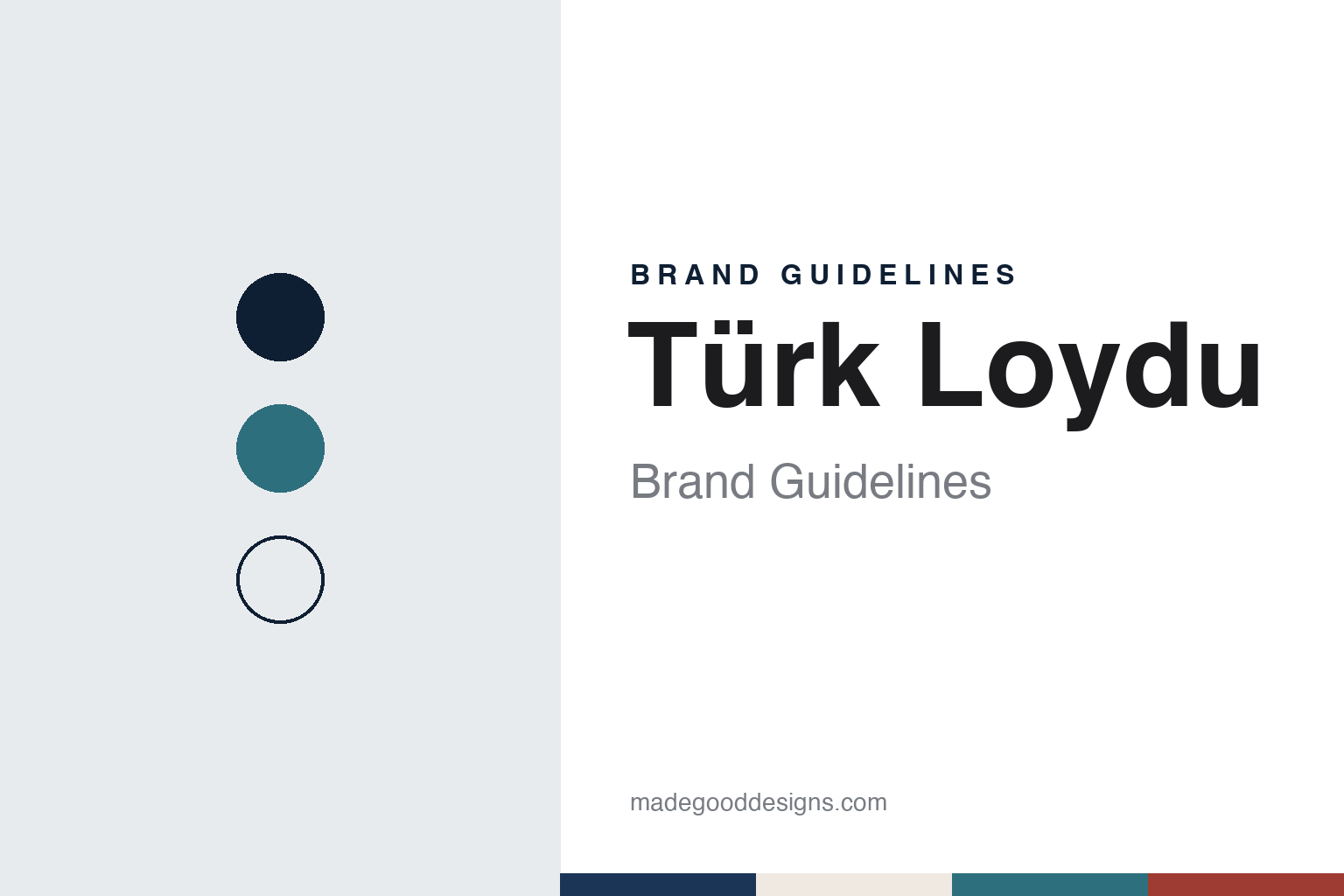
Türk Loydu Brand Guidelines
An Istanbul class society that began in a small room of the Galata passenger hall.
Aa
Two constants: a Bosphorus navy, strait teal and brick palette and a register serif. Abstract homage — not a Türk Loydu mark; no logo, certificate or rule book is reproduced.
A room in Galata
Naval architects and insurers in 1962.
Türk Loydu, the Turkish Lloyd, is Türkiye’s national ship classification society. Turkish Wikipedia says it was set up at a general assembly in 1962, led by the Chamber of Naval Architects of TMMOB, with the support of the Association of Insurance and Reinsurance Companies of Türkiye. It began as a tesis, an establishment, for the classification of ships and for certifying boilers and pressure vessels on land.
The beginnings were small. Turkish Wikipedia says the work started in a small room of the Galata passenger hall in Istanbul, rented from Denizcilik Bankası. The foundation’s own timeline says the first vessel it classed, in 1962, was a small service boat, followed in 1963 by the Harem car ferry, the first sizeable ship on its books, and that its first register book appeared in 1965. In January 2024 the chair of its foundation board told an anniversary gathering that it had begun in the early 1960s with naval engineers coming together, before insurers joined, Vira Haber reported.
The legal form changed early. A change to the Civil Code in 1966 made Türk Loydu a vakıf, a foundation, and its timeline says it was declared the national recognised classification body by the Ministry of Transport in 1981. Until 1986 it was run by a Standing Committee elected by the general assembly, and since then by a foundation board.
The offices moved as the work grew: from Galata to an apartment floor in Harbiye, then in 1982 to its own five-storey building in Tophane, and in 1996 to the Tuzla shipyard district of Istanbul, where Turkish Wikipedia says it has worked since 2008 from a modern building opened that year. In 2017 the foundation set up a company, Türk Loydu Uygunluk Değerlendirme Hizmetleri A.Ş., to carry its classification and conformity work.
Colour
From DNV rules to IACS membership.
For its first decades Türk Loydu worked with other societies. Its timeline records a 1972 agreement under which it began to use DNV rules and carried out DNV survey work in Türkiye, followed by cooperation agreements with Germanischer Lloyd in 1978 and with the Italian register RINA in 1979. By 1984, it says, all of Istanbul’s city-line ferries were under its class.
The long project was membership of the International Association of Classification Societies. The timeline says IACS membership was set as a strategic goal in 2007 and that Türk Loydu applied in 2010. It became an IACS member on 1 November 2023, according to Turkish Wikipedia and a December 2024 report in DenizHaber; the foundation calls itself the association’s twelfth member. It marked the admission and its 62nd anniversary at Çırağan Palace in Istanbul on 20 January 2024, with the chair of IACS among the guests, Vira Haber reported.
The figures it gives for its fleet have grown since. In the DenizHaber report, Türk Loydu said that 52 ships had transferred to its class after it joined IACS, taking the total to 531, and that it was recognised by 20 flag states. Its 2026 timeline entry gives 582 ships of about 1.9 million deadweight tonnes and 21 flag states.
The work reaches beyond merchant ships. Turkish Wikipedia lists the classification of vessels built under its supervision, surveys on behalf of flag states, certification of marine equipment and yacht materials, CE conformity assessment under EU rules, third-party inspection, verification of greenhouse gas reports, training, and conformity assessment for railways, power plants, and oil and gas. Its timeline also records naval vessels classed since 1993, an office in Shanghai opened in 2020, inspection work on the 1915 Çanakkale Bridge completed in 2022, and a yacht department set up in 2024.
Typography
How classification societies present themselves.
A classification society’s output is mostly rules, surveys and certificates, and its identity tends to draw on marks of approval, dates and documents. Lloyd’s Register says its surveyors have stamped an LR mark into steel since 1884 and that its 2021 logo is a reading of that stamp in a colour it calls marine green; the American Bureau of Shipping’s eagle and anchor still sit on top of 65 Broadway in New York, its headquarters from 1977 to 1986, according to Wikipedia. Founding years — 1760, 1862 — appear prominently on both societies’ websites.
The websites themselves are working tools as much as shop windows. Lloyd’s Register lists its rules and regulations, an “LR Ships in Class” search, an office and port finder and an e-certificate verification portal; ABS offers a Rule Manager, the ABS Record database of classed vessels and certificates, and databases of type-approved products and service suppliers.
Much of the work now reaches beyond ships. Lloyd’s Register says it first inspected refrigerated cold stores in 1911 and later worked in nuclear power, oil and gas; ABS describes independent certification for marine and offshore products, materials, equipment and containers. Both societies have set up or spun off separate businesses for training, software, management systems and consulting.
They also publish heavily. Lloyd’s Register lists research reports, regulatory updates, podcasts and webinars; ABS lists regulatory news, advisories and an annual review. This guide sets out what can be checked about each society — when it was founded, how it is owned and how it presents itself — and marks clearly what rests on the society’s own word.
Aa
A register serif — the voice of a register book. (Specimen set in Source Serif 4, a serif STAND-IN; NOT the Türk Loydu logo.)
Türk Loydu
A foundation with a company inside it.
The name itself is a borrowing. Loydu is the Turkish form of Lloyd, and the society’s timeline uses the same word for its peers, calling Germanischer Lloyd the German Loydu and RINA the Italian Loydu. It uses its own name in full as Türk Loydu, with the short form TL in the names of its digital services. Two bodies stand behind the brand today: the Türk Loydu Vakfı, the foundation, and the company it set up in 2017. Vira Haber listed the board of one and the staff of the other among the guests at the 2024 celebration.
The foundation also presents itself through education. In January 2024 its chair announced a Türk Loydu Academy within the foundation, and the timeline records the Academy as set up that year, alongside a scholarship system and support for research projects in maritime and related industries.
The website puts news of class contracts and agreements on its home page, with working tools alongside. These include a ship information system, an electronic plan approval system, a certificate lookup and electronic certificates. Recent news items describe a memorandum of understanding signed with the propulsion maker SCHOTTEL at SMM Hamburg in 2026 and a class contract with the Çeksan shipyard for the first ship of a chemical tanker series.
For a design guide, Türk Loydu shows how a national society can carry a borrowed name and a long local record into an international role. Compare DNV, whose rules it used from 1972, and RINA, the Italian register it signed a cooperation agreement with in 1979. For this guide we use a Bosphorus navy, a strait teal and a brick red with a serif, an unofficial interpretation; no product or logo is reproduced.
Explore & save
Keep Türk Loydu’s identity on hand — save it to a board in the Made Good inspiration library.
Türk Loydu identity set
Pin the Türk Loydu navy, strait teal and brick palette and the register serif to your own board.