Bomin Brand Guidelines
Bominflot’s 1976 roots, a 2017 wave logo and a 2024 sale to Minerva.
Aa
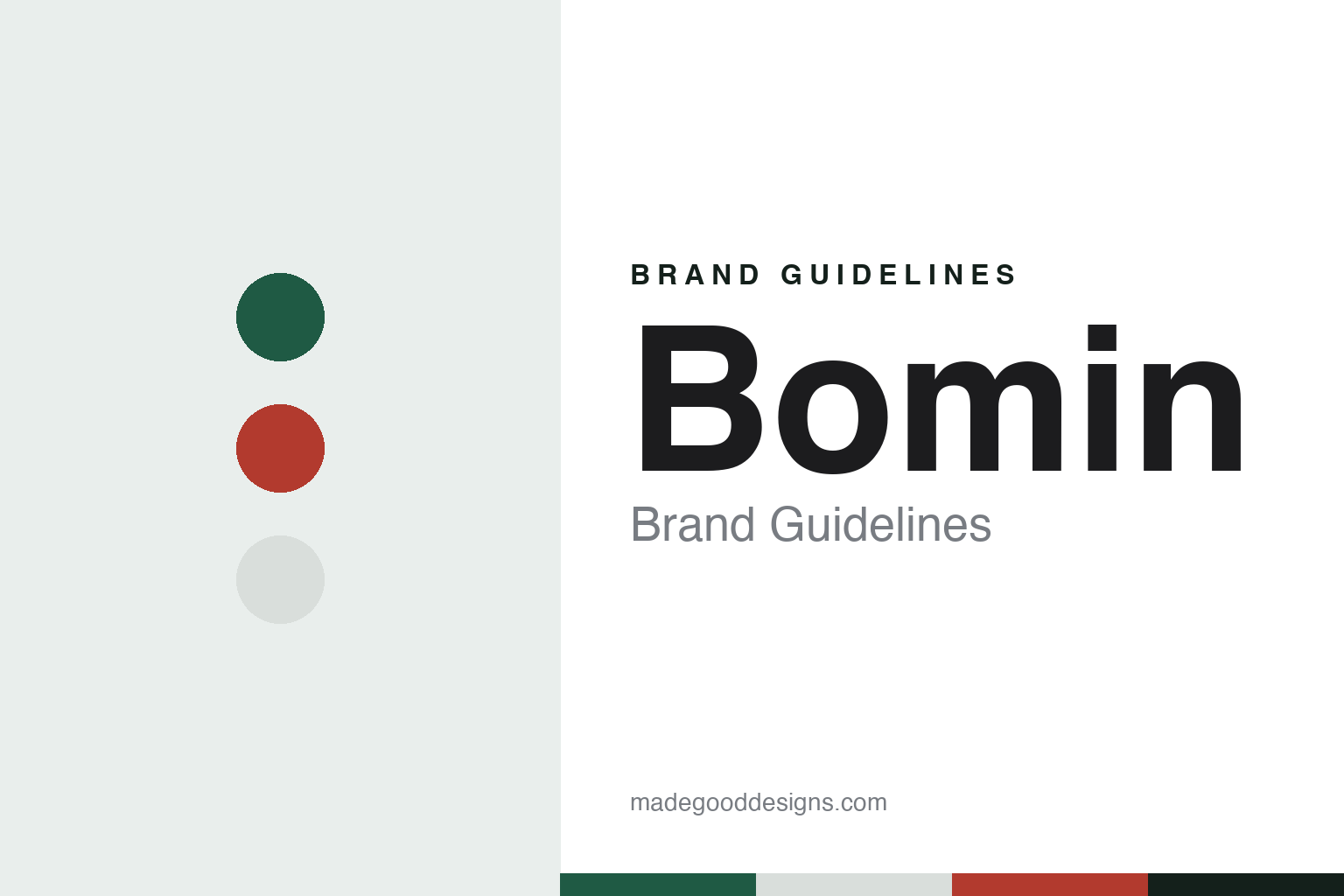
Two constants: a Bomin green and red palette and a modern maritime sans register. Abstract homage — not a Bomin product or mark; no logo, barge livery or nameplate is reproduced.
Bominflot
A Hamburg bunker trader takes a shorter name.
Bomin is the name a Hamburg bunker business took in 2012, after it changed owners. The company traced its roots to Bominflot, which it told Ship & Bunker in October 2017 had been founded in 1976 as a joint venture supplying bunkers, lubricants and spare parts to ships. By 1991, the company said in the same interview, Bominflot had grown into a worldwide trading organisation, with local offices in the main bunkering hubs and the ability to deliver wherever its customers needed fuel.
In 2011 the group’s parent was the Hamburg company Bominflot Bunkergesellschaft für Mineralöle. The law firm CMS Hasche Sigle, announcing that year that it had advised the banks on a working-capital financing for the group, described it as one of the largest independent bunker-oil traders in the world, with group companies in several countries taking part in the facility.
The buyer was Mabanaft, the trading arm of the Hamburg family group Marquard & Bahls, which German Wikipedia says Theodor Weisser founded in 1947. The deal was first announced in September 2011, and Ship & Bunker reported on 1 June 2012 that Mabanaft had completed the acquisition after antitrust approval. At that point Bominflot brought 35 years as a bunker supplier and 36 offices worldwide, the same report said. Its bunkering activities were merged with Matrix Marine Fuels, Mabanaft’s existing bunkering subsidiary, which had offices on the US Gulf Coast and in Singapore, Oman and India, to form the Bomin Group. Mabanaft said the combination made it one of the world’s five largest bunkering groups.
The renaming was handled office by office. Bominflot offices became Bomin, while Matrix kept its own brand for the time being, Ship & Bunker reported in 2012. One later example came in April 2015, when the group’s Tallinn business changed its name from AS Bominflot Estonia to Bomin Baltic AS as part of plans to grow in the Baltic region. A 2014 report in The Maritime Executive named the managing company as Bomin BunkerHolding, with activities in North and Latin America, the Mediterranean, the Middle East and Asia.
Colour
Barges, an LNG venture and a sale.
Bomin also tried a second fuel. In August 2012 Marquard & Bahls, through Bomin, and the industrial gases group Linde announced a 50/50 joint venture, headquartered in Hamburg, to build a supply chain for liquefied natural gas as a marine fuel in ports across north-west Europe, The Maritime Executive reported; the deal was then subject to antitrust approval. The venture traded as Bomin Linde LNG. After Linde bought the Marquard & Bahls shares in the autumn of 2016, the company was renamed Nauticor, Riviera reported in March 2017, and the Bomin name left the LNG business.
The oil-fuel business reorganised around physical supply. In its 2017 interview the company said it had set up four regional hubs in December 2016, for Europe, the Americas, the Middle East and Africa, and Asia-Pacific, and that it ran more than 20 owned and chartered bunker barges, with storage at major bunkering hubs. It described itself as a physical supplier and trader of marine fuels and lubricants, with control of the supply chain from order to delivery.
The group then grew smaller. By October 2024, Ship & Bunker reported, Bomin was a physical supplier only in the Americas, covering Houston, Norfolk, Panama and Ecuador. On 9 October 2024 the same publication reported that Minerva Bunkering had acquired Bomin Group from Mabanaft, a deal announced at the Singapore International Bunkering Conference and Exhibition. Hellenic Shipping News, drawing on the data firm ENGINE, described the purchase as Bomin’s physical operations in the Americas, and said Bomin had supplied very low sulphur fuel oil and low sulphur marine gasoil in US Gulf ports and in Norfolk and Portsmouth in the preceding three months. For Minerva, Houston was a first physical supply operation, while Norfolk added to one it already had, Ship & Bunker said.
Bomin’s former parent has since renamed its own trading arm: German Wikipedia says Mabanaft became MB Energy in a brand relaunch in May 2025.
Typography
How bunker suppliers present themselves.
Marine fuel suppliers sell to a small, technical audience: ship operators, charterers and fuel buyers who order bunkers for a vessel arriving at a given port on a given day. Their identities tend to be simple. Many use a plain wordmark in a single strong colour — often a deep blue, sometimes an orange or a green — with a short symbol beside it, and the name usually says what the company does: bunkering, marine fuels, oil or energy. Several have shortened or changed those names as they add new fuels or change owners.
Photography does much of the work. The companies publish pictures of their own bunker barges and tankers moored alongside container ships, bulk carriers and cruise ships, of hoses and fuel lines at the ship’s side, and of new vessels at their naming ceremonies. Port-coverage maps are the other recurring image: a world map marked with the hubs where a supplier delivers fuel itself and the wider set of ports where it arranges supply through others.
Product pages are written plainly, by fuel grade rather than by brand name: very low sulphur fuel oil (VLSFO), high-sulphur fuel oil (HSFO), marine gasoil (MGO), LNG, and biofuel blends described by their bio-component share, such as B20 or B30. Larger suppliers add pages for their trading desks — buying fuel for delivery across many ports, and managing fuel-price exposure for customers — and for delivery records, including mass flow meters and digital delivery notes.
Sustainability pages have grown alongside these. Suppliers describe the alternative fuels they offer or plan to offer, newer vessels able to run on LNG, and their own codes of conduct, usually in the company’s own words. This guide separates those descriptions from what dated trade-press reports show about each company: who founded it, who owns it, and where it supplies fuel.
Aa
A modern maritime sans, after the “modern typeface” Bomin described for its 2017 logo. (Specimen set in Archivo, a sans STAND-IN; NOT the Bomin logo.)
Bomin
Waves, a modern typeface and two parent colours.
Bomin is one of the few bunker suppliers to have explained its logo in public. In October 2017, having just launched a new brand identity, the company told Ship & Bunker that the new logo used a modern typeface and a set of waves. The waves, it said, referred to Bomin’s maritime heritage and to a core value it called “Energy,” while the green and red colours expressed its close working relationship with its parent companies, Mabanaft and Marquard & Bahls. The company linked the timing to change in shipping, pointing to the global sulphur cap due in 2020 and to a fuel supply chain it saw as more complex.
That account shows a subsidiary borrowing from its parents while keeping its own name. By the company’s count the Bominflot name ran from 1976 to 2012; Bomin then carried the business for twelve years under Mabanaft before the sale to Minerva. The 2017 identity was drawn for a group with regional hubs and barges on several continents; by 2024, Ship & Bunker reported, its physical supply had narrowed to four locations in the Americas.
For a design guide, Bomin shows how a renamed company can carry a parent’s colours into a new mark and spell out what each part of that mark is meant to say. Compare Minerva Bunkering, the supplier that bought Bomin in 2024, and Monjasa, a Danish supplier that has kept one name since 2002. For this guide we use a harbour green, a signal red and a sea grey with a sans, an unofficial interpretation; no product or logo is reproduced.
Explore & save
Keep Bomin’s identity on hand — save it to a board in the Made Good inspiration library.
Bomin identity set
Pin the Bomin green and red palette and the modern maritime sans register to your own board.