Minerva Bunkering Brand Guidelines
Mercuria’s marine fuel arm, renamed out of a restructuring.
Aa
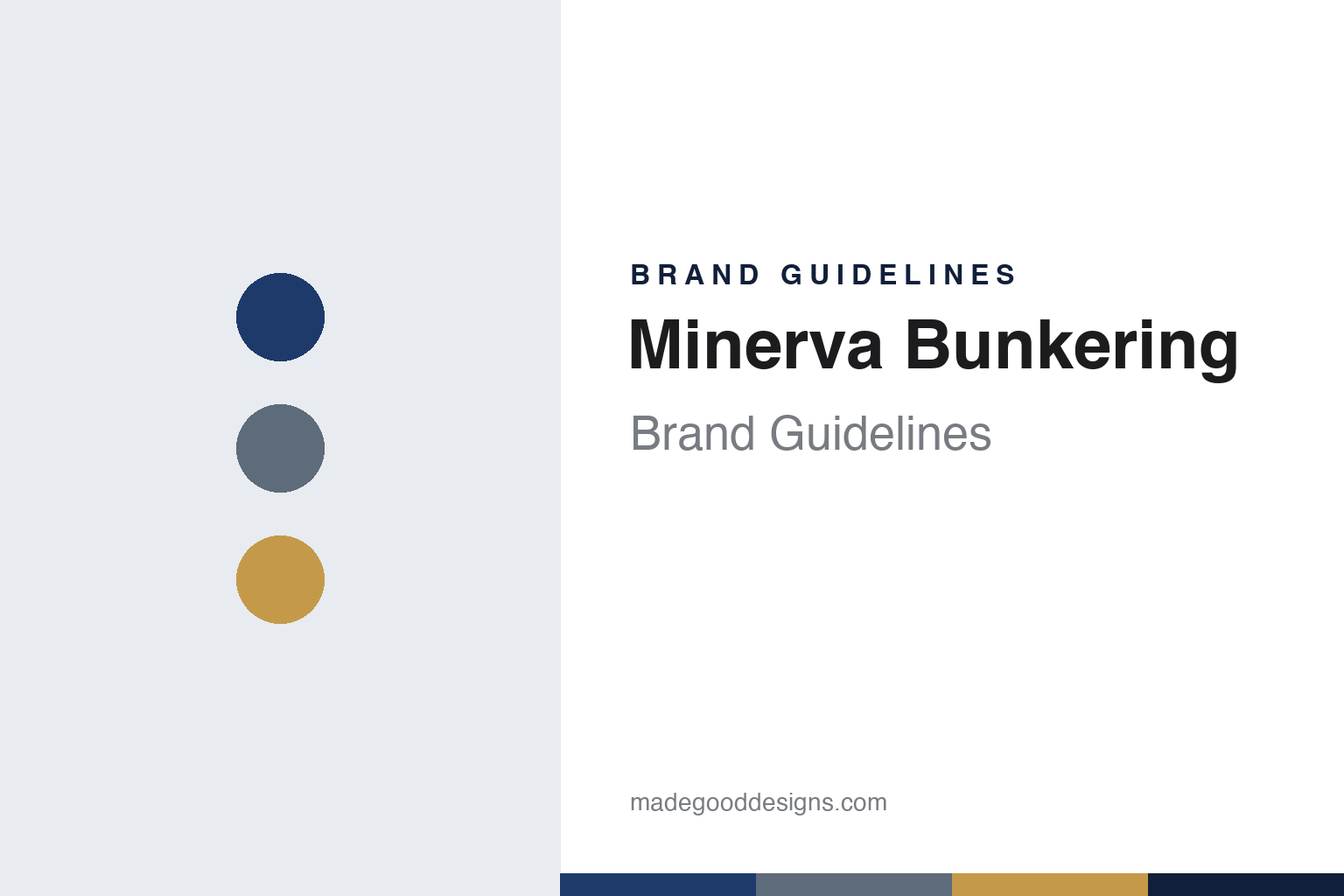
Two constants: a blue, slate and gold palette and a grotesque sans register. Abstract homage — not a Minerva Bunkering asset; no vessel, logo or mark is reproduced.
From Aegean to Minerva
A trading unit, a listed supplier and a new name.
Minerva Bunkering is the marine fuel arm of Mercuria Energy Group, the commodity trading company founded in Geneva in 2004. Its roots are in a small trading desk: Ship & Bunker reported in February 2026 that Mercuria set up the business in 2014 as Minerva Bunkers Pte Ltd, a wholly owned marine fuel trading unit with teams in Singapore, Las Palmas and Geneva. English Wikipedia dates Minerva Bunkering itself to 2019, when it absorbed both that earlier unit and a much larger physical supplier, Aegean Marine Petroleum Network.
Aegean was a bunker supplier listed on the New York Stock Exchange, which Ship & Bunker describes as having once been the largest physical bunker supplier in the world. 2018 was a crisis year for it. In May a shareholder group joined the board and the company formally cut its ties with its founder; an investigation by the new audit committee led to a June announcement that a large block of receivables would likely have to be written off; and by midsummer, the trade title reported, the company was close to liquidation. In August 2018 Mercuria took a 30 per cent stake and a board seat in exchange for financing.
On 6 November 2018 Aegean filed for Chapter 11 in New York, with Mercuria providing financing for the process and acting as the “stalking horse” bidder for the business, Ship & Bunker reported. In January 2019 the court approved that financing and a restructuring support agreement. On 4 April 2019 Aegean Marine Petroleum Network emerged from Chapter 11 under a new name, Minerva Bunkering, as a wholly owned subsidiary of Mercuria. An Aegean board director said that day that the business was now “a significantly stronger company” as part of Mercuria.
Colour
Ports, barges and a fleet arm.
Minerva is headquartered in Geneva, where chief executive Tyler Baron is based, according to Ship & Bunker’s February 2026 profile of the company. The title reported that Minerva sold about 16.2 million tonnes of bunkers in 2025, that about 80 per cent of its volumes are understood to come from physical supply, and that it trades fuel for delivery at more than 150 ports, with its own physical supply at more than 30. The company’s website lists offices in Athens, Dubai, Geneva, Hamburg, Houston, Las Palmas, London, New York, Panama, Rotterdam, Singapore and Tokyo.
Its physical ports have been added step by step. In March 2020 it took over Aegean’s physical supply licence at Fujairah in the United Arab Emirates, with two barges supplying very low sulphur fuel oil and marine gasoil, Ship & Bunker reported, citing S&P Global Platts. In October 2024 it bought Bomin from Mabanaft, adding physical supply in Houston, Norfolk, Panama and Ecuador; Houston was a new physical supply port for Minerva, the title reported. In April 2025 it placed a 113,000-cubic-metre floating storage unit at Jeddah in Saudi Arabia, used to receive cargoes, blend fuel on board and load its bunker tankers. In November 2025 it added the barge MT Mars at Las Palmas and extended its terminal concession there by 15 years, and in May 2026 the company announced a new bunkering service in Mauritania after receiving a licence from the country’s national hydrocarbons commission.
The vessels sit in a shipping arm, MM Marine, which the company says manages its bunker tankers and barges. In October 2024, during the Sibcon conference in Singapore, Minerva christened Amalthea, an 8,000-deadweight-tonne bunker tanker built at the Jiangmen Hangtong shipyard that can run on LNG and was set to work in Singapore. Baron said it was the company’s first newbuild delivery as Minerva, in a fleet of 41 vessels. The company’s website names a sister ship, Titania.
Minerva has also put weight on measuring deliveries. In 2021 it founded ADP Clear, a start-up that uses mass flow meters to give real-time records of bunker deliveries, later spun out as a separate business within the Mercuria group; both are founding members of a 2025 Bunkering Services Initiative in the Amsterdam-Rotterdam-Antwerp hub, Ship & Bunker reported.
Typography
How marine fuel suppliers present themselves.
Marine fuel suppliers sell to a small, technical audience: ship operators, charterers and fuel buyers who order bunkers for a vessel arriving at a given port on a given day. Their identities tend to be simple. Many use a plain wordmark in a single strong colour — often a deep blue, sometimes an orange or a green — with a short symbol beside it, and the name usually says what the company does: bunkering, marine fuels, oil or energy. Several have shortened or changed those names as they add new fuels or change owners.
Photography does much of the work. The companies publish pictures of their own bunker barges and tankers moored alongside container ships, bulk carriers and cruise ships, of hoses and fuel lines at the ship’s side, and of new vessels at their naming ceremonies. Port-coverage maps are the other recurring image: a world map marked with the hubs where a supplier delivers fuel itself and the wider set of ports where it arranges supply through others.
Product pages are written plainly, by fuel grade rather than by brand name: very low sulphur fuel oil (VLSFO), high-sulphur fuel oil (HSFO), marine gasoil (MGO), LNG, and biofuel blends described by their bio-component share, such as B20 or B30. Larger suppliers add pages for their trading desks — buying fuel for delivery across many ports, and managing fuel-price exposure for customers — and for delivery records, including mass flow meters and digital delivery notes.
Sustainability pages have grown alongside these. Suppliers describe the alternative fuels they offer or plan to offer, newer vessels able to run on LNG, and their own codes of conduct, usually in the company’s own words. This guide separates those descriptions from what dated trade-press reports show about each company: who founded it, who owns it, and where it supplies fuel.
Aa
A firm grotesque sans for a trading-group supplier. (Specimen set in Archivo, a sans STAND-IN; NOT the Minerva Bunkering logo.)
Minerva Bunkering
A name taken on leaving Chapter 11.
The name arrived with the restructuring. When Aegean emerged from Chapter 11 in April 2019, Ship & Bunker ran the announcement with the new Minerva logo, and Mercuria’s global head of trading said Minerva had been “built on the premise of selling fuel to its customers where and when they need it,” and that it would now be able to supply fuel physically in the places that mattered most to customers.
The company’s own pages present it as part of a larger group. The website describes Minerva as one of the largest bunker fuel suppliers, gives a staff of more than 700, and lists the network and financial strength of Mercuria among the things it draws on; its responsibilities page sets out six guiding principles under Mercuria’s code of conduct. On fuels it lists marine gasoil and low-sulphur and high-sulphur fuel oil, and says it trades carbon emissions and includes certified biodiesel among its lower-carbon fuels. Those are the company’s descriptions. Ship & Bunker reported that 2025 saw an increase in Minerva’s sales of biofuel bunker blends.
Transparency is the other theme the company returns to. Its about page names advanced metering, blockchain and smart contracts among its capabilities, and real-time delivery tracking and reporting — the same territory as ADP Clear and the ARA initiative.
For a design guide, Minerva Bunkering shows how a new name can carry a business out of a restructuring and into a trading group. Compare Bomin, the supplier Minerva bought from Mabanaft in 2024, and Peninsula. For this guide we use a Geneva blue, a slate grey and a muted gold with a sans, an unofficial interpretation; no product or logo is reproduced.
Explore & save
Keep Minerva Bunkering’s identity on hand — save it to a board in the Made Good inspiration library.
Minerva Bunkering identity set
Pin the Minerva Bunkering blue, slate and gold palette and the grotesque sans register to your own board.