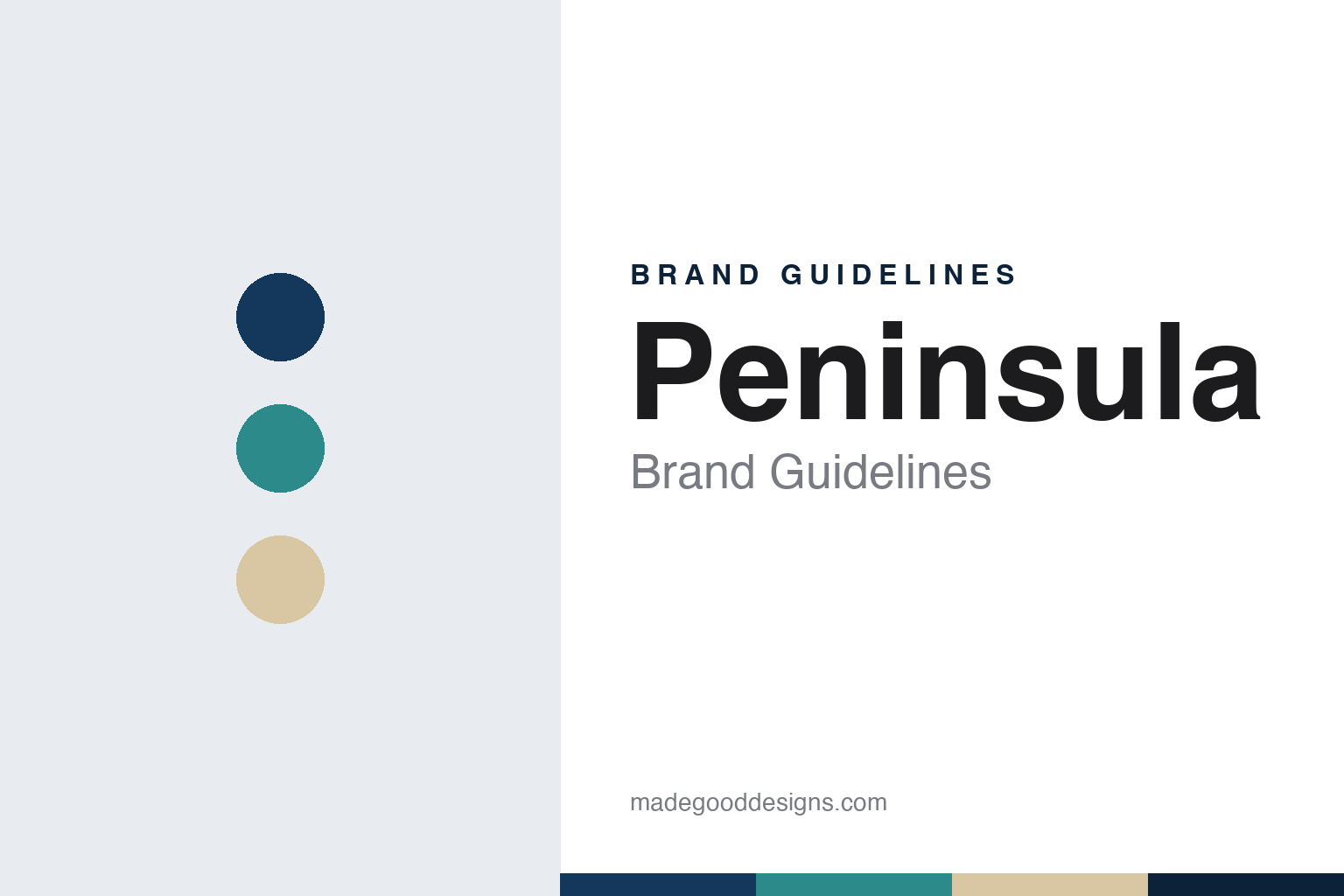
Peninsula Brand Guidelines
The 1996 bunker supplier that dropped “Petroleum” from its name.
Aa
Two constants: a navy, teal and sand palette and an open sans register. Abstract homage — not a Peninsula asset; no vessel, logo or mark is reproduced.
Peninsula Petroleum
A small fuel supplier from 1996, renamed in 2021.
Peninsula is an independent marine fuel supplier — in shipping terms, a bunker supplier — that sells fuel to ships and delivers it alongside them by barge. The company dates its start to 1996: in an anniversary statement carried by Hellenic Shipping News in April 2026, it described itself as a small marine fuel supplier at that time and named John A. Bassadone as its chief executive and founder. gCaptain, reporting in September 2024, called it a “London-based marine fuels supplier” and named Bassadone as its owner.
For most of its history the company traded as Peninsula Petroleum. In May 2021 it dropped the second word. Ship & Bunker reported on 17 May 2021 that the firm would now operate simply as “Peninsula,” that it had changed its logo and launched a new website, and that the rename signalled a shift in focus towards alternative fuels; the trade title had first reported the plan that February. In the company’s statement Bassadone called LNG its transition fuel “at present,” and the firm set out three “core strategic pillars”: customer centricity, sustainability and technology.
The shipping side was later split off. In September 2024 Peninsula moved its shipping operations into a separate company, Hercules Tanker Management, which gCaptain said would run as an independent ship owner managing a fleet of 44 vessels, including deep-sea tankers that had not been part of Peninsula’s fleet. Bassadone told the title that after “almost three decades” in marine energy it was the right time for a specialist tanker company. In its 2026 statement Peninsula calls Hercules its sister company and says vessels owned by and chartered through it carry Peninsula’s deliveries.
Colour
Barges, ports, LNG and biofuel blends.
Peninsula is a physical supplier as well as a seller of fuel. In an interview carried by Hellenic Shipping News in December 2024, chief operating officer Kenny MacLean said the company operated more than 50 barges in more than 25 physical supply hubs. Its 2026 statement gives 21 commercial offices, more than 500 ports supplied, more than 50 physical supply ports and storage sites, and more than 500 employees from over 40 nationalities; those are the company’s own figures.
The network has grown port by port. In September 2025 the South African business site Bizcommunity reported that Peninsula had launched physical supply in Algoa Bay, on South Africa’s south-eastern coast, where the ports of Port Elizabeth and Coega sit. It was working with the local logistics company and barge operator Linsen Nambi, and was set to deliver high-sulphur fuel oil and very low sulphur fuel oil — HSFO and VLSFO in the trade’s shorthand — from that October.
LNG has been its main alternative-fuel line. Peninsula announced an LNG bunkering business early in 2021, Ship & Bunker reported, and in June 2021 the title described a partnership with the Spanish gas company Enagás to build, own and operate a 12,500-cubic-metre LNG bunker vessel in the Strait of Gibraltar. That ship, Levante LNG, has worked in the western Mediterranean since 2023 and is jointly owned with Scale Gas, an Enagás subsidiary, according to the 2024 interview. In September 2024 Bassadone, through Hercules Tanker Management, signed with South Korea’s Hyundai Mipo Dockyard for an 18,000-cubic-metre LNG and bio-LNG bunker vessel due in 2027, according to a company release carried by The Maritime Executive.
Biofuel blends are the second strand. MacLean said in 2024 that Peninsula had supplied biofuel blends at hubs including Singapore and Zeebrugge, with the most common grades in the B20 to B30 range — 20 to 30 per cent bio-component, the rest conventional fuel — and that superyacht owners had shown strong interest in B100. A third strand is ammonia. In July 2026 Peninsula and the Japanese trading house ITOCHU set up a joint venture, I&P Marine Ammonia, to develop ammonia bunkering at European and Mediterranean ports, building on a memorandum of understanding signed in September 2023, according to the announcement carried by Hellenic Shipping News.
Typography
How marine fuel suppliers present themselves.
Marine fuel suppliers sell to a small, technical audience: ship operators, charterers and fuel buyers who order bunkers for a vessel arriving at a given port on a given day. Their identities tend to be simple. Many use a plain wordmark in a single strong colour — often a deep blue, sometimes an orange or a green — with a short symbol beside it, and the name usually says what the company does: bunkering, marine fuels, oil or energy. Several have shortened or changed those names as they add new fuels or change owners.
Photography does much of the work. The companies publish pictures of their own bunker barges and tankers moored alongside container ships, bulk carriers and cruise ships, of hoses and fuel lines at the ship’s side, and of new vessels at their naming ceremonies. Port-coverage maps are the other recurring image: a world map marked with the hubs where a supplier delivers fuel itself and the wider set of ports where it arranges supply through others.
Product pages are written plainly, by fuel grade rather than by brand name: very low sulphur fuel oil (VLSFO), high-sulphur fuel oil (HSFO), marine gasoil (MGO), LNG, and biofuel blends described by their bio-component share, such as B20 or B30. Larger suppliers add pages for their trading desks — buying fuel for delivery across many ports, and managing fuel-price exposure for customers — and for delivery records, including mass flow meters and digital delivery notes.
Sustainability pages have grown alongside these. Suppliers describe the alternative fuels they offer or plan to offer, newer vessels able to run on LNG, and their own codes of conduct, usually in the company’s own words. This guide separates those descriptions from what dated trade-press reports show about each company: who founded it, who owns it, and where it supplies fuel.
Aa
An open, even sans for a renamed supplier. (Specimen set in Manrope, a sans STAND-IN; NOT the Peninsula logo.)
Peninsula
One word instead of two.
The 2021 rename is the clearest brand decision on record. Dropping “Petroleum” from the name signalled a shift in focus towards alternative fuels, Ship & Bunker reported, and the change came with a new logo and a new website at peninsula360.com; the older peninsulapetroleum.com address now redirects there. Bassadone said at the time that it was “vital” for the brand to reflect the company’s vision.
The company’s later statements return to the same themes. Its 2026 anniversary statement speaks of doing business “with integrity, transparency” and of working towards a “zero-carbon future,” and lists a growing range of lower-carbon offers: biofuel infrastructure, LNG and bio-LNG supply and trading, and other alternative marine fuels. Those are the company’s own words; the documented record is the trade-press reporting of its barges, ports, vessels and partnerships.
Peninsula also speaks often through trade-press interviews about fuel supply. In November 2026, ahead of the IBIA annual convention in New York, Ship & Bunker interviewed Jonas Bentsen, the company’s head of physical sales, who advised buyers to plan physical supply three to six months ahead and said that choosing reliable supply partners mattered more to him than price.
For a design guide, Peninsula shows how a supplier can shorten its name to signal a shift towards new fuels while keeping the name customers already knew. Compare Minerva Bunkering, a supplier owned by a commodity trading group, and Monjasa. For this guide we use a harbour navy, a sea teal and a warm sand with a sans, an unofficial interpretation; no product or logo is reproduced.
Explore & save
Keep Peninsula’s identity on hand — save it to a board in the Made Good inspiration library.
Peninsula identity set
Pin the Peninsula navy, teal and sand palette and the open sans register to your own board.


