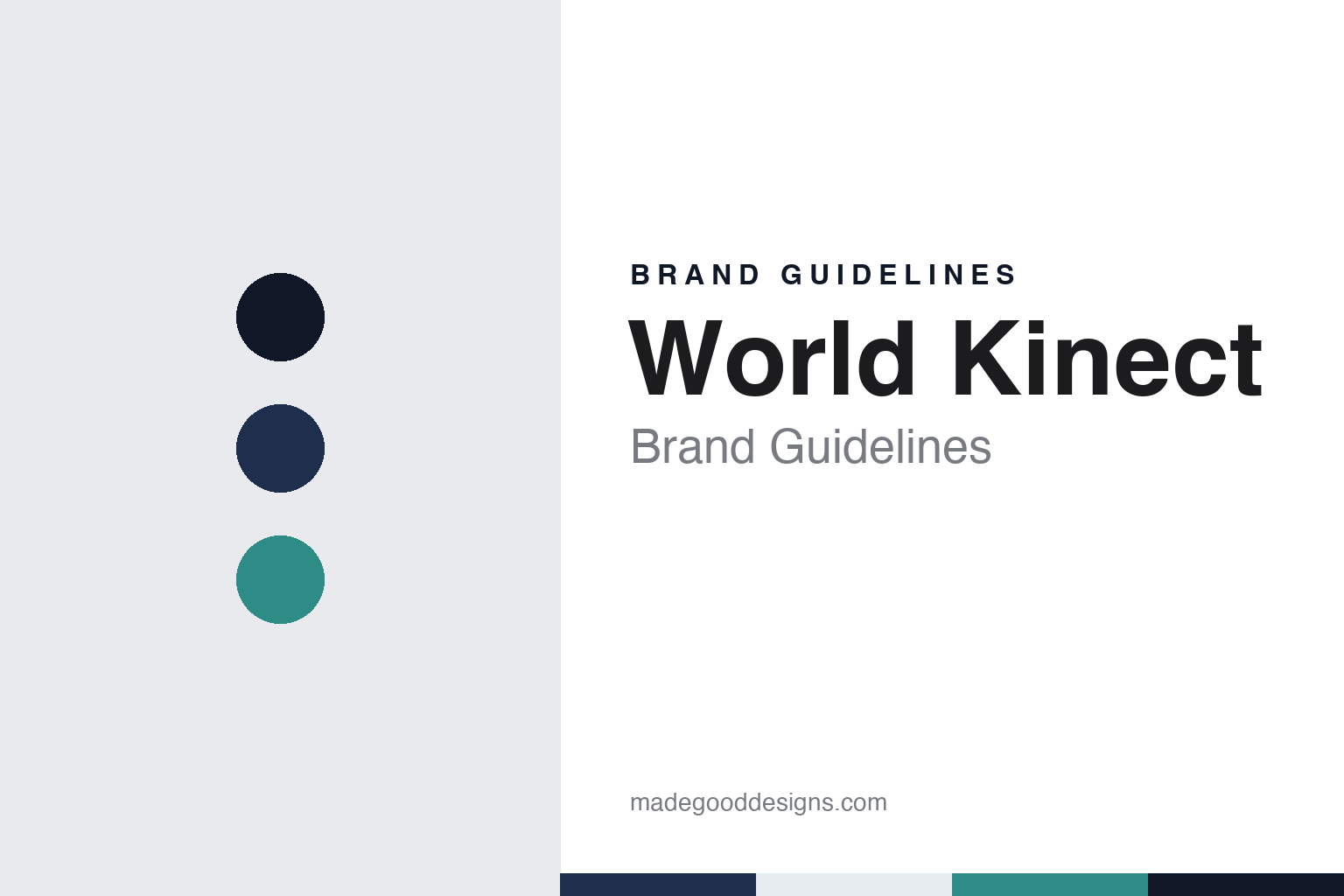
World Kinect Brand Guidelines
A 1984 New York fuel brokerage, a 2023 rename and a 2026 return to World Fuel.
Aa
Two constants: a harbour navy and channel teal palette and a plain corporate sans register. Abstract homage — not a World Kinect or World Fuel product or mark; no logo, livery or nameplate is reproduced.
Trans-Tec, 1984
A New York brokerage and a Miami listed company.
The business now called World Kinect Corporation has two starting points, both in 1984. English Wikipedia says Paul Stebbins and Michael Kasbar founded Trans-Tec Services, a marine fuel brokerage, in New York City that year, and spent the next decade building a network of offices. The company itself, in a release of September 2026, describes Kasbar as the co-founder of Trans Tec Services in 1984, “the marine fuel brokerage business whose acquisition laid the foundation” for the group.
The second starting point was International Recovery Corporation, which Wikipedia says was founded in Miami in 1984 and listed on the New York Stock Exchange in 1986. In 1995 Stebbins and Kasbar sold Trans-Tec to International Recovery, and the listed company took the name World Fuel Services Corporation. The two founders joined its board and ran the marine business before taking on senior corporate roles, according to Wikipedia.
The group then grew from fuel brokerage into a wider energy business. Wikipedia lists acquisitions including U.S. Energy Services in 2013, which became the base of its natural gas and power arm, Kinect Energy, and Avinode, an online marketplace for aircraft charter, in 2014. The company is based in the Miami area: its own releases say Miami, Florida, while Wikipedia places it in Doral, Florida.
Colour
From brokerage to physical supply.
Marine fuel remains one of the group’s core businesses, alongside aviation fuel and land fuels. Wikipedia describes the marine segment as offering bunkering, lubricants and related services, with customers including container and tanker fleets, cruise lines, yachts, offshore operators and car carriers. The company’s marine pages today divide the offer into bunker fuels and LNG, marine lubricants and additives, technical services, physical supply, future fuels and services for the EU emissions trading system.
The group is not only a broker. Its physical-supply page says it supplies marine fuels and lubricants through 18 direct supply locations and a wider global network, with ex-pipe, barge and truck delivery at confirmed locations. It gives two examples: a terminal at Nederland, Texas, where it says it is the exclusive marine fuel supplier, and Gibraltar, where its Gib Oil brand supplies marine gas oil by ex-pipe at the Western Arm Terminal and combined orders by barge. Wikipedia lists Shell Oil Gibraltar among the businesses the group bought between 2010 and 2014.
The company’s brand portfolio, as it presents it in 2026, puts World Fuel at the centre with a short list of specialist names beside it, among them World Fuel | Universal Trip Support for flight planning and trip support, the AVCARD aviation purchasing card, the Flyers commercial fuelling brand and Gib Oil. Flyers came from the 2022 purchase of Flyers Energy Group, Wikipedia says; the trip-support business was added in the fourth quarter of 2025 from Universal Weather and Aviation, the company says.
Its customers are spread across markets that rarely share a brand. The company names aviation, marine, gasoline and diesel, and natural gas among its markets, and says it serves customers in more than 200 countries and territories.
Aviation is the other large side of the business. Wikipedia describes the aviation segment as supplying fuel and related services to commercial airlines, cargo carriers, airports, fixed-base operators, corporate fleets and government aircraft. It also says the group is made up of more than 185 subsidiaries, mainly in the United States, the United Kingdom, Singapore, the Netherlands, Sweden and Costa Rica. In its first-quarter 2026 results the company referred to the sale of its UK land business as part of a wider simplification of its portfolio.
Typography
Design and documentation.
Marine fuel suppliers sell to a small, technical audience: ship operators, charterers and fuel buyers who order bunkers for a vessel arriving at a given port on a given day. Their identities tend to be simple. Many use a plain wordmark in a single strong colour — often a deep blue, sometimes an orange or a green — with a short symbol beside it, and the name usually says what the company does: bunkering, marine fuels, oil or energy. Several have shortened or changed those names as they add new fuels or change owners.
Photography does much of the work. The companies publish pictures of their own bunker barges and tankers moored alongside container ships, bulk carriers and cruise ships, of hoses and fuel lines at the ship’s side, and of new vessels at their naming ceremonies. Port-coverage maps are the other recurring image: a world map marked with the hubs where a supplier delivers fuel itself and the wider set of ports where it arranges supply through others.
Product pages are written plainly, by fuel grade rather than by brand name: very low sulphur fuel oil (VLSFO), high-sulphur fuel oil (HSFO), marine gasoil (MGO), LNG, and biofuel blends described by their bio-component share, such as B20 or B30. Larger suppliers add pages for their trading desks — buying fuel for delivery across many ports, and managing fuel-price exposure for customers — and for delivery records, including mass flow meters and digital delivery notes.
Sustainability pages have grown alongside these. Suppliers describe the alternative fuels they offer or plan to offer, newer vessels able to run on LNG, and their own codes of conduct, usually in the company’s own words. This guide separates those descriptions from what dated trade-press reports show about each company: who founded it, who owns it, and where it supplies fuel.
Aa
A plain corporate sans — World Fuel in front, World Kinect on the listing. (Specimen set in Inter Tight, a sans STAND-IN; NOT the World Fuel or World Kinect logo.)
World Fuel
A 2023 rename, reversed in 2026.
The name has changed twice in three years. In June 2023 the company announced that World Fuel Services Corporation would become World Kinect Corporation; after shareholders approved the change at its 2023 annual meeting, it began trading under the ticker WKC on 16 June 2023, Wikipedia says.
The reversal came on 23 April 2026. With its first-quarter results, the company announced that it was realigning its corporate brand to its core commercial brand, World Fuel, which would serve as its unified brand “for substantially all internal and external purposes,” effective immediately. World Kinect remains its legal name, and the shares still trade as WKC. Chief executive Ira M. Birns called the move “a return to our roots” and said World Fuel “is the name by which our customers and suppliers know us.” Its releases since then describe “World Kinect Corporation (NYSE: WKC), operating as World Fuel,” and the world-kinect.com address now forwards to worldfuel.com.
Leadership is changing as well. In September 2026 the company announced that Kasbar would step down as executive chairman and that Ken Bakshi, a director since 2002, would become chairman, both with effect from 31 December 2026; Birns remains chief executive. The company describes World Fuel as a global fuel distribution and logistics company working across air, land and marine markets.
For a design guide, World Kinect shows how a company can keep one name for its legal entity and its listing while customers see another. Compare Peninsula and Integr8 Fuels, two other names in marine fuel. For this guide we use a harbour navy and a channel teal with a sans, an unofficial interpretation; no product or logo is reproduced.
Explore & save
Keep World Kinect’s identity on hand — save it to a board in the Made Good inspiration library.
World Kinect identity set
Pin the World Kinect harbour navy and channel teal palette and the plain corporate sans register to your own board.