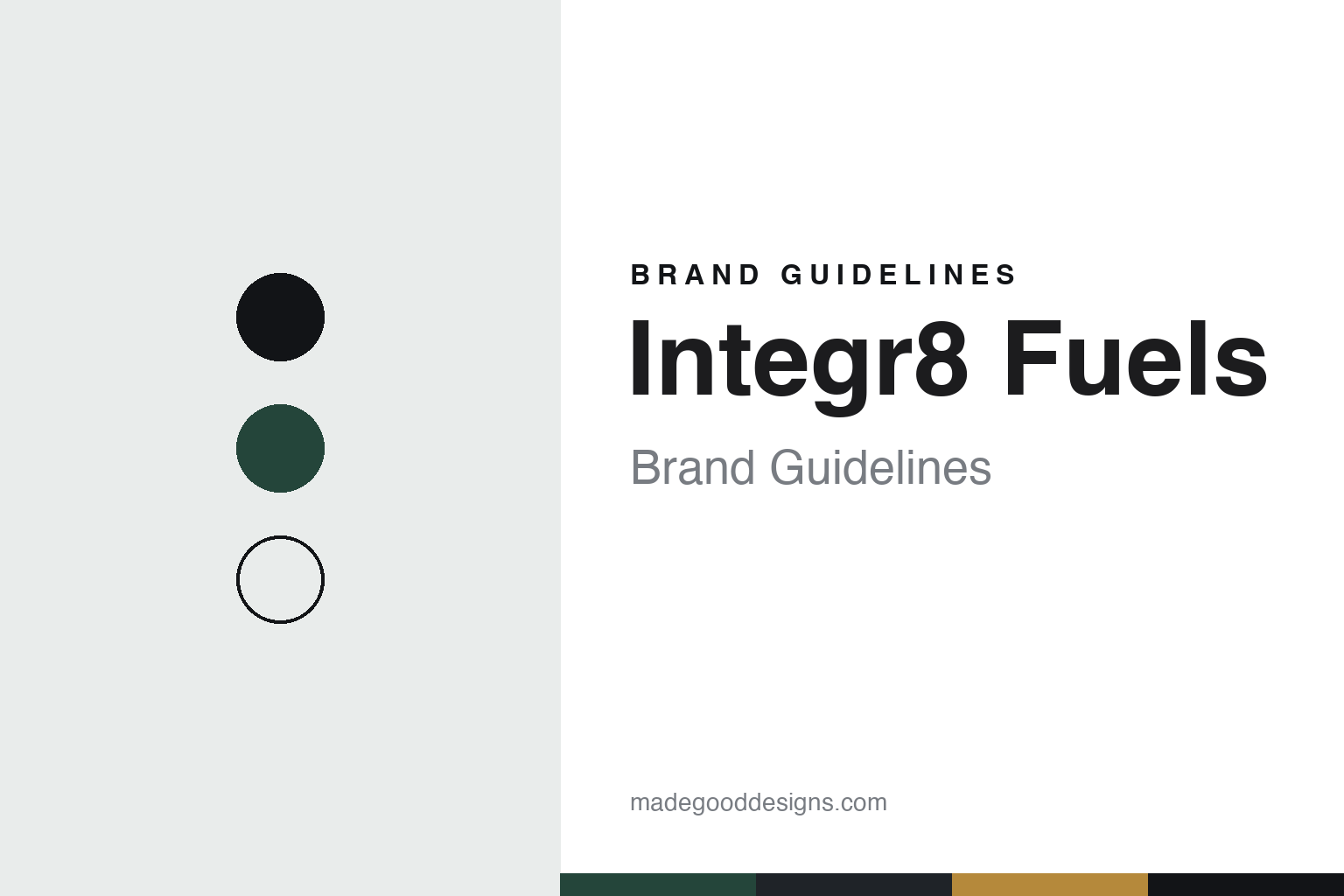
Integr8 Fuels Brand Guidelines
A shipowner’s fuel-buying desk that became a global bunker trader.
Aa
Two constants: a pine, graphite and brass palette of our own and a light editorial serif register. Abstract homage — not an Integr8 Fuels product or mark; no logo, vessel or document is reproduced.
A shipowner’s buying desk
Launched in 2011 inside Navig8.
Integr8 Fuels is a bunker trading company that began as the fuel-buying arm of a shipping group. Its own website says it launched in 2011, and Ship & Bunker’s profile of 6 February 2026 gives the same year, describing Integr8 as the marine fuel procurement arm of Navig8 Group, a shipping operations and commercial management group. At the time of that profile, the publication said, Navig8 had more than 80 vessels under management, more than 30 owned vessels, six shipping pools and more than 35 pool partners.
That origin explains the way the company talks about itself. Integr8 says its roots lie in the shipping industry and that it sees the market “through the lens of the shipowner.” Ship & Bunker reports that it handles all fuel procurement for the Navig8 fleet while also serving more than 950 third-party customers, managed by a team of about 65 traders around the world. The company says it supplies more than 5,000 vessels a year through more than 450 vetted suppliers, and that it offers 30-day payment terms as standard by pooling demand across its customers.
The ownership above it changed in 2025. On 8 January 2025, Ship & Bunker reported that the UAE-based ADNOC Logistics & Services had completed its purchase of 80% of Navig8’s parent holding company. The remaining 20% is due to follow in mid-2027, so at the time of writing that second step is still to come. Ship & Bunker’s 2026 profile describes ADNOC L&S as holding 80% of Integr8’s parent, with the rest expected to be acquired in 2027.
Colour
Offices, ports and fuel grades.
Integr8 works as a trader: the company says it buys through a curated network of suppliers and arranges fuel for owners and operators in the ports they call at. Its website groups the work into bunker trading, sustainable biofuels, a fuel management service, advisory work and regulatory compliance, the last covering the EU Emissions Trading System, FuelEU Maritime and the sourcing of EU allowances. The site keeps price pages for three fuel grades, HSFO, VLSFO and MGO, and port pages for hubs such as Singapore, Rotterdam, Fujairah, Gibraltar, Balboa and Zhoushan.
The office network has grown outward from the shipping hubs. Ship & Bunker’s 2026 profile lists 15 offices, among them Singapore, London and Dubai, with others in Athens, Oslo, Hamburg, Houston, New York, Rio de Janeiro, Cape Town, Mumbai, Shanghai, Taiwan, Tokyo and Perth; the company’s own about page gives a figure of 13. Two of those openings were reported as firsts for the firm. In October 2023 it opened in Rio de Janeiro, its first office in Brazil, having served South America from its US offices until then. In March 2024 it opened in Perth, its first office in Australasia, saying it would work with local physical suppliers holding ISCC certification.
Digital tools are a large part of the pitch. Integr8 has worked with ENGINE, a bunker procurement platform also owned by Navig8, since shortly after ENGINE launched in 2020, according to Ship & Bunker, and the company offers its own Integr8 mobile app for clients. It also says its buying teams are linked by custom-built intelligence tools and that its traders are available around the clock. The same profile notes that Integr8 sits on the technical and future-fuels working groups of IBIA, the bunker industry association. Ship & Bunker reported in October 2025 that the firm’s newly appointed technical manager would lead its training work and maintain its ISO 9001 and ISCC certification.
Typography
How marine fuel suppliers present themselves.
Marine fuel suppliers sell to a small, technical audience: ship operators, charterers and fuel buyers who order bunkers for a vessel arriving at a given port on a given day. Their identities tend to be simple. Many use a plain wordmark in a single strong colour — often a deep blue, sometimes an orange or a green — with a short symbol beside it, and the name usually says what the company does: bunkering, marine fuels, oil or energy. Several have shortened or changed those names as they add new fuels or change owners.
Photography does much of the work. The companies publish pictures of their own bunker barges and tankers moored alongside container ships, bulk carriers and cruise ships, of hoses and fuel lines at the ship’s side, and of new vessels at their naming ceremonies. Port-coverage maps are the other recurring image: a world map marked with the hubs where a supplier delivers fuel itself and the wider set of ports where it arranges supply through others.
Product pages are written plainly, by fuel grade rather than by brand name: very low sulphur fuel oil (VLSFO), high-sulphur fuel oil (HSFO), marine gasoil (MGO), LNG, and biofuel blends described by their bio-component share, such as B20 or B30. Larger suppliers add pages for their trading desks — buying fuel for delivery across many ports, and managing fuel-price exposure for customers — and for delivery records, including mass flow meters and digital delivery notes.
Sustainability pages have grown alongside these. Suppliers describe the alternative fuels they offer or plan to offer, newer vessels able to run on LNG, and their own codes of conduct, usually in the company’s own words. This guide separates those descriptions from what dated trade-press reports show about each company: who founded it, who owns it, and where it supplies fuel.
Aa
A light editorial serif — the register of the company’s research pages. (Specimen set in Newsreader, a serif STAND-IN; NOT the Integr8 Fuels logo.)
Integr8
Research as a calling card.
Much of the company’s public voice is research. Its website publishes a weekly bunker market update, research articles, webinars and a twice-yearly Bunker Quality Trends report. Ship & Bunker covered the October 2026 edition, which analysed delivered fuel-quality data from February to July 2026 and argued that global averages were masking differences between local fuel pools; ultra-low-sulphur fuel oil was the main exception to otherwise stable results, with quality notifications rising to 6.7% from 3.1%, the report said.
Volumes have moved with the market. Ship & Bunker reported traded volumes of 6.0 million tonnes in 2025, against 6.3 million tonnes in each of 2023 and 2024, and said the company sees the small decline as in line with wider market conditions. The managing director is Tushar Gole, the profile said.
The name follows the pattern of its parent: Integr8 and Navig8 both replace the “-ate” ending with the figure 8. The website pairs a light serif, ABC Arizona Serif, with the sans Post Grotesk, according to the font files it loads, and its menus lead with services, fuel grades, port names and research.
For a design guide, Integr8 Fuels shows how a trading desk born inside a tanker group can build a brand on port pages, fuel-grade data and its own research, under a short coined name that matches its parent. Compare it with KPI OceanConnect, another hybrid trading brand with a London base, and with Bunker Holding, the Danish group behind KPI OceanConnect. For this guide we use pine, graphite and brass on fog with a serif, an unofficial interpretation; no product or logo is reproduced.
Explore & save
Keep Integr8 Fuels’s identity on hand — save it to a board in the Made Good inspiration library.
Integr8 Fuels identity set
Pin the pine, graphite and brass palette and the light editorial serif register to your own board.