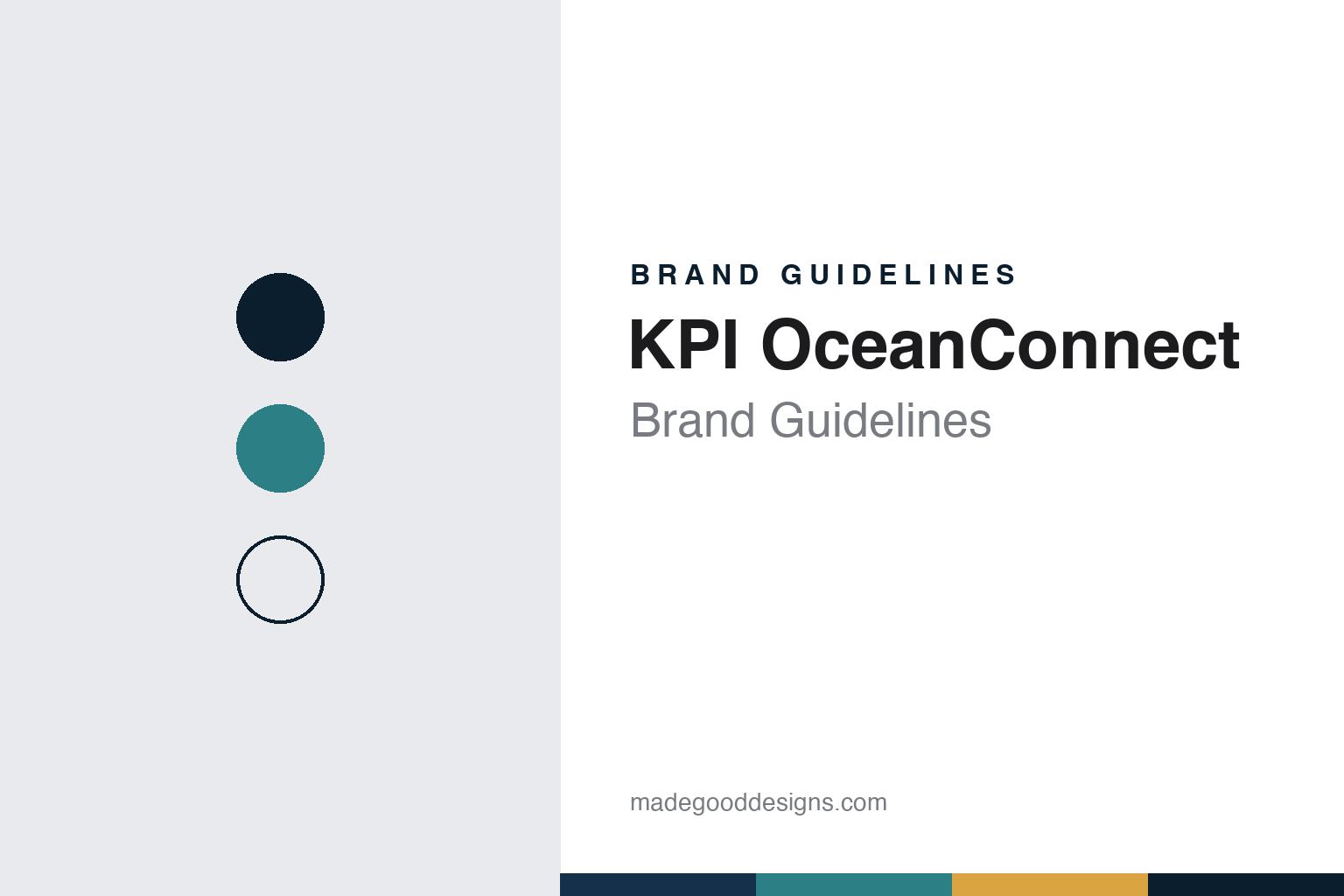
KPI OceanConnect Brand Guidelines
A 2020 merger of brokers and traders, run from London inside a Danish group.
Aa
Two constants: a navy, teal and amber palette of our own and a rounded corporate sans register. Abstract homage — not a KPI OceanConnect product or mark; no logo, vessel or document is reproduced.
Nine firms, one name
From a 1971 brokerage to a 2020 merger.
KPI OceanConnect is a marine fuels trading and broking business based in London, and its name records a merger. Ship & Bunker, in a company profile published on 6 February 2026, describes it as a hybrid broker and trader that was known as KPI Bridge Oil until it merged with OceanConnect Marine in 2020. The company’s own history timeline gives the same year, and it presents the business as built on the heritage of nine formerly independent companies.
That timeline begins in 1971 with KPI Oil Associates, which the company calls one of the first marine fuel brokerage firms in the United States, and with a first deal for Bunker “C” fuel oil at Pointe-à-Pierre in Trinidad. It continues with Bridge Oil in 1979, which the company says first traded oil, coal and other commodities from offices in London, Rotterdam, Piraeus, Istanbul, Odessa, Hong Kong and Singapore. OceanConnect follows in 2000, Clarkson’s Bunker Group in 2002, the Marine Oil Broking Co in 2003 and Davies & Newman Wake in 2008, a broker the company dates back to 1922. Trumf Bunker joined in 2015 and the South Korean trading house KTB in 2016, according to the same page.
The owner is Bunker Holding, the group founded in 1981 in Middelfart, Denmark, by Torben Østergaard-Nielsen. Ship & Bunker calls Bunker Holding the largest marine fuels firm by sales volumes and the flagship subsidiary of the United Shipping & Trading Company (USTC), a family-owned Danish group established in 1876. Within that group, the profile says, fuel is sold through individually branded trading, broking and supply companies that compete with each other as well as with the rest of the market. Ship & Bunker lists KPI OceanConnect among the group’s most significant subsidiaries, next to Dan-Bunkering, Glander International Bunkering and the physical supplier Bunker One.
Colour
Brokers, traders and a key-accounts arm.
The group has reshaped the brand several times since the merger. In September 2022, gCaptain reported that Bunker Holding’s key-account management unit, BOGA, would join KPI OceanConnect and operate under the KPI OceanConnect name, a change it linked to the group strategy “Fueling the Future,” launched that spring. Ship & Bunker’s 2026 profile says KPI OceanConnect still contains the group’s key accounts unit, now called KPI OceanConnect Global Accounts. The same profile notes that AuctionConnect, a digital bunker-purchasing service that runs online auctions, began inside OceanConnect Marine, passed to KPI OceanConnect and was later spun out as a business of its own.
The most recent step came in the eastern Mediterranean. Bunker Holding announced in November 2025 that the Baseblue brand’s operations there would merge into KPI OceanConnect, Ship & Bunker reported, after an earlier combination of the two brands in Hong Kong. The company said that from 15 January 2026 Baseblue Ltd changed its name to KPI OceanConnect (Cyprus) Ltd, completing the integration, with customer and supply agreements continuing unchanged.
What the company sells is set out plainly on its website: marine fuels, marine lubricants, alternative fuels, risk management, physical supply and compliance work around the EU Emissions Trading System and FuelEU Maritime. It calls its model “back to back plus,” meaning it offers both broking and trading rather than one or the other. Its contact pages list fifteen offices, from Athens, Limassol and Istanbul to Houston, Seattle, Buenos Aires, Seoul and Tokyo. The Tokyo office opened in September 2024 as its fifth in Asia, according to a company announcement carried by Hellenic Shipping News.
The company also points to its alternative-fuels work. Ship & Bunker reported in January 2025 that KPI OceanConnect, the Finnish refiner Neste and Global Energy Trading had delivered HVO100, a hydrotreated vegetable oil, to a cruise ship at the Singapore Cruise Terminal in November 2024, using a chemical tanker because such vessels may carry biofuel blends above B25 in Singapore. Its website also runs a yearly giving campaign called “50for50,” which a 2022 company release said had been launched in the 2021/22 financial year.
Typography
How marine fuel suppliers present themselves.
Marine fuel suppliers sell to a small, technical audience: ship operators, charterers and fuel buyers who order bunkers for a vessel arriving at a given port on a given day. Their identities tend to be simple. Many use a plain wordmark in a single strong colour — often a deep blue, sometimes an orange or a green — with a short symbol beside it, and the name usually says what the company does: bunkering, marine fuels, oil or energy. Several have shortened or changed those names as they add new fuels or change owners.
Photography does much of the work. The companies publish pictures of their own bunker barges and tankers moored alongside container ships, bulk carriers and cruise ships, of hoses and fuel lines at the ship’s side, and of new vessels at their naming ceremonies. Port-coverage maps are the other recurring image: a world map marked with the hubs where a supplier delivers fuel itself and the wider set of ports where it arranges supply through others.
Product pages are written plainly, by fuel grade rather than by brand name: very low sulphur fuel oil (VLSFO), high-sulphur fuel oil (HSFO), marine gasoil (MGO), LNG, and biofuel blends described by their bio-component share, such as B20 or B30. Larger suppliers add pages for their trading desks — buying fuel for delivery across many ports, and managing fuel-price exposure for customers — and for delivery records, including mass flow meters and digital delivery notes.
Sustainability pages have grown alongside these. Suppliers describe the alternative fuels they offer or plan to offer, newer vessels able to run on LNG, and their own codes of conduct, usually in the company’s own words. This guide separates those descriptions from what dated trade-press reports show about each company: who founded it, who owns it, and where it supplies fuel.
Aa
A rounded corporate sans — the register of the company’s website. (Specimen set in Ubuntu, a sans STAND-IN; NOT the KPI OceanConnect logo.)
KPI OceanConnect
A trading brand inside a Danish group.
Leadership has turned over with the group’s reorganisations. Ship & Bunker reported on 16 September 2026 that Thomas Lee, head of the Asia-Pacific region at KPI OceanConnect since 2023, would become brand head, while Dorthe Bendtsen, who had led the company since November 2024, first on an interim basis and permanently from May 2025, moved to a new group role as sales operations director. Her predecessor, Anders Grønborg, had moved to the group’s chief commercial officer post in November 2024, the same report said.
The visual identity is a corporate one. The website sets its text in Ubuntu, loaded from Google Fonts, and organises the brand under plain headings: who we are, what we do, ESG, insights and careers. Its values are listed as four words, partnership, innovation, passion and inclusivity. The home page leads with counters for years in business, trades a year and tonnes a year, and its market commentary sits under a section called Market Pulse, with a dashboard readers can sign up for.
For a design guide, KPI OceanConnect shows how a merged trading brand keeps one compound name and a sober sans while its owner moves units in and out behind it. Compare it with its parent, Bunker Holding, and with Glander International Bunkering, another trading brand in the same group. For this guide we use harbour navy, deep sea, sounding teal and signal amber on chart paper with a rounded sans, an unofficial interpretation; no product or logo is reproduced.
Explore & save
Keep KPI OceanConnect’s identity on hand — save it to a board in the Made Good inspiration library.
KPI OceanConnect identity set
Pin the navy, teal and amber palette and the rounded corporate sans register to your own board.