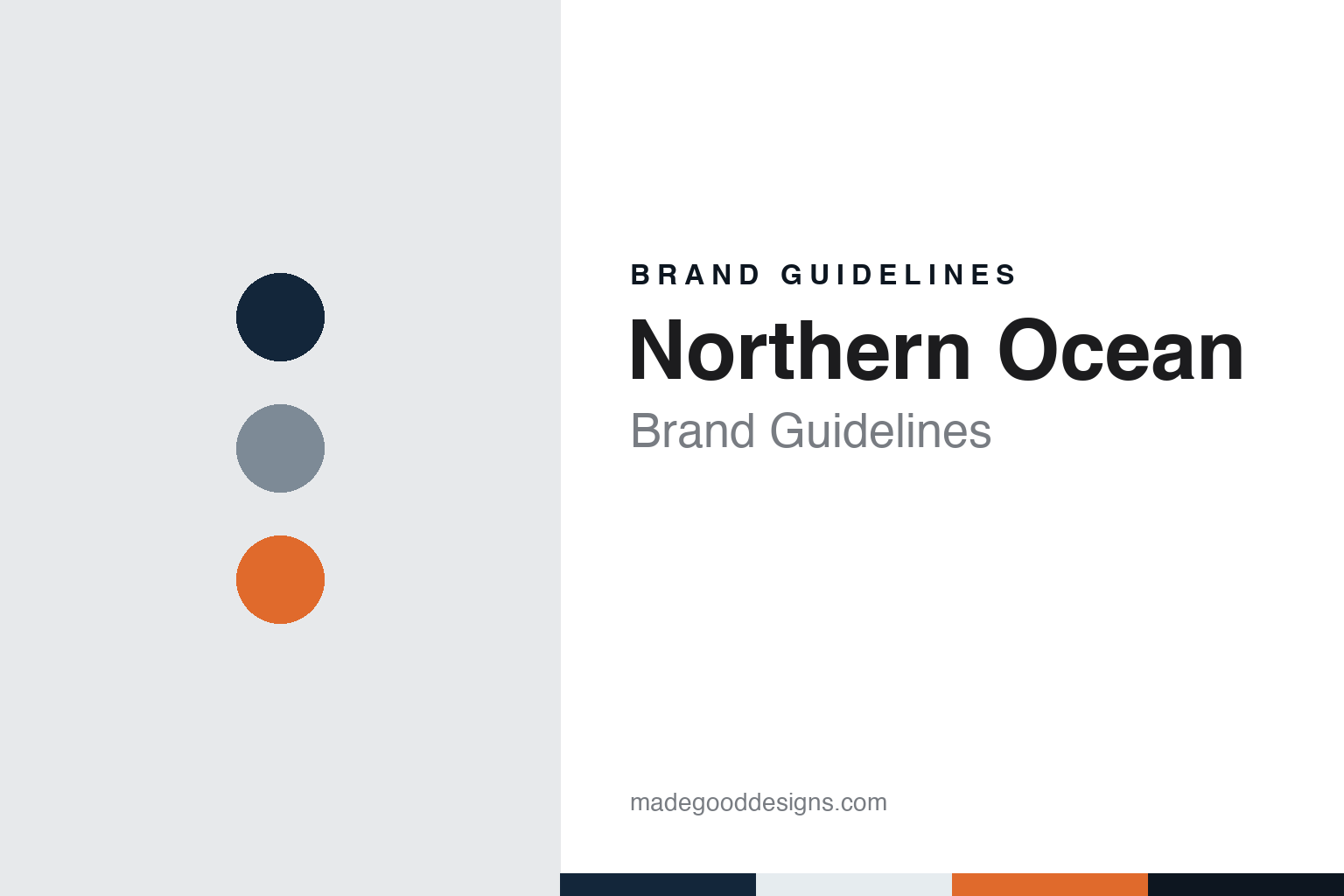
Northern Ocean Brand Guidelines
A 2017 Bermuda rig owner built around two harsh-environment semisubmersibles.
Aa
Two constants: a navy, steel grey and signal orange palette and an engineered sans register. Abstract homage — not a Northern Ocean asset or mark; no rig, logo or nameplate is reproduced.
Northern Ocean
A Bermuda company formed to own harsh-environment rigs.
Northern Ocean Ltd was incorporated in Bermuda on 3 March 2017, according to its 2025 annual report, with a single stated purpose: offshore contract drilling for the oil and gas industry in harsh environments, carried out through owning the drilling rigs themselves. The company gives Hamilton, Bermuda, as the place of its stock-exchange notices, and its shares trade on the Oslo Stock Exchange under the ticker NOL.
Its fleet began with two sixth-generation semisubmersibles, West Mira and West Bollsta, which were delivered to the company in December 2018 and June 2019, its 2021 financial statements say. Both were later renamed, becoming Deepsea Mira and Deepsea Bollsta. The 2025 annual report says the shares began trading on 9 December 2019; the 2021 statements date the start of trading on the Oslo Børs to 27 February 2020.
In their first years the rigs worked in Norway under contracts run through subsidiaries of Seadrill. West Mira began a contract with Wintershall Norge in November 2019, and West Bollsta began a ten-well contract with Lundin Energy Norway in October 2020, according to the 2021 statements.
In December 2021 Northern Ocean agreed to hand the marketing and management of its fleet to Odfjell Drilling, while keeping commercial chartering decisions for itself. After the Lundin contract ended on 1 March 2022, both rigs were warm stacked at Hanøytangen, outside Bergen, under Odfjell management, the same statements say. It is a small company on paper: at the end of 2021 it reported three employees, according to the same statements.
Colour
Two Moss Maritime CS60 semisubmersibles.
Both rigs are based on the Moss Maritime CS60 design. The company describes Deepsea Mira as able to drill in water depths of up to 10,000 feet, compliant for work on the Norwegian Continental Shelf and fully winterised, so that it can be sent to harsh-environment areas around the world. Its website pairs that specification with a 360-degree online tour of the rig.
From 2022 the two rigs worked further afield. Deepsea Mira drilled off Namibia for a subsidiary of TotalEnergies until May 2025, then began work for Rhino Resources in July 2025, and started a contract with a subsidiary of Shell on 29 March 2026, according to the 2025 annual report. Deepsea Bollsta completed a one-well contract in Namibia for a Chevron subsidiary in January 2025 before moving back to Norway, where it worked for OMV Norge and then began a long-term contract with Equinor.
That Equinor contract was reported at the time it was signed. In November 2024 the Trend News Agency reported that Equinor had agreed a two-year firm contract with Northern Ocean Wind AS, part of Northern Ocean Ltd, to use Deepsea Bollsta on the Norwegian continental shelf, starting in the latter part of 2025 with options for five further one-year extensions. Trend added that the rig would be operated by Odfjell Drilling, and described it as a sixth-generation, winterised rig designed for harsh environments.
Deepsea Mira’s order book has continued to grow. On 2 October 2026 Northern Ocean announced another contract with a Shell subsidiary, for a programme in Trinidad and Tobago and the wider Caribbean. Work is expected to begin in April 2027, with a firm term of about 150 days and an optional one-year programme in the same region; the company named Odfjell Drilling as its operating partner on the job.
Typography
Rigs, fleet pages and investor notices.
Offshore drilling contractors sell time on rigs rather than goods in a shop, so their public identity is built around the fleet. Their websites tend to pair plain corporate wordmarks, often in navy, red or orange, with large photographs of drillships, semisubmersibles and jack-ups at sea, published by the companies themselves.
The rig is the working unit of the brand. Contractors commonly give each rig its own page with a short run of specifications: the design, the water depth it is rated for, how deep it can drill, how many people it can house, and where and for whom it is working. Shelf Drilling’s fleet page, for example, gives every one of its jack-ups the same set of fields. Rig names often share a prefix or a word, so that the company name travels with each unit from contract to contract.
Fleet-status reports are the other recurring document, listing rigs with their current customers, locations and contract periods for investors and clients. When Noble Corporation completed its acquisition of Diamond Offshore in September 2024, it published an updated fleet status report alongside the announcement, The Maritime Executive reported. Operating-region maps sit next to them, placing rigs in waters from the North Sea to West Africa and Southeast Asia.
Investor pages complete the picture, because the sector has been reshaped by restructurings and mergers. Diamond Offshore went through Chapter 11 in 2020 and 2021 and became part of Noble in 2024; Shelf Drilling became part of ADES in 2025. For designers, these companies show a corporate identity carried by rig names, specification sheets, fleet reports and maps rather than by packaging or retail.
Aa
An engineered sans for a specification-led company. (Specimen set in Archivo, a sans STAND-IN; NOT the Northern Ocean logo.)
One rig, one main shareholder
Deepsea Bollsta sold, Deepsea Mira kept.
The fleet is now a single rig. On 17 November 2025 Northern Ocean announced an agreement to sell Deepsea Bollsta to a subsidiary of Odfjell Drilling, subject to regulatory approval in Norway, and on 15 December 2025 it announced that the sale had closed; the company said it used the proceeds to repay its bank loan and reduce its other borrowing. Its 2025 annual report names Deepsea Mira as the only rig it owns, working off Namibia for a Shell subsidiary at the time of the report and expected to stay in West Africa through that contract.
Ownership has narrowed too. Hemen Holding Limited, which Northern Ocean describes as its main shareholder, made a mandatory offer for the remaining shares in 2024 and finished with about 54.3 per cent, the company announced in August 2024. After Hemen crossed the 50 per cent threshold again in July 2026, a second mandatory offer ran from 12 August to 9 September 2026. When it closed, Northern Ocean announced a preliminary result under which Hemen would hold about 83 per cent of the shares. In October 2026 the company announced a private placement and a refinancing, and its shares remain listed in Oslo.
The company presents itself in a restrained, investor-facing way. Its website opens with the line “Delivering value through active management of harsh-environment offshore drilling assets,” followed by a rig page with specifications, the online rig tour, quarterly and annual reports, prospectuses and a long run of stock-exchange notices headed “NOL:”. Its remaining rig carries the Deepsea prefix, the same one Trend used for the Odfjell-managed rigs Deepsea Aberdeen, Deepsea Atlantic and Deepsea Stavanger.
For a design guide, Northern Ocean shows how a rig-owning company with one semisubmersible can present itself almost entirely through specifications and investor notices. Compare Odfjell Drilling, which manages Deepsea Mira and now owns its former sister rig, and Seadrill, whose subsidiaries ran its first Norwegian contracts. For this guide we use a deep North Sea navy, a cold steel grey and a signal orange with a sans, an unofficial interpretation; no product or logo is reproduced.
Explore & save
Keep Northern Ocean’s identity on hand — save it to a board in the Made Good inspiration library.
Northern Ocean identity set
Pin the Northern Ocean navy, steel grey and signal orange palette and the engineered sans register to your own board.