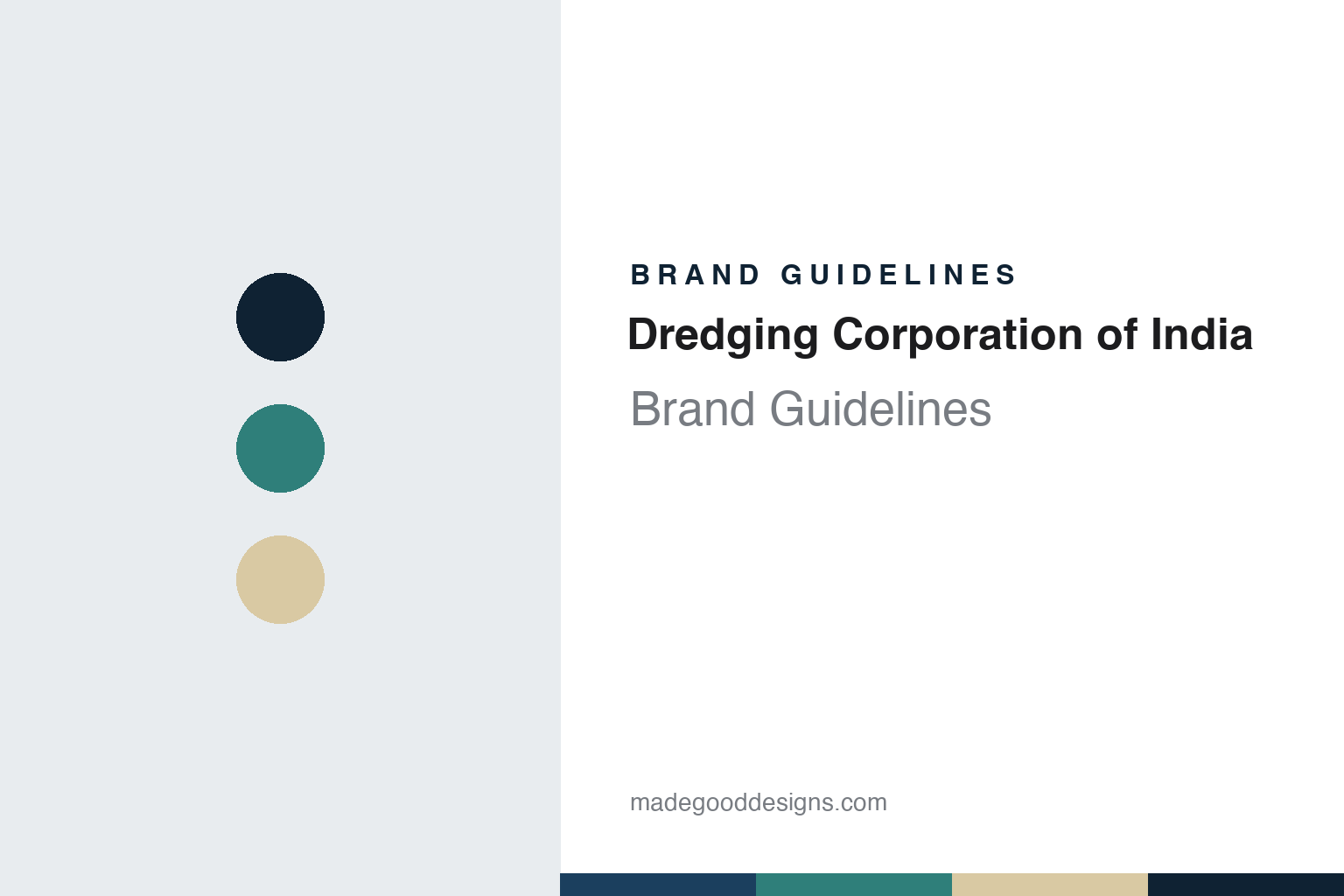
Dredging Corporation of India Brand Guidelines
A Visakhapatnam dredging company of 1976, now owned by four Indian ports.
Aa
Two constants: a harbour navy, sea teal and sand palette and an engineering sans register. Abstract homage — not a Dredging Corporation of India vessel or mark; no ship, logo or livery is reproduced.
Visakhapatnam, 1976
A public-sector dredging company for India’s major ports.
The Dredging Corporation of India, usually shortened to DCI and in recent press to DCIL, was incorporated as a public-sector company in March 1976 under India’s Companies Act of 1956, according to English Wikipedia. The company says it was set up that year to provide dredging services to the country’s Major Ports, and its head office is in Visakhapatnam, on India’s east coast. Its home page carries the line “Dredging for Progress” and a “50 Years Experience” badge.
Its work is the routine business of keeping harbours open. The company describes maintenance dredging to hold the depths of shipping channels for major and minor ports, the Indian Navy and fishing harbours along what it gives as a 7,500-kilometre coastline, and capital dredging to create new harbours or deepen existing ones. English Wikipedia says almost all maintenance dredging at Indian seaports is carried out by DCI because of government rules, and that it works occasionally at foreign ports, naming Sri Lanka, Taiwan and Dubai. Its service pages add land reclamation, beach nourishment, inland waterways, shallow-water and reservoir de-siltation, and project consultancy.
The ownership has changed in stages. Wikipedia records listings on the Calcutta and Delhi exchanges in October 1992, a debut on the Bombay Stock Exchange on 28 February 2000 and a public offer in March 2004. On 1 November 2017 the Government of India approved the disinvestment of the company, and on 8 November 2018 it approved the sale of its stake to four government-owned ports. The company says the government transferred its entire holding of 73.47 per cent, with management control, on 8 March 2019: 19.47 per cent to the Visakhapatnam Port Trust and 18 per cent each to the Jawaharlal Nehru, Paradip and Deendayal port trusts. The company says its shares are still listed in Mumbai and Calcutta and on the National Stock Exchange, and The New Indian Express described it in October 2025 as operating under that consortium of four major ports.
Colour
A fleet named by number.
DCI’s fleet is its most visible face. English Wikipedia groups it into trailing suction hopper dredgers, cutter suction dredgers and a backhoe dredger, with names that follow one pattern: DCI Dredge VI, VIII, IX and onward to DCI Dredge XXI among the hopper dredgers, DCI Dredge VII, Aquarius and XVIII among the cutters, and survey launches numbered I to III. The company’s own profile counts two cutter suction dredgers, ten trailer suction dredgers, one backhoe dredger, one inland dredger and ancillary craft; BusinessLine reported in September 2026 that DCI had 13 vessels.
The fleet page reads like a specification sheet. DCI Dredge VIII is listed as built in 1977 with a hopper capacity of 6,500 cubic metres; the backhoe dredger DCI Dredge BH-1, built by the De Donge yard in the Netherlands, was taken over on 22 November 2011; and DCI ID Ganga, an inland cutter suction dredger, is registered at Kakinada in Andhra Pradesh. For beach nourishment, the company says, Dredge-XVI to Dredge-XXI can pump sand ashore over distances of up to 2,500 metres and can also discharge by rainbowing.
The newest ship is the DCI Dredge Godavari, a 12,000-cubic-metre trailing suction hopper dredger built by Cochin Shipyard with technical and design support from Royal IHC of the Netherlands. The New Indian Express reported that it was launched at Cochin on 18 October 2025 and called it the first 12,000-cubic-metre Beagle Series dredger built anywhere; in March 2026 the paper gave its length as about 127 metres and its dredging depth as up to 36 metres. In September 2026 BusinessLine reported that the ship was expected to join the fleet during 2026–27, and that DCI had begun a programme to acquire 11 more dredgers over five years for port and inland-waterway work.
Typography
How dredging contractors present themselves.
Dredging and marine contracting is a business mostly seen from the shore. A trailing suction hopper dredger working a port channel, or a cutter suction dredger anchored off a reclamation site, is often the only public sign of a contractor, so the hull itself does much of the brand work: a strong field colour such as orange, red or blue, with the company’s wordmark painted large along the side so it reads from a quay or a news photograph.
The companies’ own websites tend to follow a shared pattern. Photographs of dredgers at work, as the firms publish them, sit beside fleet pages that sort the vessels by type, hopper dredgers, cutter suction dredgers, backhoe dredgers and support craft, each with a specification sheet of length, hopper capacity and dredging depth. Ship names are part of the identity too, whether a numbered series or a run of river and place names.
Project-reference pages carry the rest of the story. Rather than advertising, these firms describe what they have built or deepened: land reclamation, port deepening, channel maintenance, beach nourishment and coastal works, usually grouped by region or by type of work and illustrated with aerial views. Larger groups that also build roads, bridges and buildings sort a very mixed portfolio into categories so that a dredging job and a bridge contract sit side by side.
Because many clients are port authorities and governments, the most practical pages are often the plainest: tender notices, archives of completed contracts, investor and stock-exchange filings, and annual reports. For a designer, the useful lesson is how much of a marine contractor’s identity lives in operational material, vessel livery, fleet lists and contract pages, and how a restrained palette and a clear sans can hold that material together.
Aa
An engineering sans — plain, numbered and technical. (Specimen set in IBM Plex Sans, a sans STAND-IN; NOT the Dredging Corporation of India logo.)
Dredging Corporation of India
A public-sector name owned by ports.
The company’s public pages are those of an Indian public-sector undertaking. Alongside the fleet and service pages, its website carries tenders, an archive of tenders and completed contracts, investor notices for shareholders, a vigilance section and an in-house magazine, Darpan. It also posts a warning about fake websites and fake job offers that use its name; its own address is dredge-india.com.
Its order book is reported in the same plain register. BusinessLine reported in September 2026 that, according to the company’s annual report for 2025–26, DCI had won five-year maintenance dredging contracts for the Mumbai Harbour channel and the JN Port channel running from 2025–26 to 2029–30, maintenance work at Cochin Port, and a backhoe-dredging job in the inner harbour basin and approach channel at VOC Port in Thoothukudi. The same report said the company was in talks with Hindustan Shipyard and Mazagon Dock Shipbuilders about dry-docking and repair, to cut the time its dredgers wait for a yard slot. In March 2026 its managing director told The New Indian Express that DCI was also looking at submarine cable trenching, offshore wind support and inland waterways.
The company’s mission statement lists dredging and reclamation, marine construction, marine services, shallow-water and inland dredging, underwater mining and project consultancy, and its stated vision is to become a global player in integrated dredging services. The New Indian Express reported in October 2025 that DCI handles nearly 60 million cubic metres of dredging a year out of an estimated national total of 120 million, and that the company expected the Godavari to lift its capacity to about 80 million.
For a design guide, Dredging Corporation of India shows a state contractor’s identity carried by numbered ships, specification sheets and tender notices. Compare Royal IHC, the Dutch firm that supported the Godavari design, and Damen, the Dutch shipbuilding group. For this guide we use a harbour navy, a sea teal and a sand tone with a sans, an unofficial interpretation; no product or logo is reproduced.
Explore & save
Keep Dredging Corporation of India’s identity on hand — save it to a board in the Made Good inspiration library.
Dredging Corporation of India identity set
Pin the harbour navy, sea teal and sand palette and the engineering sans register to your own board.