CHEC Brand Guidelines
A 1980 harbour company, re-formed in 2005 inside CCCC.
Aa
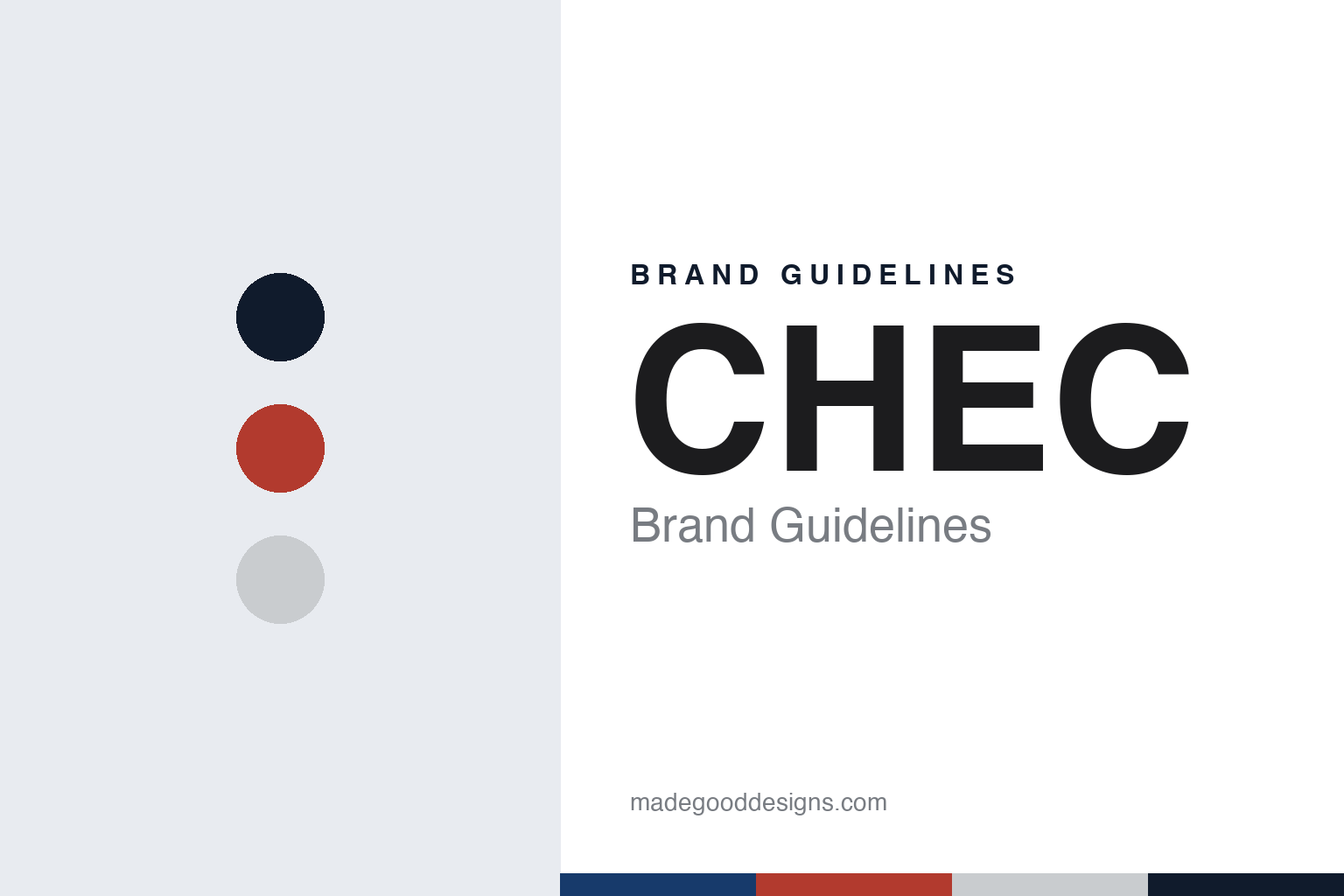
Two constants: an ocean blue, harbour red and concrete grey palette and a contractor sans register. Abstract homage — not a CHEC vessel or mark; no ship, logo or livery is reproduced.
China Harbour, 1980
From a 1980 harbour company to a CCCC subsidiary.
CHEC is the short name of China Harbour Engineering Company, the Beijing contractor known in Chinese as 中国港湾. Chinese Wikipedia traces it to a predecessor, China Harbour Engineering Company, set up in 1980. In 1988 that company joined the Ministry of Communications’ First Navigation Engineering Bureau and other companies, 14 in all, to form the China Harbour Construction Corporation, which was restructured in 1996 as China Harbour Construction (Group) Corporation.
The present company dates from 2005. English Wikipedia says China Harbour Engineering Company Ltd was established in December 2005, when the China Harbour group merged with China Road and Bridge Corporation to form China Communications Construction Company, or CCCC. CCCC, which English Wikipedia describes as majority state-owned and publicly traded, listed shares in Hong Kong in 2006 and in Shanghai in 2012. CHEC remains its subsidiary, and the website footer gives its full name as China Harbour Engineering Company Limited.
Its scope is wide. English Wikipedia lists marine engineering, dredging and reclamation, roads and bridges, railways, airports and plant construction. On its English website CHEC presents itself in four roles, as an engineering contractor, an investment operator, an urban developer and an “ecological manager,” and it groups its work by region: Africa, America, Asia, Europe and Oceania. Its Chinese pages call it a globally known engineering contractor and a service provider across the whole value chain of international ports; both are the company’s own descriptions.
Colour
Dredging, reclamation and ports.
Dredging and reclamation sit at the centre of the record. On the Chinese side of its website, CHEC lists among its reference dredging and fill works the deepwater channel improvement at the mouth of the Yangtze, land reclamation for a steel works at Caofeidian, dredging and fill for coal terminals at Qinhuangdao, dredging at the Three Gorges project and reclamation for the Hong Kong port of the Hong Kong–Zhuhai–Macao Bridge. The same list also includes a cutter suction dredger, the Jinhangjun 215.
Ports make up the other half. The company’s marine references include the Yangshan deepwater port in Shanghai, the second phase of the East Port Said terminal in Egypt and the third phase of the Balboa container terminal in Panama, and its English home page features the Abidjan port expansion in Côte d’Ivoire and the Doha New Port. English Wikipedia says CHEC won the first phase of the New Doha Port in January 2011, covering the excavation of 58 million cubic metres of material, an eight-kilometre quay wall and a five-kilometre rubble breakwater. Chinese Wikipedia adds the Kribi deepwater port in Cameroon and Hong Kong airport and container-terminal works carried out in joint ventures.
The work reaches well beyond the waterline. Chinese Wikipedia also lists reclamation and apron construction for the expansion of Macau International Airport, carried out in a joint venture, the first-phase reclamation for Tung Chung new town in Hong Kong, the Grand Lisboa hotel in Macau through a subsidiary, and bridges such as the Second Penang Bridge in Malaysia and the fourth bridge over the Panama Canal; the company’s own site features the Penang crossing as well.
Trade press records how the contracts are announced. Offshore Energy reported that China Harbour and Lekki Port Company signed the engineering, procurement and construction contract for the Lekki Deepwater Port in Nigeria at a meeting in Singapore on 11 May 2012, covering a 2.2-kilometre breakwater, a six-kilometre navigation channel and wharves for 8,000-TEU container ships. In August 2026 DredgingToday reported that Nigeria’s federal government had awarded CHEC, through the Nigerian Ports Authority, a contract to reconstruct and dredge the Escravos Channel serving Warri Port, in Delta State in southern Nigeria.
Typography
How dredging contractors present themselves.
Dredging and marine contracting is a business mostly seen from the shore. A trailing suction hopper dredger working a port channel, or a cutter suction dredger anchored off a reclamation site, is often the only public sign of a contractor, so the hull itself does much of the brand work: a strong field colour such as orange, red or blue, with the company’s wordmark painted large along the side so it reads from a quay or a news photograph.
The companies’ own websites tend to follow a shared pattern. Photographs of dredgers at work, as the firms publish them, sit beside fleet pages that sort the vessels by type, hopper dredgers, cutter suction dredgers, backhoe dredgers and support craft, each with a specification sheet of length, hopper capacity and dredging depth. Ship names are part of the identity too, whether a numbered series or a run of river and place names.
Project-reference pages carry the rest of the story. Rather than advertising, these firms describe what they have built or deepened: land reclamation, port deepening, channel maintenance, beach nourishment and coastal works, usually grouped by region or by type of work and illustrated with aerial views. Larger groups that also build roads, bridges and buildings sort a very mixed portfolio into categories so that a dredging job and a bridge contract sit side by side.
Because many clients are port authorities and governments, the most practical pages are often the plainest: tender notices, archives of completed contracts, investor and stock-exchange filings, and annual reports. For a designer, the useful lesson is how much of a marine contractor’s identity lives in operational material, vessel livery, fleet lists and contract pages, and how a restrained palette and a clear sans can hold that material together.
Aa
A contractor sans — square, direct and bilingual. (Specimen set in Archivo, a sans STAND-IN; NOT the CHEC logo.)
CHEC
A four-letter name beside a Chinese one.
CHEC’s name works in two scripts. Its website switches between 中国港湾 and the English “China Harbour Engineering Company,” and trade titles such as DredgingToday sometimes spell it “China Harbor.” Its project pages sort the work into ports, buildings, roads and bridges, rail, comprehensive urban development, ecological and environmental work, pipe networks and green power, each illustrated with a named project and its country.
Its news pages carry the routine of a large contractor. In late October and early November 2026 they reported a meeting of the Institution of Civil Engineers’ China committees hosted by the company and a family open day at the Ndayane port project in Senegal, to which the project invited the client, consultants and local employees’ families. Alongside those stories the site keeps a list of global offices, publications and a magazine, China Harbour, under the Chinese title 《中国港湾》.
For a design guide, CHEC shows how a state-owned contractor presents a very mixed portfolio through project categories, regions and named port works. Compare Dredging Corporation of India, a state dredging company owned by four ports, and Damen, the Dutch shipbuilding group. For this guide we use an ocean blue, a harbour red and a concrete grey with a sans, an unofficial interpretation; no product or logo is reproduced.
Explore & save
Keep CHEC’s identity on hand — save it to a board in the Made Good inspiration library.
CHEC identity set
Pin the ocean blue, harbour red and concrete grey palette and the contractor sans register to your own board.