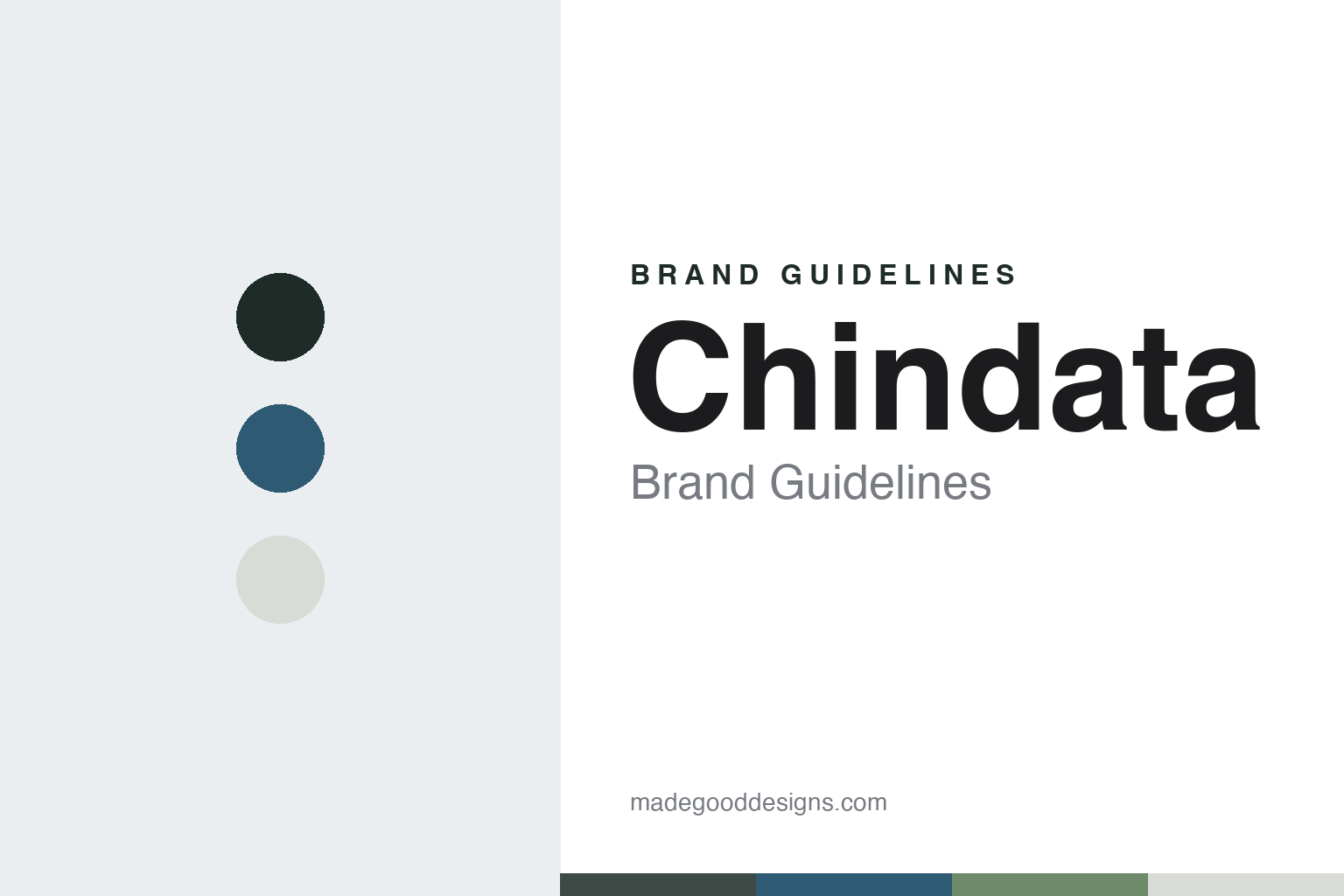
Chindata Brand Guidelines
A Beijing hyperscale operator named after a mountain range and a river.
Aa
Two constants: a slate, river blue and green palette of our own and a calm serif register. Abstract homage — not a Chindata asset; no logo, building or photograph is reproduced.
A mountain and a river
A data-centre arm, a buyer and a new name.
Chindata says it was founded in 2015 and takes its name from the Qinling Mountains and the Huai River. In its own brand story the mountains stand for the solid base that large computing infrastructure needs and the river for data flowing between sites; “Chin” stands for China and “Data” for connectivity.
The business had a different owner at first. Mingtiandi reported in October 2020 that the mainland Chinese side of Chindata had been the data-centre division of Wangsu Science and Technology, a network-infrastructure company listed in Shenzhen, until Bain Capital bought a controlling stake in May 2019; Bain itself has said its first investment came in 2018. Bain had already bought the Singapore-based Bridge Data Centres, and in July 2019 it merged the two, Mingtiandi reported. Chindata’s own timeline records 2019 as the year it acquired Bridge Data Centres and set itself up as a platform for emerging markets in the Asia-Pacific.
The same timeline traces the early build-out: in 2016 a plan for sites around Beijing, Shanghai and Shenzhen and what it calls a next-generation hyperscale operating model; in 2017 its first projects in the Greater Beijing area; in 2018 data centres in operation there, construction in the Yangtze River Delta and plans for the Greater Bay Area. Mingtiandi named Alex Ju as the company’s founder and chief executive at the time of its stock-market listing.
Colour
Four years on Nasdaq.
Chindata listed on Nasdaq on 30 September 2020 under the symbol CD, with Bain Capital as its largest shareholder and the Dutch pension manager APG next, Mingtiandi reported the following day. At that point the combined company ran two facilities in Malaysia, one of them in Cyberjaya under the Bridge Data Centres name, and six hyperscale sites in China, the same report said. The paper described Chindata as a business Bain had assembled from separate portfolios in China and Malaysia, and noted that South Korea’s SK Holdings had bought a stake that July, making it the third-largest shareholder.
The listed years brought changes at the top. In December 2021 the company announced that Alex Ju had left the chief executive role with immediate effect, and a Bain Capital executive became interim chief executive; Mingtiandi reported in August 2023 that Huapeng Wu had been named chief executive that February.
Bain then took the company private. In June 2023 it made a preliminary offer for the shares it did not own; China Merchants Capital put forward a competing proposal; and in August 2023 Chindata’s board agreed a definitive deal with Bain, Mingtiandi reported, noting that Bain already held a large majority of the voting rights and planned to fund the purchase with cash from its funds, debt and shares rolled over by existing holders. The report gave the group’s capacity as 898MW across China, India and Malaysia at the end of March 2023. The same report said the shares would leave Nasdaq once the deal closed, and in September 2025 Mingtiandi reported that Bain had taken Chindata private in 2023.
The website is organised around places and engineering: a locations menu organised by region, a gallery, video and documentation pages, and an innovation section that names its airflow design and modular cooling, power-distribution and fibre-pipeline units.
Typography
How operators present themselves.
Data-centre operators sell something most of their customers never see in person: buildings full of power, cooling and racks, usually in business parks on the edge of a city. Their websites and reports therefore do much of the work of explaining what they own and where it is. In this guide’s set, the companies present themselves through a small number of recurring formats rather than a consumer product.
The first is the campus itself. Operators publish aerial photographs and architectural renderings of their sites, often before a building is finished, together with galleries and short videos. These images are the company’s own material and show the buildings as the operator wants them seen; a rendering of a planned campus is a plan, not a finished site.
The second is the map and the number. Location pages are organised by city or region, and some show a stylised map of how sites relate to one another, sometimes marked as not to scale. Capacity is given in megawatts and floor area in square metres, alongside counts of sites in operation and under construction. Founding years, listing dates and lists of markets often appear as a strip of figures on a home page.
The third is the technical and corporate layer. Interconnection pages describe, in plain terms, how customers can reach telecoms carriers and public clouds from inside a building, often called cloud on-ramps. Sustainability pages and annual environmental, social and governance reports set out the company’s stated targets, and investor pages carry results, filings and presentations. For a designer, these formats show how a business with few visible products builds an identity from places, figures and documents.
Aa
A calm serif for a name drawn from a landscape. (Specimen set in Source Serif 4, a serif STAND-IN; NOT the Chindata logo.)
WinTriX and HEC
A split between China and the rest of Asia.
After the buyout the group was renamed WinTriX DC Group, Mingtiandi reported, and its Chinese and international businesses went separate ways. In September 2025 Bain agreed to sell the China operations to a consortium led by HEC Group, the Shenzhen industrial group whose HEC Technology unit is listed in Shanghai and which works in alternative energy, liquid cooling, electronic components and robotics. Mingtiandi put the China business at more than 1GW of capacity in operation and in the pipeline. Bain said on 16 January 2026 that the sale to the consortium, led by Shenzhen Dongyangguang Industry, had been completed, and called it the largest transaction in the history of China’s data-centre industry.
Bridge Data Centres stayed outside the deal. Mingtiandi reported in September 2025 that Bain was focusing on the Singapore-based Bridge, which operates in Malaysia, Thailand and India.
Chindata’s website now lists its China clusters in the Greater Beijing area, the Yangtze River Delta and the Greater Bay Area, with new projects in Qingyang in Gansu, Zhongwei in Ningxia, Ulanqab in Inner Mongolia and Shaoguan in Guangdong. Its timeline says the first phase of its Qingyang zero-carbon data-centre base was topped off in 2023, and records the 2025 change of shareholder as its China business being “fully acquired” in a deal led by HEC Group. Its head office is in Beijing, and its locations menu also lists Yichang in Hubei. The company says it released a full-stack solution for AI data centres in 2023 and unveiled a second version in 2024. Bain, in its January 2026 statement, said Chindata had grown since its first investment into one of China’s leading hyperscale data-centre platforms; that is Bain’s description.
For a design guide, Chindata shows how a company can build a brand story from a place name rather than a product. Compare GDS, another Chinese hyperscale operator, and Princeton Digital Group, an Asia-Pacific platform. For this guide we use slate, river blue and a muted green with a serif, an unofficial interpretation; no product or logo is reproduced.
Explore & save
Keep Chindata’s identity on hand — save it to a board in the Made Good inspiration library.
Chindata identity set
Pin the Chindata slate, river blue and green palette and the calm serif register to your own board.