ČD Cargo Brand Guidelines
The Czech state railway’s freight arm since 2007.
Aa
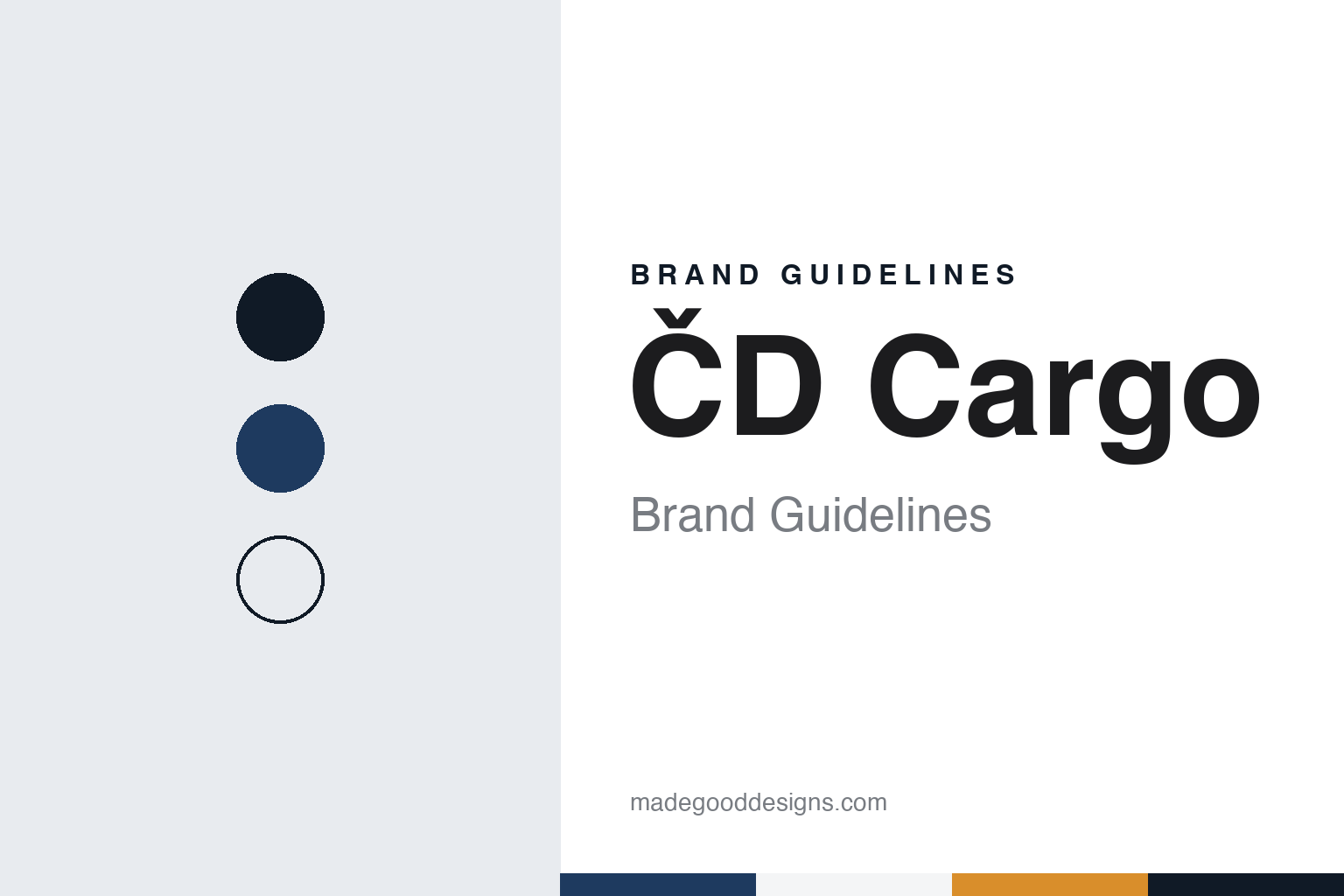
Two constants: a river deep blue, amber and steel grey palette and a grotesque sans register. Abstract homage — not a ČD Cargo asset or mark; no locomotive, livery or logo is reproduced.
Out of České dráhy
A 2007 government resolution and a new subsidiary.
ČD Cargo is the freight company of the Czech state railway, České dráhy (ČD). Czech Wikipedia says it was founded on 31 October 2007 following a Czech government resolution of 25 July 2007, and came into legal existence when it was entered in the commercial register on 1 December 2007. The company itself gives 1 December 2007 as its start and describes its formation as a contribution of part of ČD’s freight business into a new subsidiary.
The split moved a large slice of the railway. According to Czech Wikipedia, ČD Cargo received about a third of all ČD locomotives, all 32,000 freight wagons, part of the rolling-stock depots and roughly 13,000 of the parent’s approximately 55,000 employees, along with ČD’s shareholdings in several companies, which became ČD Cargo subsidiaries. České dráhy, which the company’s history page says was created in 1993 when Czechoslovakia divided, remains the sole shareholder and exercises the powers of the general meeting. A three-member board runs the company, overseen by a six-member supervisory board, and an audit committee was added on 1 October 2009. Below the head office, the company says, sit regional operating directorates with local workplaces, rolling-stock repair centres, a revenue accounting office in Olomouc and traffic control at Česká Třebová. Its stated aims are to keep a leading position in Czech and central European rail freight, to develop its staff and to work with technical schools to recruit young railway workers.
Partnerships were explored early. Czech Wikipedia says the government discussed joining ČD Cargo with the Slovak freight carrier Železničná spoločnosť Cargo Slovakia in 2007 and 2008, but no agreement was reached because the two sides saw ownership stakes and a possible privatisation of the merged company differently. The idea of combining with foreign carriers returned in 2010, the same year that talks took place with Poland’s PKP Cargo; ČD Cargo remained a wholly owned ČD subsidiary.
Colour
Vectron, TRAXX and a European network.
ČD Cargo describes itself as the largest Czech rail freight carrier and, by annual volume, one of the five largest rail freight carriers in the member states of the European Union. It offers trainload, wagon-group and single-wagon services, containers and out-of-gauge shipments, wagon hire and siding services. Czech Wikipedia says that by 2022 it held all the licences needed to run trains in the Czech Republic, Germany and Austria, and, through subsidiaries, in Poland, Slovakia, Hungary and Croatia. Those subsidiaries include CD Cargo Germany, CD Cargo Poland, CD Cargo Slovakia and ČD Cargo Adria, and the company also has branches in Vienna and Germany.
Its locomotive story mixes rebuilding with new traction. Czech Wikipedia says the first locomotives ČD Cargo modernised were class 753.7 diesels, under a mid-2008 contract with CZ LOKO covering thirty retired machines of the 750, 752 and 753 classes, and that the first rebuilt unit left the works in under five months. On 13 April 2016, the same article says, ČD Cargo signed a contract with Siemens for its first five class 383 Vectron multi-system locomotives, equipped for Germany, Poland, the Czech Republic, Slovakia, Austria, Hungary and Romania. By 2021 it had received ten Bombardier TRAXX MS3 locomotives, numbered as class 388, and ordered ten more; the type received approval from the European Union Agency for Railways on 10 December 2021.
Its share of the home market has narrowed over time. Czech Wikipedia, measuring by gross tonne-kilometres, gives ČD Cargo 92.28 per cent of Czech rail freight in 2008, its first year as a separate company, 63.49 per cent in 2017, 50.98 per cent in 2024 and 50.15 per cent in 2025. The article links the decline mainly to lower volumes of solid fuel, especially brown coal, lost traffic for the Ostrava steelworks, less salvage timber and a general fall in single-wagon consignments.
Typography
Design and documentation.
Rail freight operators sell a service that most people only glimpse from a level crossing or a station platform, so their identities lean heavily on the one thing everyone does see: the locomotive. Liveries, fleet numbers and named engines carry the brand across a whole network, and operators publish photographs of their fleets on their websites, in press releases and on social channels. A repaint for a customer, a partner or an anniversary is usually announced as news in its own right.
The second visual constant is the map. Operators that sell regular routes tend to show them as network diagrams, with ports, terminals and inland hubs joined by lines, much like a passenger timetable. Those that run trains to order describe their work in service categories instead, such as intermodal container trains, block trains for bulk goods, single wagonload and first- and last-mile shunting, and the wording on those pages is the company’s own description of what it offers.
Fleet pages are a genre of their own. Many operators list their locomotive classes with build dates, power systems and the routes they work, and new orders are presented as milestones, often with the builder and the leasing company named alongside. Numbers on these pages, from staff and trainloads to tonnage and market share, are figures the companies give about themselves at a particular date, and they change from year to year.
Sustainability pages have become standard across the sector. They usually set out targets, partnerships and new traction such as electric, bi-mode or biofuel locomotives, each tied to a dated announcement. In the guides that follow, those pages are treated as statements of what each company says it is doing and when, alongside its ownership history and the names it has traded under.
Aa
A grotesque sans for a freight register. (Specimen set in Archivo, a sans STAND-IN; NOT the ČD Cargo logo.)
ČD Cargo
Restructuring since 2024.
Since 2024 the company has been cutting capacity. On 22 July 2025 the Czech News Agency (ČTK) reported that ČD Cargo planned to cut up to 700 jobs by the end of 2025, more than a tenth of its workforce; its annual report put average staff at about 6,500 in 2024. The company carried 56.7 million tonnes of goods in 2024, 2.7 million fewer than a year earlier, and ČD had pointed to lower timber volumes, reduced output at the Liberty Ostrava steelworks and less brown coal for power stations and heating plants. In April 2025, ČTK added, ČD Cargo had put 24 surplus locomotives and 1,089 wagons up for electronic auction, and its chief executive said volumes in 2026 would not exceed 45 million tonnes, with around 40 million tonnes a year expected in the longer term unless new commodities came to rail. Czech Wikipedia now puts the workforce at about 4,600 in the Czech Republic.
For a design guide, ČD Cargo shows how a state freight carrier presents a large mixed fleet, from rebuilt diesels to multi-system electrics, alongside network maps and service pages for trainloads and single wagons. Compare its Polish neighbour in our PKP Cargo Brand Guidelines and the German state railway’s freight arm in our DB Cargo Brand Guidelines. For this guide we use a river deep blue, a night ink, an amber and a steel grey with a grotesque sans, an unofficial interpretation; no product or logo is reproduced.
Explore & save
Keep ČD Cargo’s identity on hand — save it to a board in the Made Good inspiration library.
ČD Cargo identity set
Pin the ČD Cargo river deep blue, amber and steel grey palette and the grotesque sans register to your own board.