Thenamaris Brand Guidelines
A 1972 Piraeus ship manager run by one family.
Aa
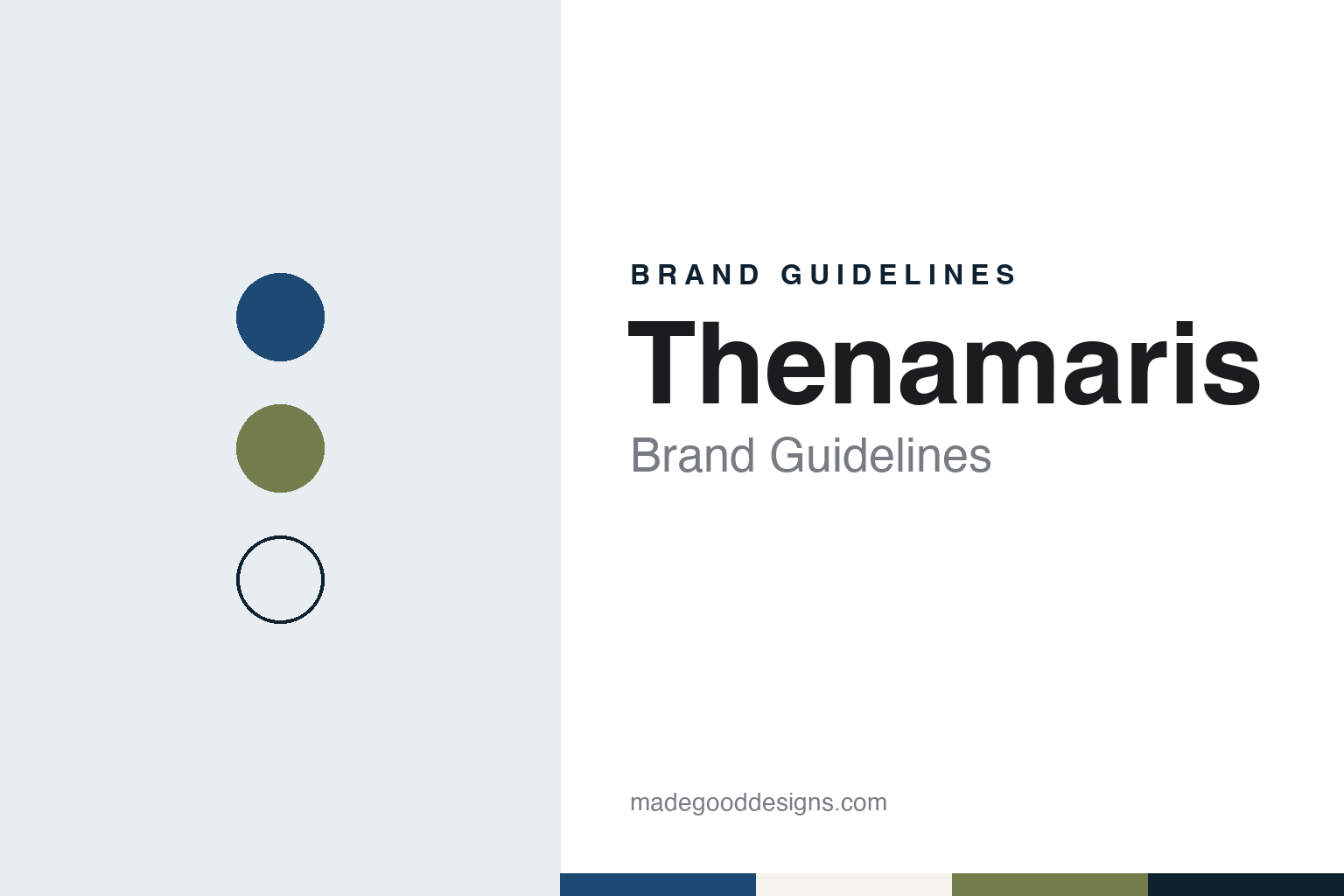
Two constants: an Aegean blue, deep sea and olive palette and a calm text serif register. Abstract homage — not a Thenamaris product or mark; no logo, ship or funnel is reproduced.
Piraeus, 1972
Eight dry cargo ships and a family business.
Thenamaris was established in 1972 in Piraeus, Greece, with eight dry cargo vessels under management, the company says; Riviera Maritime Media gave the same founding year and starting fleet in January 2025. Its founder was Athina (“Nounou”) Martinou, whom Riviera calls a prominent figure in Greek shipping. Greek Reporter wrote in October 2024 that she took on the management of her family’s ships in 1971, together with her sons Thanasis, Dino and Andreas, a year before the company’s own founding date, and that the fleet had grown to 36 ships by 1975.
The company’s history describes quick early growth. In 1976 it placed its first newbuilding contract on behalf of its principals, with the Namura shipyard in Japan, for three bulk carriers of 26,000 deadweight tonnes each. By 1978, it says, it managed 50 vessels with a combined deadweight of more than 900,000 tonnes, ranging from bulk and ore/oil carriers to car carriers and heavy-lift ships. By the mid-1980s it also managed very large and ultra-large crude carriers.
The family management changed in the 1990s. Greek Reporter wrote that Athina Martinou passed the reins to her children in 1991; Thanasis Martinos later left to set up Eastern Mediterranean Maritime, Andreas founded Minerva Marine in 1997, and Dino stayed at Thenamaris. His son, Nikolas Martinos, now manages the company, Greek Reporter said, and Riviera described Thenamaris as “Nikolas Martinos-led” in January 2025.
Colour
Tankers, then LNG, then a ConBulk arm.
Thenamaris presents itself as a ship manager for its principals, the owners of the ships, and tells its history in managed tonnage. In the 1980s it set up links with crewing agencies, including Thenamaris Philippines, which handles the recruitment, training and development of officers and crew for the managed fleet. By the end of that decade, the company says, the managed fleet had reached a deadweight capacity of about 3,000,000 tonnes. In 1986 its shore staff moved into a purpose-designed office in Vouliagmeni, on the Athens coast, still the head office today.
In the 1990s Thenamaris coordinated newbuilding projects for its principals, mostly double-hulled tankers. As older ships were sold, the company says, the average age of the managed fleet halved, from 20 years in the mid-1990s to 10 years in 2005.
Two specialist arms followed. Thenamaris LNG was set up in 2011 to manage three LNG carriers built by Samsung Heavy Industries and delivered in 2013, 2014 and 2015; it later added two LPG carriers from Hyundai Mipo Dockyard in 2017 and two LNG carriers from Hyundai Heavy Industries in 2020 and 2021. Thenamaris ConBulk was formed in 2020 to manage container ships and bulk carriers, which until then had been run alongside the tankers. The website now presents three fleets under those names, the Thenamaris tanker fleet, the ConBulk fleet and the LNG fleet, plus a newbuilding team.
Seafarers for the three companies are recruited from six locations, the careers pages say: Athens, Manila, Varna in Bulgaria, Odesa, Hamburg and Split in Croatia. Commercial services run from offices in Athens and Singapore. The services section lists eight areas of work, from technical management, operations and marine personnel to sale and purchase, energy management and newbuilding supervision, each with its own page, and the sustainability section groups environmental, energy and corporate social responsibility pages with its ESG reports.
Typography
How ship managers present themselves.
Third-party ship managers sell a service rather than a product. They run vessels that belong to someone else, so their identities have no hull, funnel or cargo of their own to show. Instead they present themselves through the work: technical management, crewing, newbuilding supervision and the training of seafarers. V.Group, for example, describes itself as “an independent service provider, not a ship owner or a manufacturer,” and Anglo-Eastern says it manages vessels on behalf of shipowners, charterers and operators.
Their marks tend to be simple and sit on corporate websites. Blue and teal wordmarks are a familiar sight in the trade, but not a rule: V.Group’s logo files come in green and black versions, and Anglo-Eastern’s header pairs a white wordmark with a golden emblem. Around those marks sit photographs of ships and crews as the companies publish them — a managed vessel at sea, a simulator room, cadets with their teachers or on graduation day.
The websites follow a common plan. There are service pages for technical management and crewing, often split by vessel type, from tankers and bulk carriers to LNG carriers and cruise ships. Training-centre pages show simulators and classrooms; Anglo-Eastern, for instance, runs its own academy and training centres in India and the Philippines. Office maps and location lists stretch across Asia and Europe, and careers-at-sea pages set out cadet programmes and routes to promotion.
This guide looks at how each manager tells that story: who founded it, who owns it, which mergers shaped it, and how it describes its services and its seafarers. Figures for fleets, staff and offices are given as the companies or dated reports state them, and each palette here is an unofficial interpretation, not a brand standard.
Aa
A calm text serif for a family ship manager. (Specimen set in Source Serif 4, a serif STAND-IN; NOT the Thenamaris logo.)
Thenamaris
Fleet counts, new ships and a short slogan.
The website gives current company figures: 87 vessels under management, more than 3,800 seafarers and more than 300 shore-based employees, with 48 tankers, 24 bulk carriers, two container ships, seven LNG carriers and six LPG carriers, plus a newbuilding list that includes tankers, VLACs, LNG carriers and container ships. The figures move with deliveries and sales. In January 2025 Riviera counted 92 ships on the website and said the newbuilding programme would take Thenamaris towards 100 vessels; it reported deliveries that month including the Ultramax bulk carrier Seahawk, the MR2 tanker Seaexplorer and the Aframax/LR2 tankers Seatrust and Seascout, built in Vietnam and China.
In May 2024 SAFETY4SEA, which called Thenamaris one of the largest Greek ship operators, reported that it had partnered with Navarino to roll out Starlink satellite connectivity across most of its fleet, used mainly by crews for calls home and also for remote inspections.
The company’s own language is short and direct. Its home page carries the line “How shipping should be,” and its stated vision is to be “the model ship management company.” Its values are listed as fair, enterprising, rigorous and enthusiastic, and its history page closes by saying the company has been delivering management services for more than 50 years since its founding.
For a design guide, Thenamaris shows a family ship manager that presents itself through a slogan, four values and plain fleet counts. Compare Hafnia, a product-tanker owner, and V.Ships, a third-party ship manager. For this guide we use an Aegean blue, a deep sea navy and a muted olive with a serif, an unofficial interpretation; no product or logo is reproduced.
Explore & save
Keep Thenamaris’s identity on hand — save it to a board in the Made Good inspiration library.
Thenamaris identity set
Save the Thenamaris Aegean blue, deep sea and olive palette and the calm text serif register to your own board.