Blacks Brand Guidelines
A Clyde sailmaker that turned to tents, catalogues and outdoor shops.
Aa
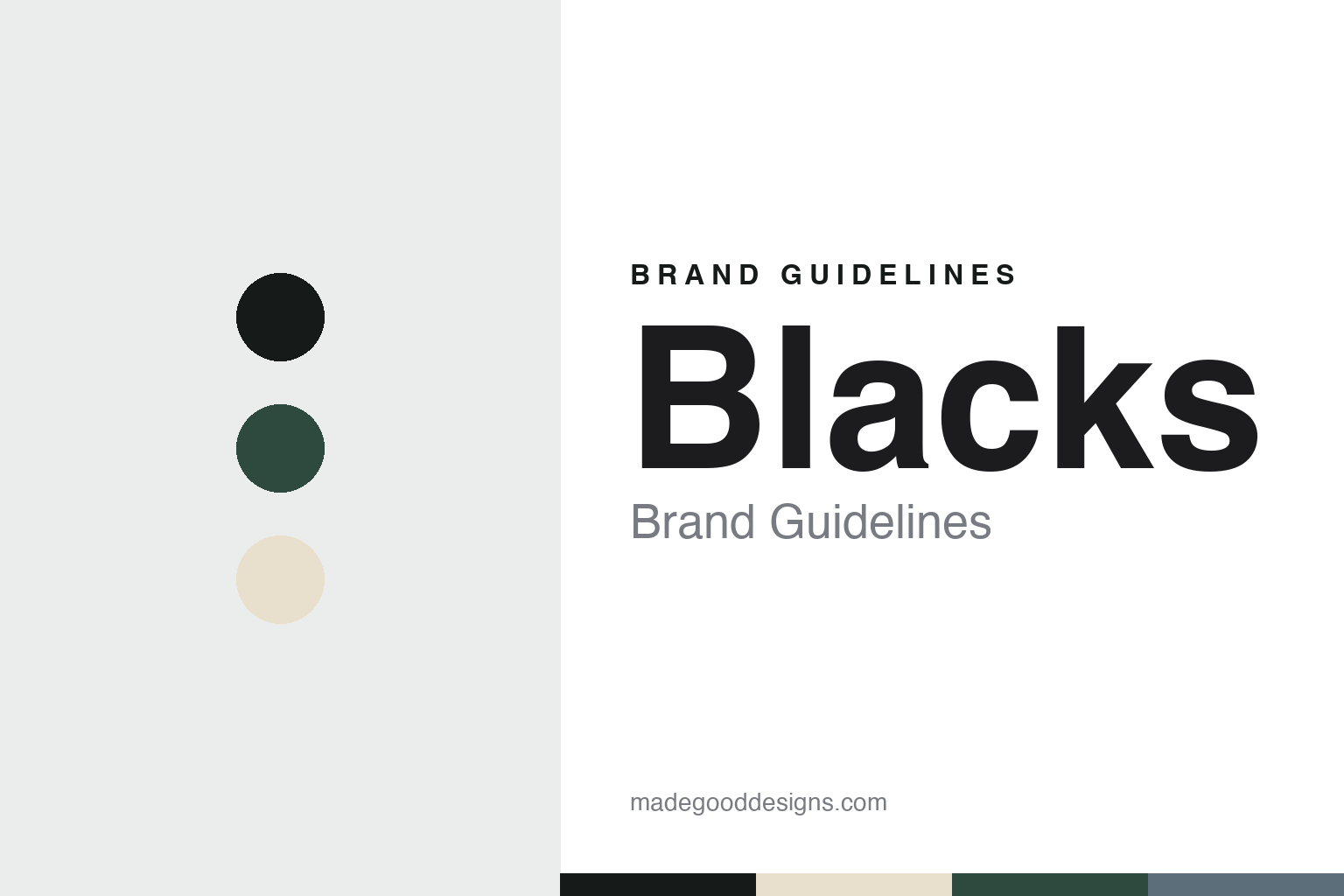
Two constants: a black, sailcloth cream and heather green palette and a catalogue serif register. Abstract homage — not a Blacks product or mark; no logo, tent or catalogue is reproduced.
Thomas Black of Greenock
From sails to bell tents and a camping catalogue.
Blacks began as a sailmaker’s business on the Clyde. Thomas Black, a former merchant seaman who had spent two years in the Australian goldfields, married in 1861 and moved to Greenock, where he set up on his own as a sailmaker, according to Gale’s International Directory of Company Histories, in an entry written in 2001. English Wikipedia’s timeline dates the start of the business to 1863, after two years learning the trade in Glasgow, and records a centenary brochure in 1963.
As steamships replaced sail, the trade shrank. His son, Thomas Black junior, took the firm over in 1905 and turned it to bell tents, marquees and garden tents for fêtes and functions; English Wikipedia says the idea came from a tent-making business he had seen in Kansas City on his way home from California, while the Gale history links it to the camping he had seen in California. The firm also hired out tents and marquees, using former sailmakers to put them up. It was incorporated as Thomas Black and Sons (Greenock) Ltd in 1923 and opened a London showroom on Bury Street, near the British Museum, in 1928.
The interwar years made the name. In 1930 the company supplied about 4,700 tents, with beds and bedding, for the celebrations of the thousandth anniversary of Iceland’s parliament, and the design later became known as the “Icelandic” tent, English Wikipedia says; the Gale history gives nearly 5,000 tents. In 1931 the firm began its Good Companions catalogue of lightweight camping gear, and the Good Companions name was registered as a trade mark. In 1933 it equipped the walker Jock Scott for treks from Greenock to Cape Town and across North America, both sources say.
Colour
Black & Edgington and Blacks Leisure.
From 1946 Blacks grew by buying other firms. It acquired Camp and Sports Co-operators, known as Camtors, in 1946 and City Camp and Sports of Birmingham in 1953, opened a Canadian subsidiary in 1958 and a warehouse in Ogdensburg, New York, in 1962, and bought the ski and outdoor firm Jackson & Warr the same year, English Wikipedia and the Gale history say. In 1967 it joined the London tent and flag maker Benjamin Edgington through a reverse takeover, forming Black & Edgington. English Wikipedia says the group took in Vango (Scotland), maker of the Force Ten tents, in the late 1970s.
Retail moved to the centre of the business. In 1970 Black & Edgington bought Milletts Stores (1928) Ltd and launched Blacks Outdoor Stores, starting in Leeds, Birmingham and Liverpool, the historian Kathryn A. Morrison wrote on her Building Our Past blog in 2020. The Gale history says the retail arm was renamed Blacks Camping and Leisure in 1975. After a takeover bid in 1983 the group was broken up: English Wikipedia says tent making went back to Vango and the hire and flag divisions to a management buyout, while the Blacks shops passed to outside buyers. After a 1984 deal with Greenfields, the retailer took the name Blacks Leisure Group plc, the Gale history says.
Under that name it moved into general sports retail with the First Sport chain from 1988, and in 1994 renamed its Blacks Camping shops Blacks Outdoor, according to both sources. In December 1999 it bought The Outdoor Group, owner of Millets, adding a chain the Gale history put at 199 stores. English Wikipedia says the group sold its First Sport chain to JD Sports in 2002.
Typography
Shops, catalogues and owners.
Outdoor, camping and ski retailers sell other companies’ boots, tents and jackets alongside ranges of their own, so much of their identity lives in the shop rather than the product. Trade press coverage of the British chains returns to the same few things: the size and setting of a store, the specialist departments inside it, and the services offered at the counter, such as boot and rucksack fitting or a cycle workshop.
Store format is the clearest divide. In its 2017 review of a merger in the sector, the Competition and Markets Authority described one group of chains trading from smaller, typically high-street shops and another from larger stores, typically out of town, able to carry a broader range. Newer openings mix the two ideas: shops that put two or three of a group’s fascias under one roof, smaller “express” formats with in-store kiosks for the full range, and concessions run by specialist cycling, fishing or equestrian businesses inside a larger store.
Names carry much of the work. Several chains in this guide are named after a place or an activity rather than a founder, and several sit inside larger groups owned by listed retailers or private-equity firms, while the shopfront name stays the same. Campaigns can be timed to the season: one chain’s 2026 autumn and winter campaign came with a floor refresh across all its stores, trade press reported.
This guide sets out what can be checked about each brand — where it began, who has owned it and when, and how its stores are laid out — and marks clearly what rests only on the company’s own word.
Aa
A catalogue serif for a firm that sold through printed catalogues. (Specimen set in Source Serif 4, a serif STAND-IN; NOT the Blacks logo.)
Blacks
A pre-pack sale and a new owner.
The 2000s were difficult for Blacks Leisure. English Wikipedia says the company closed 89 shops in 2009 under a company voluntary arrangement agreed with its creditors. On 7 December 2011 it invited offers for the business after a profit warning, Retail Gazette reported, adding that the company did not expect any value to be left for its shares. On 9 January 2012 administrators were appointed and sold the business straight on to JD Sports in a pre-pack deal covering 302 stores trading as Blacks and Millets and about 3,500 staff, Accountancy Age reported. The listed company ended there; the brands continued under JD Sports Fashion, and English Wikipedia says the head office moved to JD’s base in Bury, Greater Manchester.
Under JD, Blacks sells own labels such as Peter Storm and Eurohike, English Wikipedia says, alongside outside brands. From late 2024 some shops changed fascia. The Inverness Courier reported in October 2024 that the Blacks on Academy Street, Inverness, would become a GO Outdoors Express store, another JD outdoor format, in January 2025. Local papers reported similar conversions of Millets shops: YorkMix in York in October 2024, and IoM Today in Douglas in February 2025. The Blacks website was still trading in November 2026.
The name has carried several layers of identity: the Good Companions catalogue and trade mark of the 1930s, the Blacks of Greenock retail name, Blacks Camping and Leisure from 1975 and Blacks Outdoor from 1994.
For a design guide, Blacks shows how a Victorian craft business on the Clyde turned into a tent maker, a catalogue seller and then a chain of outdoor shops under a sports retailer; compare Millets and JD Sports. For this guide we use Greenock black, sailcloth cream and heather green with a serif, an unofficial interpretation; no product or logo is reproduced.
Explore & save
Keep Blacks’s identity on hand — save it to a board in the Made Good inspiration library.
Blacks identity set
Pin the Blacks black, sailcloth cream and heather green palette and the catalogue serif register to your own board.