Bonusprint Brand Guidelines
The film-by-post brand that became a photo-book shop and then a web address.
Aa
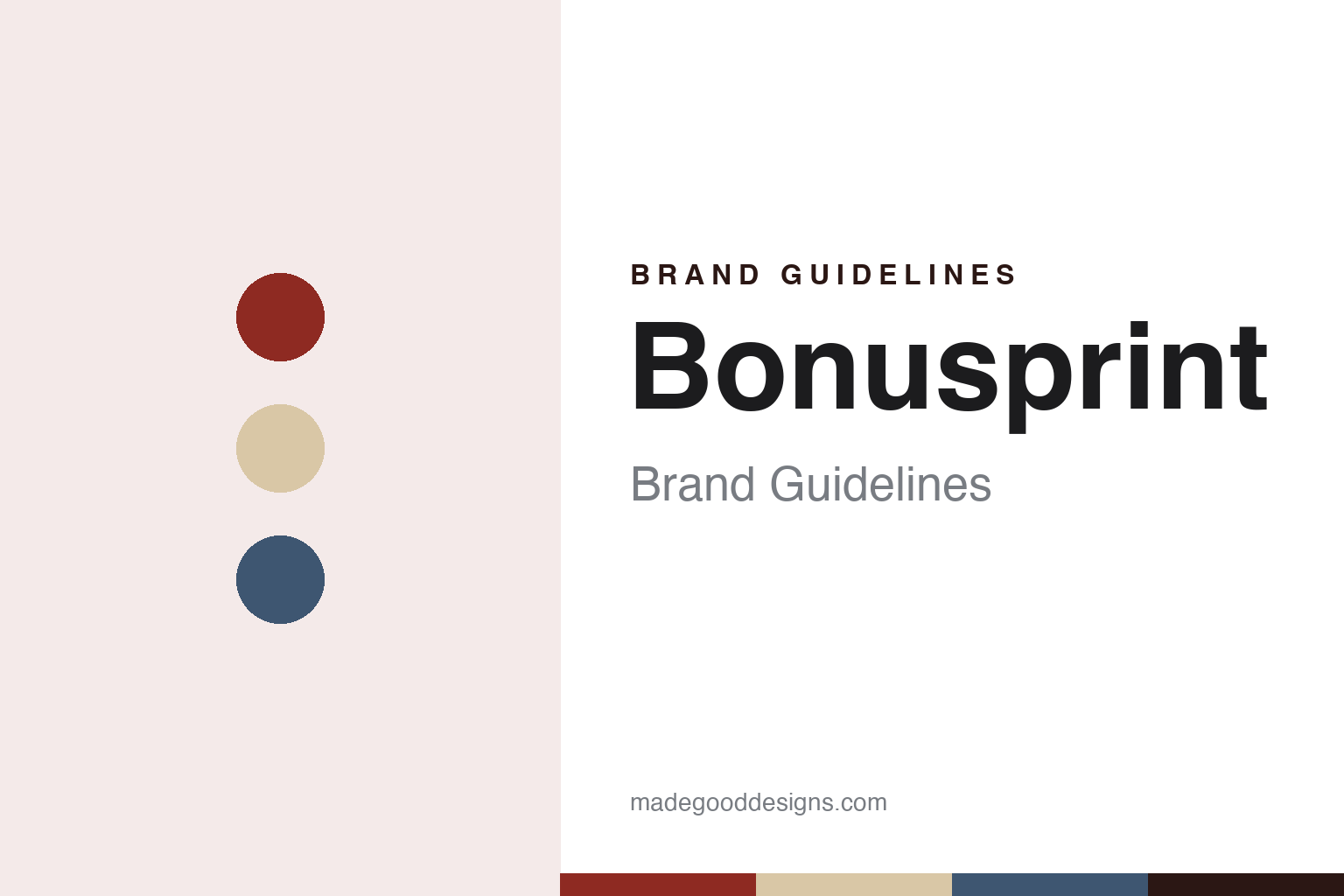
Two constants: a darkroom red, envelope buff and linen blue palette and a mail-order sans register. Abstract homage — not a Bonusprint product or mark; no envelope, logo or print is reproduced.
Grunwick
Film in an envelope, prints back by post.
Bonusprint began as one of the trading names of Grunwick Film Processing Laboratories, a photographic finishing business in London. English Wikipedia says the firm was founded in 1965 by George Ward, John Hickey and Tony Grundy, and traded under several brand names, among them Bonusprint, Doubleprint and Tripleprint. An announcement about the brand’s sale, published by ePHOTOzine in January 2011, also dates Bonusprint to 1965.
The business worked by post. Customers mailed their undeveloped films and their payment to the laboratory, and the finished photographs came back through the postal service, English Wikipedia explains. It links the model to the spread of amateur colour photography: small high-street chemists that had once developed family snapshots could no longer afford the equipment, which left the field open to larger specialist laboratories such as Grunwick. In the 2011 announcement, the company described its own path as running from black-and-white processing to colour processing by post, and on to online digital printing.
In the 1970s the laboratory, then at Dollis Hill in north-west London, became the setting of the Grunwick dispute. In August 1976 a group of workers walked out, joined a trade union and asked for it to be recognised; the company refused recognition, and the strikers were dismissed, BBC News reported in a September 2016 account of the strike. The dispute lasted about two years and drew wide support from other unions. A court of inquiry set up by the government recommended that the union be recognised and the strikers reinstated; the company did not accept the recommendations, and a House of Lords ruling upheld its right not to recognise the union, according to English Wikipedia. The strikers called off their action in 1978, and their demand for collective bargaining was not met. English Wikipedia describes the dispute as a cause célèbre of trade unionism and labour-relations law in that decade.
Colour
From prints by post to photo books.
Bonusprint changed hands in January 2011. According to the announcement published by ePHOTOzine on 31 January 2011, the Dutch photo-book company albelli bought the brand and its website from Grunwick for an undisclosed sum, a month after buying Fotobook of Edinburgh. albelli was the consumer brand of Albumprinter, based in the Netherlands; Storio group, its present-day successor, says albelli itself was founded in 2008. By then Bonusprint was based in Hertfordshire, the announcement said, and albelli planned a new online shop at the Bonusprint address offering photo books, calendars, posters and gifts alongside digital photo prints.
The new owner moved quickly. In August 2011 HEXUS reported that Bonusprint had launched a free iPad app for turning a set of photographs into a photo book; the printed result was a 24-page, spiral-bound book with one image per page. The same month ePHOTOzine reported that Bonusprint was launching its first television campaign in 25 years to promote its online photo-book service, under the line “printing smiles”, on channels including E4, ITV2 and Living. The advertisement used real family photographs, the magazine said, and the campaign was backed by public relations, customer marketing and online activity.
Reviews from the period show what the products looked like. ePHOTOzine’s November 2011 review of the SpeedyBook described a 20 × 15 cm hardback with a blue linen cover, made entirely in the browser with no software to download, holding 24 photographs, one to a page, on matte paper; the reviewer could rotate or reposition each picture within its frame but had no other editing tools. In January 2012 Expert Reviews noted that Bonusprint let customers build web albums that could be shared publicly or kept private behind a password, and found the website’s raised, button-like tabs dated in appearance.
Typography
Photo books and prints, online.
Photo-book and photo-printing services sell something the customer has already made: the pictures. Their own sites therefore tend to lead with the customer’s photographs rather than with the company. Home pages show open books, framed prints and wall pieces in ordinary rooms, often styled around an occasion such as a wedding, a new baby, a holiday or the end of a year, and the product sits in the frame as a finished keepsake.
The making itself is shown through the tools. Most of these companies offer an online editor and a phone app, and they describe both in plain, step-by-step language: upload, choose a size and cover, arrange the pages, order. Automatic layouts, themes and templates are presented as time-savers, while desktop editors with grids, rulers and finer controls are offered to people who want to place every picture themselves.
Product naming follows the physical object. Ranges are sorted by format, page count, binding and cover — soft cover, hard cover, fabric, leather, lay-flat — and by paper finish, with words such as matte, lustre or gloss doing most of the work. Wall pieces are named by their material, from stretched cotton and acrylic to metal, wood and framed prints, so the label tells the buyer what will hang on the wall.
Behind the consumer brands sit the labs and the owners. Corporate pages explain which group a label belongs to, where its printing sites are and how its brands divide up the countries they serve, while lab-led services describe their printing methods and papers in more detail. For a designer, the useful lessons are in that split: a warm, occasion-led consumer voice on top, and a precise, material-led vocabulary underneath.
Aa
A plain mail-order sans for a brand built on envelopes and order forms. (Specimen set in Archivo, a sans STAND-IN; NOT the Bonusprint logo.)
Bonusprint
Inside albelli, then Photobox.
Bonusprint’s later owners were those of albelli. MENA, the Dutch management magazine, reported in July 2017 that Cimpress — known as Vistaprint until 2014 — had taken a stake in albelli in 2011; that albelli had then grown abroad with brands such as Önskefoto in Sweden and Bonusprint in Britain, followed by Fotoknudsen of Norway; and that Cimpress was selling its shares to albelli’s management and the Utrecht investor Gilde Buy Out Partners. The Dutch competition authority ACM cleared the Gilde fund’s takeover of Albumprinter on 25 August 2017.
In January 2022 albelli merged with Photobox, the photo-printing company founded in London in 2000, according to a statement from the combined business, which on 8 February 2024 renamed itself Storio group, with its announcement made from Amsterdam. Storio group says it runs six brands across thirteen European markets: Photobox, albelli, Hofmann, posterXXL, fotoknudsen and önskefoto. Bonusprint is not on that list, and in November 2026 the bonusprint.co.uk address forwarded visitors to Photobox’s UK website, so Bonusprint no longer operates as a separate online shop.
Bonusprint’s documented identity is mostly verbal. Grunwick sold it beside two sister names, Doubleprint and Tripleprint, and the 2011 relaunch put the line “printing smiles” and real family pictures at the centre of its television advertisement. The products that reviewers described in 2011 were small and plain: a spiral-bound book ordered from an iPad, and a 20 × 15 cm hardback in blue linen with matte pages carrying one photograph each.
For a design guide, Bonusprint shows a photo brand that kept one name from envelopes of film to app-made books across more than four decades, and was then absorbed into a larger group’s main brand. Compare Photobox, which now receives its web address, and albelli, its owner from 2011. For this guide we use darkroom red, envelope buff and a linen blue with a sans, an unofficial interpretation; no product or logo is reproduced.
Explore & save
Keep Bonusprint’s identity on hand — save it to a board in the Made Good inspiration library.
Bonusprint identity set
Pin the Bonusprint darkroom red, envelope buff and linen blue palette and the mail-order sans register to your own board.