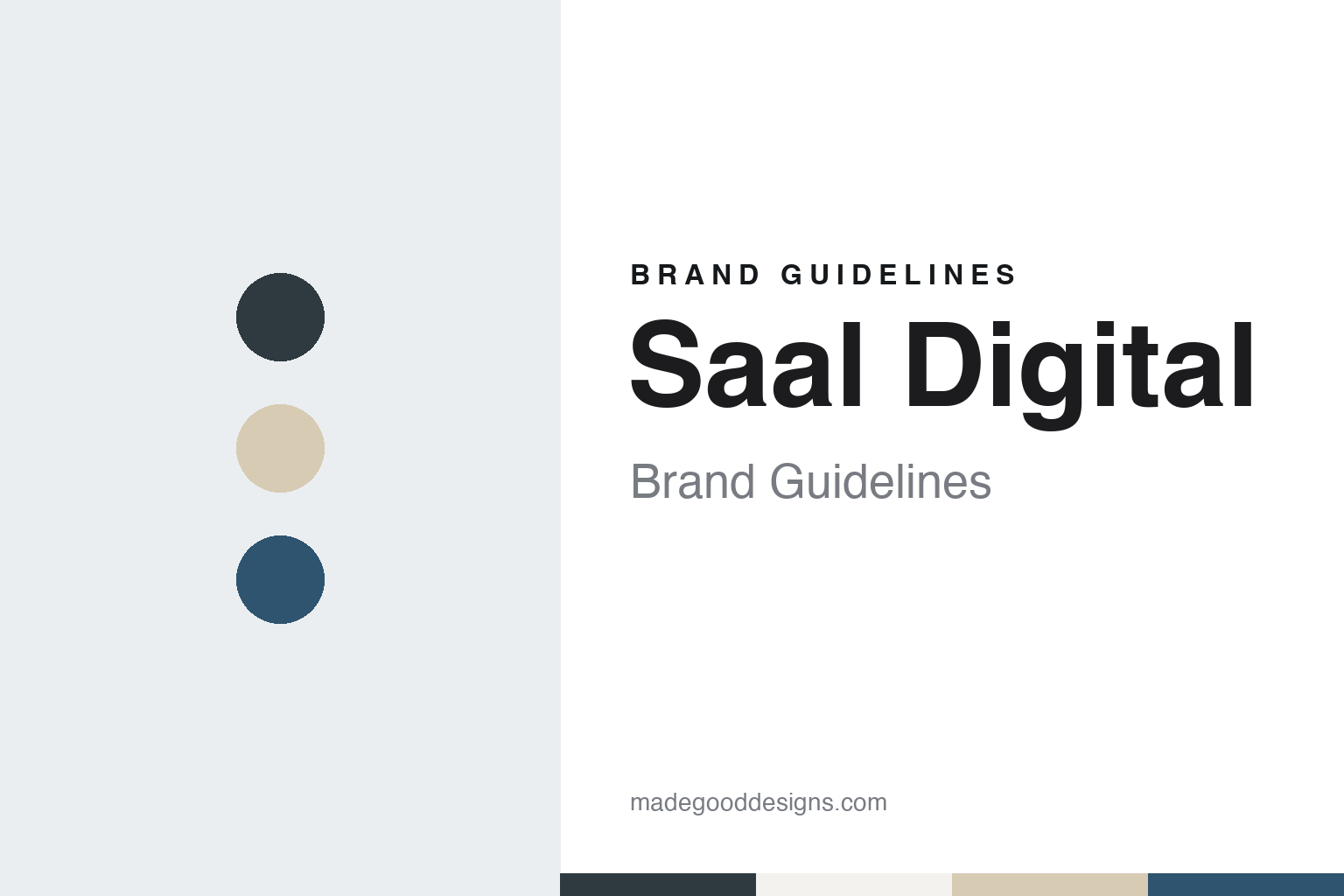
Saal Digital Brand Guidelines
A family photo lab from Franconia that turned its books to open flat.
Aa
Two constants: a slate, linen and acrylic blue palette and a plain lab sans register. Abstract homage — not a Saal Digital product or mark; no book, cover or logo is reproduced.
A photo shop with a lab
From a 1981 shop counter to a second generation.
Saal Digital began as a photo shop. In 1981 Reinhard Saal opened a small photographic business with its own in-house laboratory, the photo magazine FOTO HITS reported in July 2026, in an article marking the company’s 45th year. The trade site photoscala gave the same founding year and the same origin, a specialist photo shop with its own lab, in September 2026. The founder still describes himself as a photographer: “As a photographer, I know how high the demand for quality is,” he said in October 2025, when photoscala quoted him as founder and managing director (our translation).
The business moved with the technology. According to FOTO HITS, Saal helped to establish the one-hour photo lab in 1986, saw early what digital photography would mean for a lab, and in 2008 committed to layflat binding for its photo books, so that a panorama could run across two facing pages without a break in the middle. That binding is still part of how the books are sold: the Professional Line book that photoscala tested in October 2025 opened flat across each spread, and the reviewer noted that large pictures could run over both pages without a disturbing fold.
It is still a family company. Since the early 2000s, FOTO HITS says, Reinhard Saal and his son Robin Saal have run the business together as its second generation, with the founder still in charge of production and checking tens of thousands of books a month. fotoMAGAZIN named Robin Saal as a managing director in December 2025, and photoscala quoted a third managing director, Uwe Glander, in November 2025 and again in September 2026. In that later report photoscala called Saal Digital a family firm, founded in 1981, that grew out of a specialist photo shop with its own lab.
Colour
Röttenbach, linen, cork and acrylic glass.
Production sits in one place. FOTO HITS put the workforce at about 150 people in July 2026 and the production site at Röttenbach, in Franconia in northern Bavaria, where a company photograph showed one of four production halls on the site. The company sells into 29 countries, a figure photoscala gave in September 2026 as the company’s own.
The range runs from prints and wall pictures to books, and the books come in two tiers. The standard photo books carry a printed photo cover in gloss or matt, while the Professional Line books offer a cover picture behind acrylic glass, or surfaces in a leather look, cork, wood or linen, photoscala’s Thomas Probst wrote in October 2025. He described the line as aimed at occasions such as weddings and anniversaries. His test copy, an A4 landscape book in natural linen with 34 inside pages, was printed on Fujifilm Crystal Archive Album gloss paper with layflat binding, and he noted that the Professional Line books carry no QR codes, either on the cover or on the inside pages. An optional presentation box is sold to hold the book.
The covers change what a designer can do. A linen cover takes no photo, only text, and the editor offers a deliberately narrow choice of typefaces for it, because larger and heavier lettering reads more clearly on the textured cloth; ornate scripts are hardly offered, the same test found. Probst advised thicker type on linen, since fine lettering looked slightly washed out on the weave.
The ordering tools are described in the same review. Pages can be built from templates or from custom layouts that the user saves; automatic image optimisation can be switched off for photographers who have edited their own files; and ICC profiles let a user preview on a calibrated monitor how colour and contrast will look on the paper. In July 2026 FOTO HITS added that the company had built AI-assisted editing tools into its own design software, from image improvement and automatic corrections to suggested treatments for pictures and clip art.
Trade magazines have tested the products. In its 6/2026 issue FOTOnow rated the company “excellent” for its finishing and service, and an acrylic-glass wall picture received the same rating in a lab test in November 2025, the anniversary report says.
Typography
Books, prints and the labs behind them.
Photo-book and photo-printing services sell something the customer has already made: the pictures. Their own sites therefore tend to lead with the customer’s photographs rather than with the company. Home pages show open books, framed prints and wall pieces in ordinary rooms, often styled around an occasion such as a wedding, a new baby, a holiday or the end of a year, and the product sits in the frame as a finished keepsake.
The making itself is shown through the tools. Most of these companies offer an online editor and a phone app, and they describe both in plain, step-by-step language: upload, choose a size and cover, arrange the pages, order. Automatic layouts, themes and templates are presented as time-savers, while desktop editors with grids, rulers and finer controls are offered to people who want to place every picture themselves.
Product naming follows the physical object. Ranges are sorted by format, page count, binding and cover — soft cover, hard cover, fabric, leather, lay-flat — and by paper finish, with words such as matte, lustre or gloss doing most of the work. Wall pieces are named by their material, from stretched cotton and acrylic to metal, wood and framed prints, so the label tells the buyer what will hang on the wall.
Behind the consumer brands sit the labs and the owners. Corporate pages explain which group a label belongs to, where its printing sites are and how its brands divide up the countries they serve, while lab-led services describe their printing methods and papers in more detail. For a designer, the useful lessons are in that split: a warm, occasion-led consumer voice on top, and a precise, material-led vocabulary underneath.
Aa
A plain lab sans for a family photo maker. (Specimen set in Figtree, a sans STAND-IN; NOT the Saal Digital logo.)
Saal Digital
A competition, a paper partner and a survey.
Saal Digital also runs a photography competition. The inaugural Saal Digital European Photo Awards took entries from 15 September to 31 October 2025 in six categories, among them sustainability, nature, architecture and long exposure, and the company planted a broadleaf tree in Germany for each picture submitted, photoscala reported. In December 2025 fotoMAGAZIN reported that a jury had chosen six winners from more than 15,000 entries, by photographers from Germany, Austria, Spain and Italy; the tree planting was capped at 3,000, and the cap was reached. Robin Saal sat on the jury, and the winning and final pictures were gathered in a photo book of the awards.
A second edition opened on 1 September 2026 in partnership with the German paper maker Hahnemühle, with entries closing on 2 November 2026, photoscala reported. Its six categories were wedding, landscape and nature, black and white, travel and documentary, sustainability, and fine art, and each prize combined vouchers for Saal Digital products and for Hahnemühle papers printed by Saal Digital. The company also surveys its own customers: in November 2025 photoscala reported a Saal Digital poll of 724 professional and amateur photographers who subscribe to its newsletters in Germany, France, Italy, Spain and the UK, in which 77 per cent said they used AI for editing and retouching.
For a design guide, Saal Digital shows how a photo lab can describe itself through materials — linen, cork, acrylic glass and pages that open flat — and through the family that runs it. Compare CEWE, another German photo-book maker, and Blurb, the San Francisco photo-book company. For this guide we use slate, linen sand and an acrylic blue with a sans, an unofficial interpretation; no product or logo is reproduced.
Explore & save
Keep Saal Digital’s identity on hand — save it to a board in the Made Good inspiration library.
Saal Digital identity set
Pin the Saal Digital slate, linen and acrylic blue palette and the plain lab sans register to your own board.