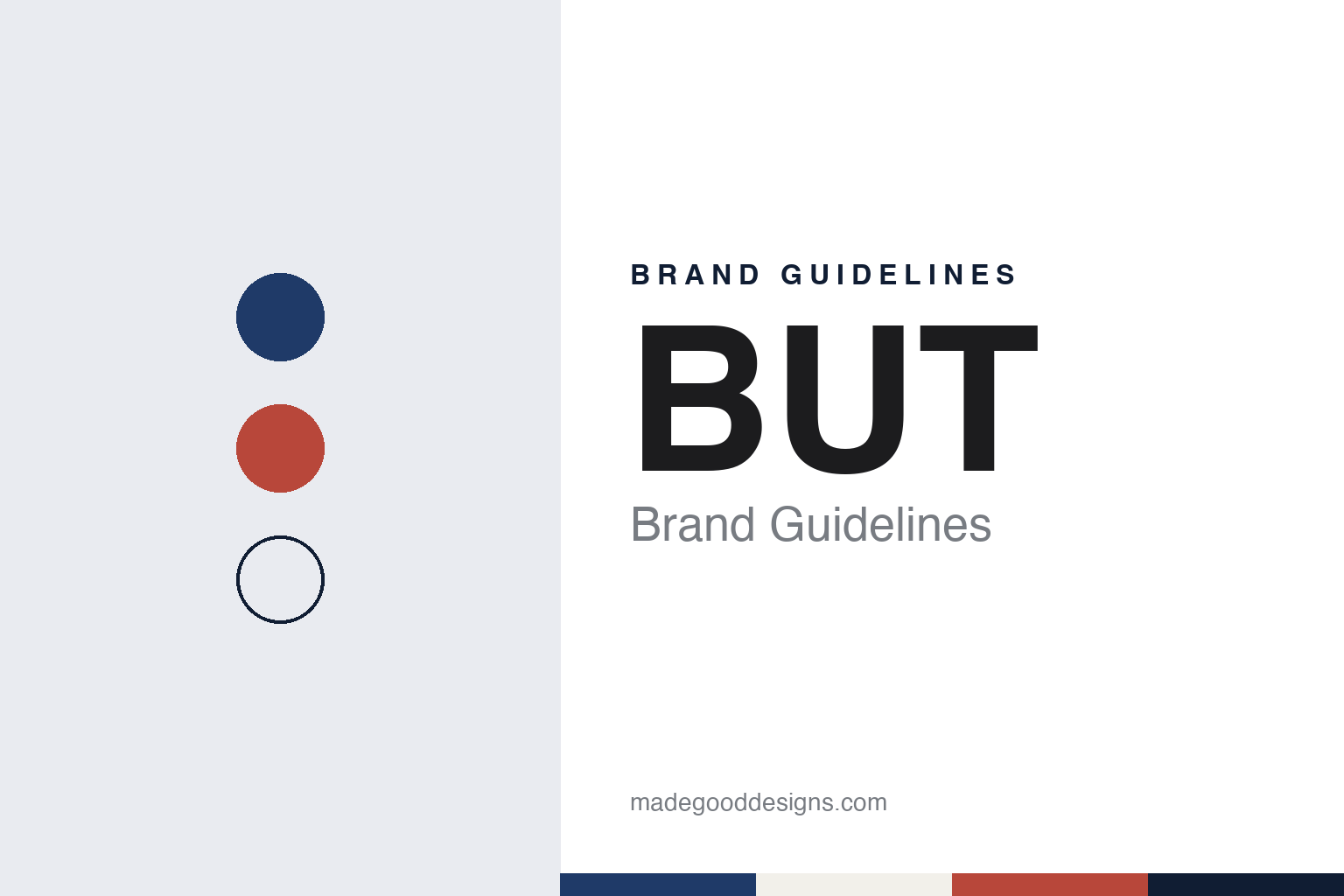
BUT Brand Guidelines
A Le Havre franchise network that grew into a national chain.
Aa
Two constants: a harbour blue, clay red and linen palette and a grotesque sans register. Abstract homage — not a BUT product or mark; no logo, sign or catalogue page is reproduced.
Le Havre, 1972
A furniture retailer and his son, and the franchise model.
BUT is a French chain selling furniture, decoration, household appliances and consumer electronics. French Wikipedia says the banner was created in 1972 in Le Havre, the Normandy port, by André Venturini, and that with his son Michel he expanded the network quickly through franchising. English Wikipedia gives the same founder, town and year, and adds that there were 140 BUT stores in 1982 and 280 in 2015. French sources usually write the name But; English Wikipedia and the English statements of France’s competition authority use capitals, BUT, which this guide follows.
The franchise model shaped the chain. In its 2022 decision on the Conforama purchase, the competition authority, the Autorité de la concurrence, described BUT as a network of 322 stores in mainland France and the overseas departments, run either by the company or by franchisees, and named BUT and Conforama as the two main groups offering furniture franchises in those overseas departments. In 2021 the same authority had counted 302 stores under the BUT banner, alongside its website.
The range is broad. French Wikipedia groups it into three markets found in every BUT store: furniture and decoration, including living-room furniture, bedding and kitchens; household appliances, both built-in and small; and image and sound. The trade site Retail Insight Network described the outlets in June 2016 as selling furniture, appliances and decorative accessories as well as a range of electronics.
The chain has also been visible on television. French Wikipedia says BUT was the official sponsor of the game show Le Juste Prix from 1987 to 2001 on TF1, and became its sponsor again in 2024 after the show returned on M6.
Colour
Carrefour, Kingfisher and private equity.
BUT changed hands several times before its current owners arrived. French Wikipedia says the hypermarket group Carrefour took a 47 per cent stake in July 1987 and reduced its holding in December 1993, as part of a restructuring of its own business. In 1997 the British group Kingfisher, owner of B&Q and the electrical retailer Comet, bought BUT and placed it in its Kingfisher Electricals division, according to both language editions of Wikipedia.
From the end of March 2008 to the end of June 2016, BUT belonged to Decomeubles Partners, a company held by a consortium of Colony Capital, Goldman Sachs and OpCapita, French Wikipedia says. On 29 June 2016 the trade site Retail Insight Network reported that the American investment firm Clayton, Dubilier & Rice had entered exclusive discussions to buy BUT in a 50:50 partnership with WM Holding, a company related to the Austrian furniture retailer XXXLutz; at that date it put the network at 303 company and franchisee stores. French Wikipedia says the transaction was completed in November 2016.
The 2016 owners form the holding company Mobilux. In September 2021 the Autorité described Mobilux as controlled by a subsidiary of Clayton, Dubilier & Rice and by the owner of the XXXLutz group, whose own furniture stores trade outside France, in countries including Germany, Austria, Switzerland and Sweden.
BUT has also crossed the border. In July 2022, French Wikipedia says, it opened its debut store outside France, in the PlaYce shopping centre in Yaoundé, Cameroon, under the name “BUT by Arno,” through a partnership between the Greek company Arno and the French company Duval, with a sales floor of about 1,300 square metres.
Typography
How furniture retailers present themselves.
Furniture retail is a category built around the showroom. The chains in this group, from the north-eastern United States and the American South to Canada, Australia and France, sell sofas, beds, tables and storage from large stores where pieces are set out as rooms, so a customer can see a bedroom or a living room as a whole before choosing its parts.
Print came early. The International Directory of Company Histories describes an Atlanta furniture partnership of the 1880s and 1890s selling through illustrated newspaper advertisements and through salesmen who carried photographs of furniture styles from door to door. Catalogues, flyers and weekend sale pages followed in the twentieth century, and today the same chains publish websites with room planners and online showrooms alongside the stores.
Naming tends to be plain. Many of these businesses carry a founder’s surname, sometimes joined to another name after a merger or purchase, and ranges are often sold under the retailer’s own label as well as under manufacturers’ brands. Store formats are named just as directly: showrooms, outlets, clearance centres and mattress departments.
Corporate pages fill in the rest. Listed companies publish founding dates, stock-exchange listings and leadership changes for investors, while family-owned chains tell the same story through founders and generations. Purchases of one chain by another, and changes of owner, are usually dated there too. For a designer, the useful material is this mix of a long-running name, a room-set showroom and a steady flow of printed and digital promotions; the tones and typefaces in each guide here are our own reading of that, not an official system.
Aa
A compact grotesque sans for a three-letter banner. (Specimen set in Archivo, a sans STAND-IN; NOT the BUT logo.)
BUT
Owner of its old rival.
In 2020 BUT’s parent took over its main rival. The Autorité said on 29 June 2020 that the European Commission had referred to it Mobilux’s proposed purchase of Conforama France, then a subsidiary of the Steinhoff group, and its later decision records that Mobilux made its offer on 9 June 2020, during a court-supervised conciliation procedure for Conforama. On 23 July 2020 the Autorité allowed Mobilux to complete the purchase before its review ended. The trade magazine Neomag reported on 24 September 2020 that the takeover of 162 Conforama stores in France had been completed, and that the two chains would work together in an “Alliance” on purchasing and digital projects while remaining separate companies with separate head offices.
The Autorité opened an in-depth examination on 15 September 2021. On 28 April 2022 it found that the deal raised three kinds of competition risk: buying power that could leave bedding suppliers economically dependent on the combined group; weaker terms for furniture franchisees in the overseas departments, where BUT and Conforama were the two main franchisors; and overlaps between stores in 56 local catchment areas. It nonetheless cleared the deal without conditions under the “failing firm” exception, which it said it had never applied since it gained merger-control powers in 2009, because it judged that Conforama would otherwise have disappeared and that no less harmful offer existed. The law firm Bird & Bird summarised the ruling in the same terms in 2022.
The two chains then moved under one French roof. The marketing trade title CB News reported on 8 September 2024 that BUT and Conforama had created the But Conforama group, four years after the Alliance and a year after setting up shared governance, with a holding company, But Conforama Holding France SAS, running supply chain, information systems, administration and finance, public affairs and property, while the two banners kept separate commercial strategies. The companies gave the group about 500 stores and 15,000 staff at that date.
For a design guide, BUT shows how a three-letter banner from a port town grew through franchisees and a run of owners into one half of a national group. Compare Conforama, its sister chain since 2020, and IKEA, the Swedish-founded flat-pack retailer that sells into the same French homes. For this guide we use a harbour blue, clay red and linen with a sans, an unofficial interpretation; no product or logo is reproduced.
Explore & save
Keep BUT’s identity on hand — save it to a board in the Made Good inspiration library.
BUT identity set
Pin the BUT harbour blue, clay red and linen palette and the grotesque sans register to your own board.