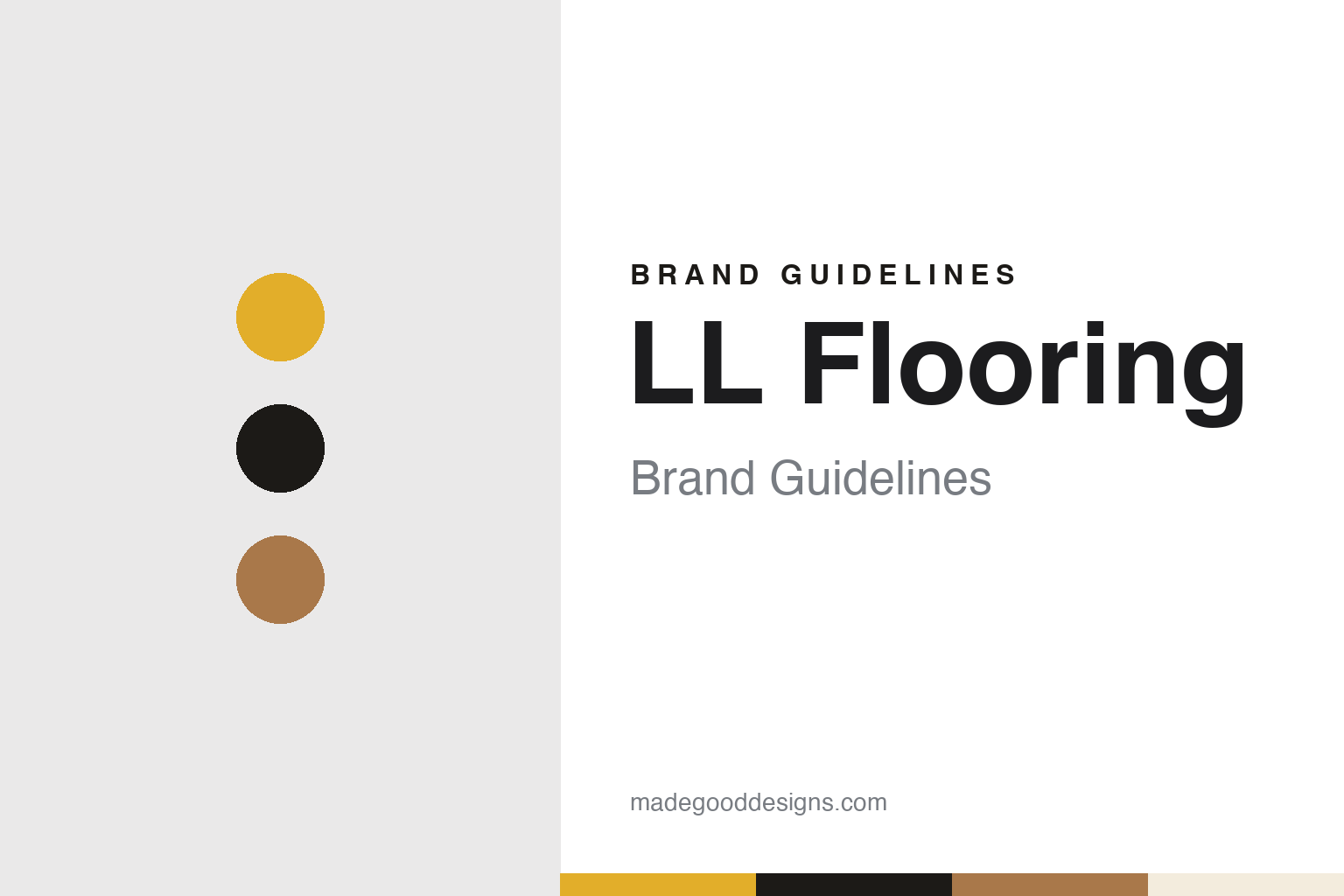
LL Flooring Brand Guidelines
Lumber Liquidators’ 2020 name, dropped after the 2024 Chapter 11.
Aa
Two constants: a yellow, black and oak palette and a Yard-sign sans register. Abstract homage — not an LL Flooring or Lumber Liquidators product or mark; no plank, logo or sign is reproduced.
Lumber Liquidators
Surplus wood from a trucking yard.
LL Flooring was the name used from 2020 to 2024 by the American flooring retailer founded as Lumber Liquidators. English Wikipedia says the business was started in 1994 by Tom Sullivan, a building contractor who bought surplus wood from other companies and resold it from the back of a trucking firm’s yard in Stoughton, Massachusetts. It found its niche in hardwood flooring, and its first store opened in West Roxbury, Massachusetts, on 5 January 1996, followed by a second in Hartford, Connecticut, that August.
The chain grew from that one small store in the Boston area, Floor Covering News (FCNews) noted in February 2025, by offering a wide variety of flooring at competitive prices, with clearance sales and promotions drawing price-conscious customers. English Wikipedia says it expanded into Canada in the fourth quarter of 2010 and was operating more than 415 stores across North America by the end of 2018. Along the way it added online sales, catalogues and a call center in Virginia, the same article says. Its base moved south to Virginia: FCNews describes the company that filed for bankruptcy in 2024 as a Richmond-based retailer, with a distribution center at Sandston, near Richmond. Before its bankruptcy the company’s shares were listed on the New York Stock Exchange under the ticker LL, English Wikipedia says.
In April 2020 the company publicly rebranded as LL Flooring, and the corporate entity became LL Flooring Holdings, Inc. with effect from 1 January 2022, according to English Wikipedia. FCNews described the new identity as a move to win back public opinion after the troubles of the previous decade, and in 2025 it quoted flooring retailers who were divided over whether dropping the old name had been wise.
Colour
Hard surfaces, and a federal case.
Under both names the business sold hard-surface flooring rather than carpet. English Wikipedia lists hardwood, laminate, vinyl plank, tile, bamboo and cork, with flooring tools and accessories. FCNews wrote in 2025 that under the LL Flooring banner the retailer offered an assortment of hard surfaces and a range of flooring accessories, with in-home delivery and installation, and that it sold mainly to homeowners and to flooring-focused professionals, such as installers, remodelers and small to medium-sized home builders, through stores in metropolitan areas.
The company built recognition through television as well as its stores. English Wikipedia says that in 2009 it began sponsoring the HGTV and DIY Network cable channels and the ABC programme Extreme Makeover: Home Edition.
Its record also includes a federal case. On 22 October 2015 Lumber Liquidators pleaded guilty in federal court to charges under the Lacey Act of 1900 over the illegal importation of hardwood flooring, and in February 2016 it was sentenced to criminal fines, forfeiture and payments to conservation organisations, English Wikipedia says. FCNews recorded the same plea and the 2016 penalties in its 2025 review of the company’s history. The case concerned the company’s timber imports; it was resolved by the 2016 sentence.
Both FCNews and English Wikipedia describe Lumber Liquidators as a retailer rather than a manufacturer, and neither gives a single country of origin for its range.
Typography
Design and documentation.
Flooring, carpet and tile retailers sell something that is hard to judge on a screen. A carpet’s pile, a vinyl plank’s grain and a tile’s glaze are chosen by hand and by eye, so these companies present themselves largely through physical display: showroom floors laid with sample sections, racks of carpet samples, stands of plank flooring and, in tile shops, walls set with finished panels. Several now take the showroom to the customer as well, sending vans or fitters with sample boards to measure a room at home, and their websites let shoppers order small samples before they buy.
Range and store naming tend to be plain. Collections are usually named for a material, a colour or a place, and products are grouped by room and by type, such as carpet, laminate, vinyl, luxury vinyl tile, engineered wood or porcelain, rather than by technical code. Shop fascias usually carry the retailer’s own name in large type, and some chains also run concessions inside department stores under their own brand.
The advertising follows the same practical line. The companies’ own pages and press reports show campaigns built around sales periods, interest-free credit, home visits and fitting, published in catalogues, on television, online and on shop windows, with buying guides that explain yarns, finishes and room-by-room choices.
Behind the shops, the corporate story is often one of founders, family owners, investors and changes of control. Corporate pages and press reports record listings on and departures from stock markets, private-equity and hedge-fund owners, administrations and pre-pack sales, and brands that survive after the original company has closed. This guide sets out who founded each chain, who owns it and what happened to it, as dated sources record it.
Aa
A tall, condensed sans in the manner of a yard sign. (Specimen set in Oswald, a sans STAND-IN; NOT the LL Flooring or Lumber Liquidators logo.)
LL Flooring
A monogram that lasted four years.
The LL Flooring name lasted just over four years. On 11 August 2024 LL Flooring filed for Chapter 11 bankruptcy protection in Delaware, English Wikipedia says; FCNews reported that at the filing it operated 442 stores and planned to go out of business after 30 years. On 3 September 2024 the company announced that it would close all its stores, but on 9 September it reached a last-minute agreement with F9 Investments, a Miami-based private-equity firm led by the founder, Tom Sullivan, and the court approved the purchase on 16 September, according to English Wikipedia. F9 took 219 stores and their inventory, the Sandston distribution center and the company’s intellectual property, FCNews reported, while the remaining stores were set to close.
Under the new owner the stores went back to the original name. English Wikipedia says the remaining locations had been rebranded Lumber Liquidators by October 2024, and FCNews quoted the company’s announcement that “yellow and black” was coming back. LL Flooring therefore no longer trades under that name; the business continues as Lumber Liquidators under F9. In the same announcement, quoted by FCNews, the founder said management would be local rather than run from large offices in Richmond, and FCNews reported that the range was to be cut to a more manageable selection.
Ownership has stayed unsettled since. In April 2026 Bed Bath & Beyond Inc. announced a preliminary agreement to buy F9 Brands, whose businesses included Lumber Liquidators and Cabinets To Go, Bisnow reported, noting that Lumber Liquidators then had more than 200 stores in the United States. The deal was later called off, Bloomberg Law reported in September 2026, describing F9 Investments as the parent company of Lumber Liquidators.
For a design guide, LL Flooring shows how a rebrand can be reversed: a short corporate monogram gave way again to the original, more literal name and its yellow and black. Compare Floor & Decor, another American hard-surface retailer, and Mohawk, an American flooring maker. For this guide we use a sawdust yellow, a near-black and an oak brown with a condensed sans, an unofficial interpretation; no product or logo is reproduced.
Explore & save
Keep LL Flooring’s identity on hand — save it to a board in the Made Good inspiration library.
LL Flooring identity set
Pin the LL Flooring yellow, black and oak palette and the Yard-sign sans register to your own board.