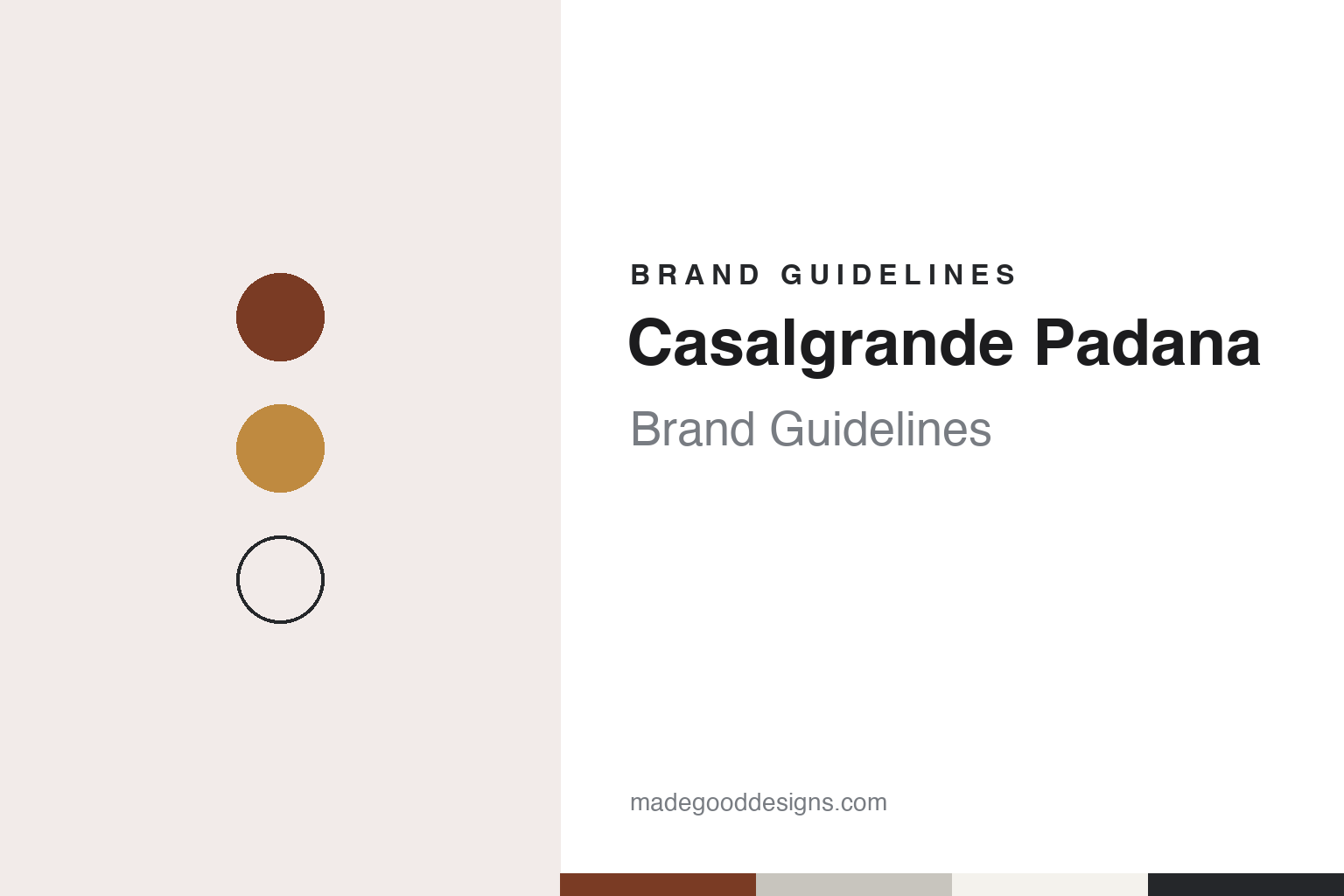
Casalgrande Padana Brand Guidelines
Porcelain stoneware from Reggio Emilia since 1960.
Aa
Two constants: a clay, ochre and porcelain grey palette and a soft serif register. Abstract homage — not a Casalgrande Padana product or mark; no tile, logo or pattern is reproduced.
A district company
Founded in 1960, producing from 1961.
Casalgrande Padana was founded in 1960 in Casalgrande, a town in the province of Reggio Emilia on the western side of Italy’s main ceramic tile district. Both the company and Italian Wikipedia give that year, and the company’s 2021 sustainability profile dates the start of production to 1961. Italian Wikipedia describes it as a joint-stock company that concentrates on porcelain stoneware, or gres porcellanato, for floors and wall coverings.
One name runs through its history. Sassuolo Oggi reported in June 2010 that Franco Manfredini joined Casalgrande Padana in 1961 as its first employee, became a partner two years later and was made president and managing director in 1974. The same report said he had been elected president of Confindustria Ceramica, the Italian ceramics industry association, in May 2009, and had just been named a Cavaliere del Lavoro by decree of the Italian president. He had first joined the board of Assopiastrelle, the association’s earlier name, in May 1986, and had chaired its committees on technical standards, on schools and universities, and on the environment. Fifteen years later he still chaired the company: professione Architetto described him as president of Casalgrande Padana in December 2025.
The company grew into a multi-plant producer. In 2010 Sassuolo Oggi wrote that it operated six plants covering 700,000 square metres, produced 27.3 million square metres of ceramic slabs a year, about four-fifths of them full-body technical ceramic, and had taken control of Nuova Ceramiche Ri.Wal. The company’s 2021 profile gave a slightly different picture: five factories with an annual capacity of 25 million square metres, more than 1,000 employees and all production in Italy. It listed three brands, Casalgrande Padana, Alfalux and Saime, and said about 70 per cent of its customers were outside Italy.
Colour
Façades, large slabs and a ceramic cloud.
Casalgrande Padana presents itself less as a maker of decorative tiles than as a supplier of ceramic materials for architecture. Its website describes products for building envelopes, floors and coverings, and sorts collections by effect: stone, marble, metal, wood, colour, cement, granite and terrazzo. Its named systems include Kontinua large-format tiles, ceramics for façade cladding, raised floors and Extragres 2.0, an external floating floor. A range called Tactile is made for tactile walking surfaces in public spaces.
The company has used architecture as its showcase. In January 2010 Sassuolo 2000 reported that the town of Casalgrande had lent the company the land inside a roundabout on the Strada Pedemontana, beside its plant, for a work by the Japanese architect Kengo Kuma. Named the Casalgrande Ceramic Cloud, it was planned at about forty metres long and five metres high, built from the company’s technical ceramics. Casalgrande Padana told the paper it treated the project as a chance to test new uses of its own ceramic parts in architecture, working with the universities of Ferrara and Catania.
Its showrooms follow the same idea. The company calls them Creative Centres, and its 2021 profile said five had been built to move past the usual showroom by combining product display with work in architecture, design and production. The same profile records that the company sponsored the fourth Biennale of Architecture in Pisa and adopted a formal code of ethics in 2014. The profile adds that the German Quality and Finance Institute gave it a “Top Job 2021–22” seal as one of the top 300 employers in Italy.
Typography
How tile makers show themselves.
Ceramic tile makers sell surfaces that people mostly meet as rooms, so their own material leans heavily on finished spaces. Pamesa’s website, for example, offers downloadable catalogues, moodboards, “by effect” and “by space” product searches and a BIM library for architects, and Porcelanosa’s 2026 showrooms in Vila-real presented its large-format porcelain through furnished settings, Interempresas reported. Room-set photography, in which a collection is laid across a kitchen, a bathroom or a terrace, is a common way to show a range.
Naming follows the surface. Pamesa’s 2026 ranges carry names such as Heritage, Trevi and Taj Mahal, and makers sort them by finish, format and thickness. Trade reports in 2026 described Porcelanosa adding 160 cm by 160 cm floor pieces and 3 mm slabs for furniture cladding, and Pamesa grouping its new ranges into four families, each defined by the kind of material effect it shows.
Trade fairs are the other main stage. Cersaie, held at BolognaFiere in Italy, reached its 43rd edition from 21 to 25 September 2026, according to Castellón Información. Both companies built their 2026 stands as furnished settings: Pamesa called its 2026 space The Gallery, and Porcelanosa printed a magazine to guide visitors around its stand. Pamesa’s website also keeps virtual tours of its stands at Cersaie and at Cevisama from 2017 to 2022, while Porcelanosa stages its own annual show in Vila-real, which reached its 32nd edition in 2026.
Behind the collections sit corporate pages that read quite differently. They list group companies, plants, acquisitions and leadership teams, and they are often the clearest public record of who owns which brand. This guide relies on those pages only for what the companies say about themselves, and on press reports and encyclopedias for dated facts.
Aa
A soft serif for an architecture-minded maker. (Specimen set in Fraunces, a serif STAND-IN; NOT the Casalgrande Padana logo.)
Casalgrande Padana
An architecture prize since 1990.
The strongest part of Casalgrande Padana’s public identity is a competition. Italian Wikipedia and the company both date the Grand Prix to 1990: an international award for built works that make inventive use of the company’s porcelain stoneware, judged by a panel of architects and designers. professione Architetto reported in December 2025 that the thirteenth edition had drawn more than 1,000 entries, with 20 shortlisted by a jury of architects, critics, teachers and trade journalists chaired by Franco Manfredini.
That edition went to Italian projects in all three categories, the magazine said. The prize for large surfaces and façade cladding went to the interiors of the Colosseo–Fori Imperiali station on Rome’s Metro Line C, designed by Andrea Grimaldi and Filippo Lambertucci of Sapienza University; the other category winners were a school at Puos d’Alpago and Villa Dellago on Lake Garda. Behind the Rome station in that category the magazine placed a group of works by Alfonso Femia Atelier(s), including student housing at Asnières-sur-Seine, an innovation hub at Cesson-Sévigné near Rennes and the Milano 3.0 residential district. Earlier recognitions, as Sassuolo Oggi listed them in 2010, include a Sodalitas Social Award for product innovation and an EY Entrepreneur of the Year award in 2006, and the Premio Impresa Ambiente, an Italian business award for the environment, in 2007. The same report said all its plants were certified to ISO 14001 and EMAS.
The company’s logo, typeface and colours are not documented in any public design history. For a design guide, Casalgrande Padana shows how a tile maker can build its brand around architects rather than consumers, through a prize, a public sculpture and technical systems. Compare Iris Ceramica, a neighbour in the same district, and Atlas Concorde. For this guide we use a clay red, a kiln ochre and a porcelain grey with a serif, an unofficial interpretation; no product or logo is reproduced.
Explore & save
Keep Casalgrande Padana’s identity on hand — save it to a board in the Made Good inspiration library.
Casalgrande Padana identity set
Save the clay, ochre and porcelain grey palette and the soft serif register to your own board.