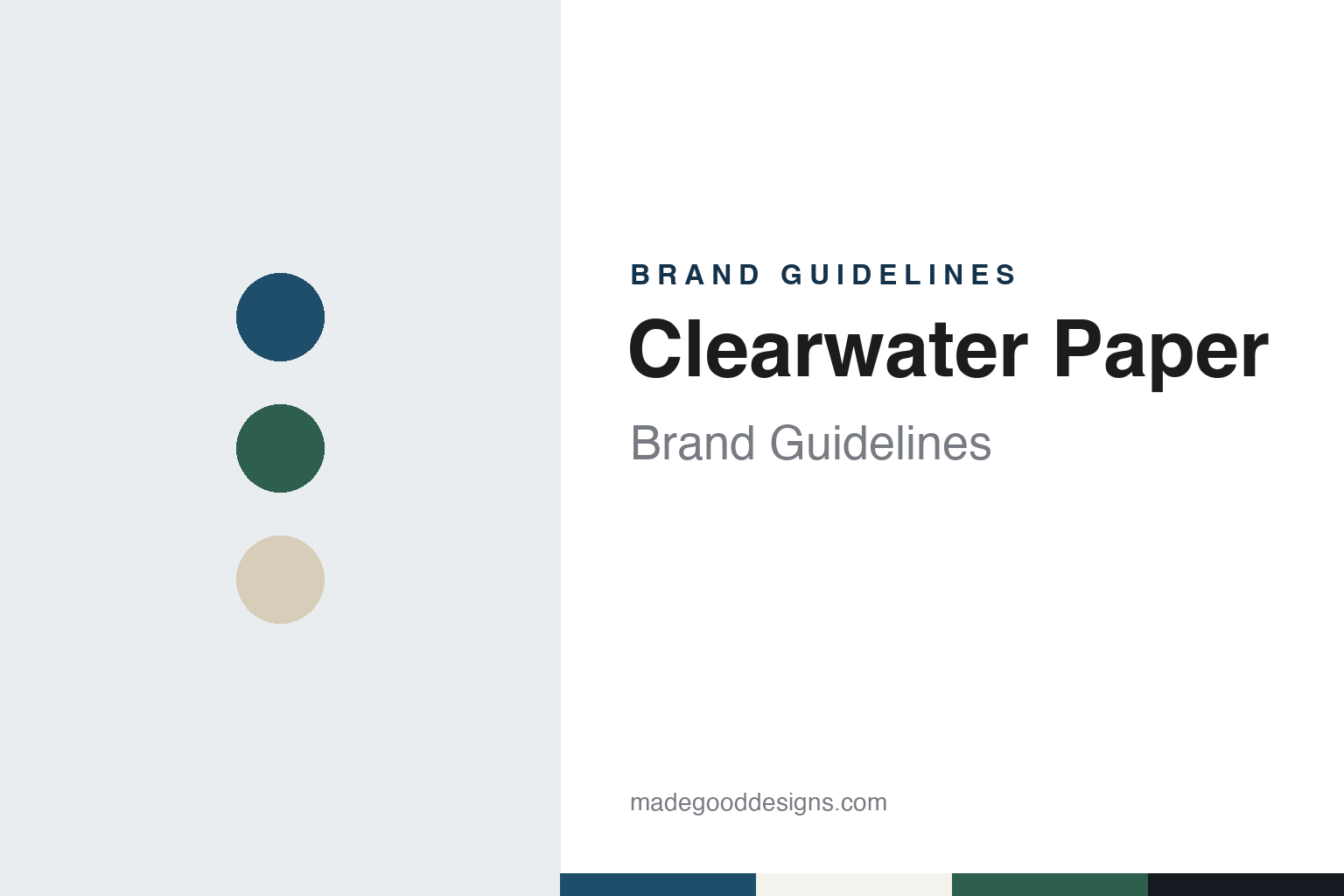
Clearwater Paper Brand Guidelines
The Idaho timber name that became a paperboard company.
Aa
Two constants: a river blue, pine and pulp palette and a bookish serif register. Abstract homage — not a Clearwater Paper product or mark; no carton, logo or wordmark is reproduced.
From Potlatch
A timber company, a river and a 2008 spin-off.
Clearwater Paper is a paperboard maker based in Spokane, Washington, whose name goes back to an Idaho timber company. English Wikipedia says the Clearwater Timber Company was founded in December 1900 by Frederick Weyerhaeuser and John A. Humbird to log land along the Clearwater River in Idaho. It started a sawmill on the river at Lewiston in 1927, and in 1931 it was acquired by Potlatch Forests, according to the same article.
Under Potlatch, Lewiston became the centre of a pulp and paper business. Wikipedia says a pulp and paperboard mill started there in 1950 and a second mill followed at Arkansas City, Arkansas, in 1977. Potlatch entered tissue in 1953 by buying a mill at Pomona, California, began making private-label tissue at Lewiston in 1963, opened a tissue plant in North Las Vegas, Nevada, in 1993 and consolidated its Midwest tissue converting at Elwood, Illinois, in 2006.
Clearwater Paper itself dates from 2008. Potlatch’s board announced the spin-off of its pulp-based businesses on 17 July 2008, and the new company was created on 9 December 2008, Wikipedia says; Potlatch went on as a real estate investment trust, while Clearwater took the tissue and paperboard plants. The Spokesman-Review reported on 17 December 2008 that the spin-off was complete and that Clearwater Paper would begin trading on the New York Stock Exchange that day under the symbol “CLW.” Potlatch shareholders received one Clearwater share for every 3.5 Potlatch shares they held. The newspaper listed the new company’s operations as Lewiston, plus plants in Elwood, at Cypress Bend in Arkansas and in Las Vegas, and noted that both companies were headquartered in Spokane.
Colour
Sixteen years of store-brand tissue.
For its first sixteen years Clearwater ran two divisions: consumer products, and pulp and paperboard. The consumer side made household tissue, from paper towels and napkins to bathroom and facial tissue, mostly for retailers’ own labels. Wikipedia says the division produced through-air-dried (TAD) towels as well as premium and value lines, and describes Clearwater as the largest supplier of private-label toilet paper to US grocery chains as of 2024.
The tissue side grew and then contracted. In late 2010 Clearwater bought Cellu Tissue Holdings of Alpharetta, Georgia, adding plants across the eastern United States and one in Ontario, Wikipedia says. A new site at Shelby, North Carolina, started up in December 2012 making private-label TAD tissue meant to compete with national TAD brands, and the North Las Vegas plant was upgraded in the same year. Between 2013 and 2021 the company closed or sold most of the former Cellu Tissue sites, including five sold to Dunn Paper in 2014 and a Wisconsin mill sold to the same buyer in 2018.
The tissue business was sold in 2024. On 22 July 2024 Clearwater announced an agreement to sell it to Sofidel America, the US arm of the Italian tissue maker Sofidel, The Spokesman-Review reported; the company said the move took it a step further toward becoming “a premier independent supplier of paperboard” in North America. Sofidel announced on 1 November 2024 that it had finalised the purchase after obtaining all regulatory approvals, taking over four plants, at Shelby, Lewiston, Las Vegas and Elwood, and about 1,700 employees. Sofidel called it the largest acquisition in its history and said it made Sofidel the fourth-largest tissue paper maker in North America.
The two businesses still meet at Lewiston. Wikipedia says Clearwater’s pulp operation there sends slush pulp to the Sofidel tissue plant on the same site.
Typography
Design and documentation.
Tissue and hygiene-paper makers mostly sell under names that are not their own. The corporate group is often a holding name, and shoppers meet it through a portfolio of consumer brands: Essity’s brands page lists TENA, Tork, Libero, Lotus and Zewa, each with a short category label and a link to its own website, while Sofidel puts Regina first and runs separate Regina sites for seven European countries alongside national names such as Sopalin, Le Trèfle and Hakle.
Consumer pack design follows those brand families rather than the parent. Brand names travel across toilet paper, kitchen towels and handkerchiefs, and some identify themselves by a physical detail: Sofidel says its KittenSoft tissue is recognisable by a heart-shaped embossing. Many brands came to their current owners through acquisitions, so a group’s portfolio often mixes a home-grown house brand with bought national names that keep their local identities.
The away-from-home side looks different again. Here the product is often a system for washrooms and other busy places, pairing paper with dispensers. Essity describes Tork as tissue and dispenser systems for professional and high-traffic environments and says more than 30 million Tork dispensers are refilled regularly; Sofidel lists away-from-home products as one of four business lines, next to its consumer brands, private label goods for retailers and parent reels, the large semi-finished reels sold to other converters.
The corporate websites then speak to a different audience: investors, job seekers, suppliers and journalists. Their pages typically set out the brands, the mills and the owners. Sofidel tells its story decade by decade from its first facility in 1966, and Essity explains its business areas and its 2017 origin as a spin-off from SCA. Sustainability sections on forests, water and plastics sit alongside those histories, written in each company’s own words.
Aa
A bookish serif for a board maker that supplies printers and carton converters. (Specimen set in Source Serif 4, a serif STAND-IN; NOT the Clearwater Paper logo.)
Clearwater Paper
Three bleached board mills and a cup stock.
Clearwater had already begun to reshape itself before the tissue sale. Earlier in 2024 it took over Graphic Packaging’s bleached paperboard mill at Augusta, Georgia, The Spokesman-Review reported in July that year. Since the sale, Wikipedia says, the company has operated three solid bleached sulfate (SBS) mills, at Lewiston, Arkansas City and Augusta, plus smaller converting sites run by its subsidiary Manchester Industries, a Richmond, Virginia, paperboard sheeting and distribution business it bought in 2016. It sold the Lewiston sawmill to Idaho Forest Group in November 2011.
SBS board goes into folding cartons, liquid packaging, plates, cups and some commercial printing, and Clearwater also makes softwood market pulp. Its product names include Candesce, a board for premium folding cartons and print, Ancora, a coated board bleached white on both sides, NuVo, a cup stock with up to 35 per cent post-consumer fibre, and ReMagine, a carton and blister-pack board with 10 or 30 per cent post-consumer fibre, according to Wikipedia. The same article says its mills follow the chain-of-custody standards of the Forest Stewardship Council, the Sustainable Forestry Initiative and the Programme for the Endorsement of Forest Certification, and that Clearwater was the first North American SBS maker to offer FSC certification across its product lines.
The paperboard years have not been smooth. The trade site papnews reported on 27 October 2026 that a major disruption at the Augusta mill had reduced volumes and raised costs in the third quarter of 2026, with problems continuing into October, and that the company had refinanced its debt. Chief executive Arsen Kitch said management was making progress towards normal operations at Augusta, the report said.
For a design guide, Clearwater Paper shows a company whose output mostly reaches people inside other brands’ packaging: first as store-brand tissue, now as the board behind cartons and cups. Compare Sofidel, which bought its tissue plants, and Georgia-Pacific, another US maker of tissue and paper products. For this guide we use a river blue, a pine green and a pulp beige with a serif, an unofficial interpretation; no product or logo is reproduced.
Explore & save
Keep Clearwater Paper’s identity on hand — save it to a board in the Made Good inspiration library.
Clearwater Paper identity set
Pin the Clearwater Paper river blue, pine and pulp palette and the bookish serif register to your own board.