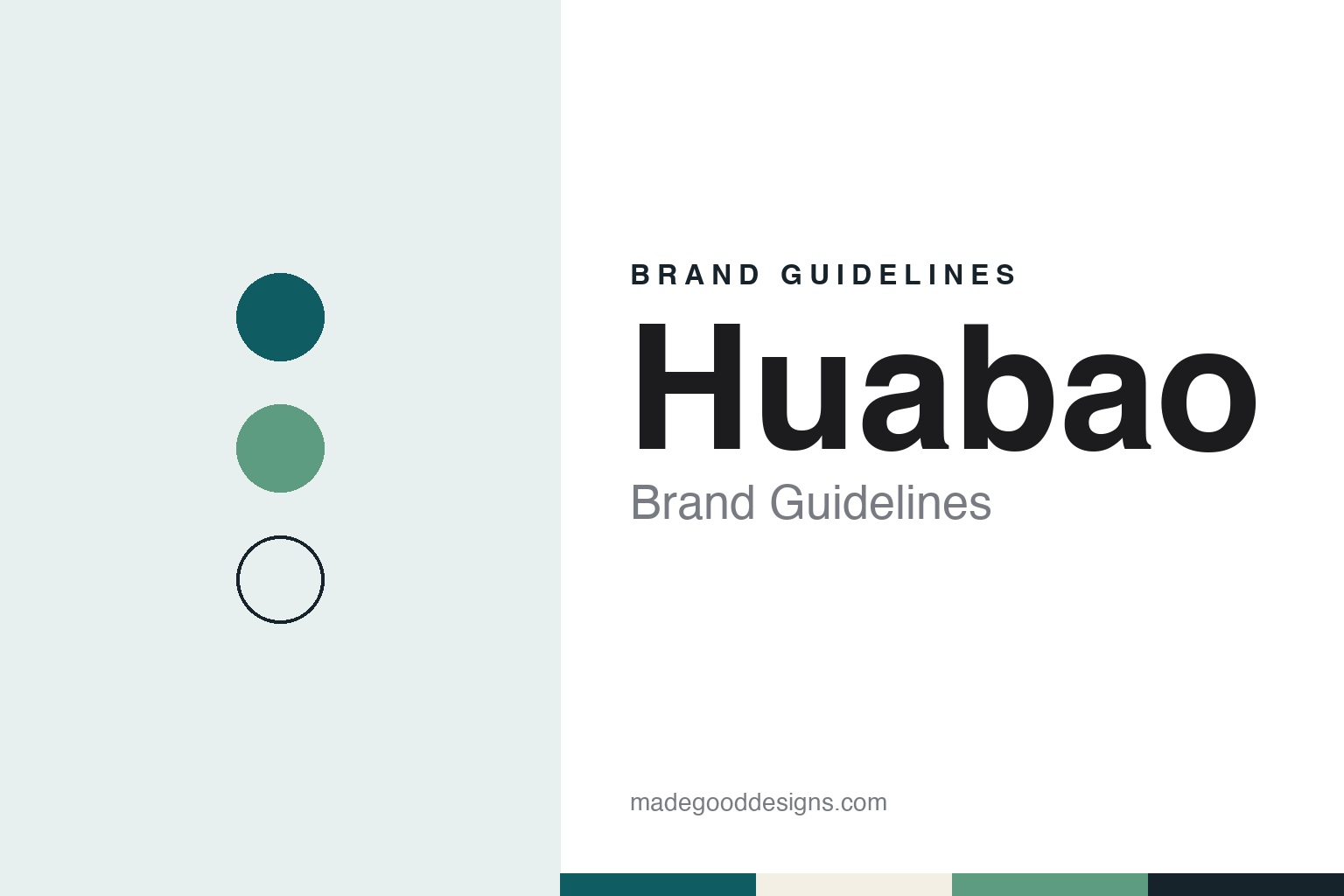
Huabao Brand Guidelines
A Shanghai flavour house with many regional brands.
Aa
Two constants: a peacock teal, jade and ivory palette and a calm serif register. Abstract homage — not a Huabao product or mark; no logo, label or package is reproduced.
Jiading, 1996
A Shanghai flavour company and its Hong Kong parent.
Huabao is a Chinese flavour and fragrance group whose parent, Huabao International Holdings Limited, is listed in Hong Kong. Its company profile says Huabao International was established in 1996 and listed on the Hong Kong Stock Exchange under the code 00336 in 2006. Its timeline begins in 1996, when the group set up Huabao Food Flavors & Fragrances Co. in Jiading District, Shanghai, for the research, production and sale of flavours and fragrances.
Sources give the listing history differently. Chinese Wikipedia says the Hong Kong company took the Huabao International name on 30 April 2004, renamed from an earlier company, while Huabao’s own timeline says its flavours and fragrances business was listed in Hong Kong in 2006.
Huabao also claims a much older lineage for its food flavours. Its business pages trace them to the Continental Chemical Society, which the company describes as the first national flavour business, set up in Shanghai in 1912 and the predecessor of its Shanghai H&K unit, and they date the “H&K” brand to 1947. The sources used for this guide do not say how the Continental Chemical Society operated during the Japanese occupation of Shanghai of 1937–1945. At a ceremony in June 2026, a Huabao executive described the Peacock (Kongque) brand as China’s oldest century-old national brand, the Securities Times reported.
The group grew through the 2000s by founding and buying regional companies. Its timeline lists Yunnan Tianhong Flavors & Fragrances in 2001, Shanghai H&K Flavors & Fragrances in 2004 and a 51 percent stake in Huafang Tobacco Flavors in 2005. A German research centre, Aromascape Development Centre GmbH, followed in 2007, a 51 percent stake in Xiamen Amber, a maker of daily-chemical fragrances, in 2008, and F&G Botswana in 2009. In 2013 the domestic headquarters moved to the Huabao Industry Park in Shanghai, and a US company was set up the same year.
Colour
Flavours, aroma materials and condiments.
Huabao describes its main business as the research, production and sale of flavours and fragrances for tobacco, food and personal care, together with aroma raw materials, tobacco raw materials and ingredients — the company names reconstituted tobacco leaf and expanded stems — and condiments. It calls its strategy “Concentric Diversification,” and its English website carries the line “FLAVOR YOUR LIFE.” Chinese Wikipedia names its main brands as Peacock and Hedon. The group’s development strategy page sets out plans to use its flavour technology to expand into food and beverage flavours, then into additives and food ingredients, and to build a large production base for aroma raw materials in Asia.
Tobacco flavours come first on the group’s flavour page. The company names its tobacco-flavour brands as HEDON, Tianhong, Hua Fang and OWADA, and says it has long-term cooperation with tobacco companies in China; in 2011 it acquired Guangdong Province Golden Leaf Technology Development. Food flavours run through Shanghai H&K and a Guangzhou unit set up in 2008 for savoury flavours, and the company lists uses from dairy products and beverages to baking, instant noodles and snack foods. Daily-chemical flavours come from Xiamen Amber, founded in 1998 and quoted on China’s NEEQ share-transfer system since 2015, according to Huabao.
The aroma raw materials segment includes Yancheng Chun Zhu Fragrances, acquired in 2015, and companies in Zhaoqing and Yongzhou, and Huabao says its customers include international fragrance companies. Condiments arrived on 4 September 2018, when the group acquired all of Jiahao Foodstuff, a Zhongshan company founded in 1994 whose two main products are chicken bouillon and wasabi paste; Huabao quotes Jiahao’s positioning as a “professional brand for the professional chef.”
Abroad, the timeline lists the German research centre, the Botswana company, a Korean joint venture set up in 2012 and a US company founded in 2013, alongside the Shanghai, Yunnan, Guangdong and Fujian operations at home.
Typography
Flavour and fragrance houses.
Flavour and fragrance houses sell to other companies, so their public identity is built for buyers, investors and future staff more than for shoppers. Their websites tend to divide the business into a few lines: flavours for food and drink, fragrances for fine perfumery and consumer goods, and ingredients sold in their own right. Mane groups its pages under flavours, fragrances and ingredients, for example, and Robertet adds natural raw materials and natural actives.
Creation is shown through people and places. Houses publish pages on their perfumers and flavourists, their training schools and their creation centres: Mane describes a perfumery school where apprentices train for at least two years, and Robertet lists a New York creation centre opened in 2006.
Natural materials are the other recurring story. Houses around Grasse lean on the region’s flower and plant heritage and on extraction methods: Robertet frames its sourcing as “Seed to Scent,” from the field to the finished creation, while Mane presents named extraction technologies and, in 2026, an experimental garden. Sourcing pages often pair those stories with certifications and supplier assessments, stated in the companies’ own words.
Ownership is part of the identity too. Some houses stress family control and independence; listed ones publish regulated announcements on shareholders and acquisitions. Robertet, listed in Paris since 1984, set out a change of shareholders in November 2024, and Mane’s change of chief executive in February 2025 kept the group in family hands, WWD reported. This guide sets out what can be checked about each house: who founded it, who owns it and what it says about where its materials come from.
Aa
A calm serif for a group of old and new flavour brands. (Specimen set in Noto Serif, a serif STAND-IN; NOT the Huabao logo.)
Huabao Technology
From Huabao Flavours to Huabao Technology.
Huabao has two listed layers. On 1 March 2018 its subsidiary Huabao Flavours & Fragrances Co., Ltd. was listed on the ChiNext board of the Shenzhen Stock Exchange under the code 300741, the group’s timeline says. In June 2026 that subsidiary took a new name: the Securities Times reported that an unveiling ceremony for Huabao Technology Co., Ltd. was held in Shanghai on 18 June 2026, marking the change from “Huabao Flavours” to “Huabao Technology” after thirty years. The report quoted the company’s aim of becoming a provider of flavour and wellness solutions with global reach, and said Huabao presented its research centres and what it calls “product chips,” reusable technology modules for product development.
The Hong Kong parent keeps the Huabao International name, and its website, hbglobal.com, presents the group in simplified Chinese, traditional Chinese and English; the older huabao.com.hk address forwards visitors to it. The site groups the business into four segments — flavours, tobacco raw materials and ingredients, aroma raw materials and condiments — each with a list of the companies behind it, rather than under one master brand.
For a design guide, Huabao shows a holding-company identity that sits above many regional brands, from Peacock and H&K to Hedon and Jiahao, with a parent name in Hong Kong and a renamed operating company in Shenzhen. Compare Givaudan and Firmenich, two Swiss-rooted flavour and fragrance houses. For this guide we use a peacock teal, a jade green and a warm ivory with a serif, an unofficial interpretation; no product or logo is reproduced.
Explore & save
Keep Huabao’s identity on hand — save it to a board in the Made Good inspiration library.
Huabao identity set
Pin the Huabao peacock teal, jade and ivory palette and the calm serif register to your own board.