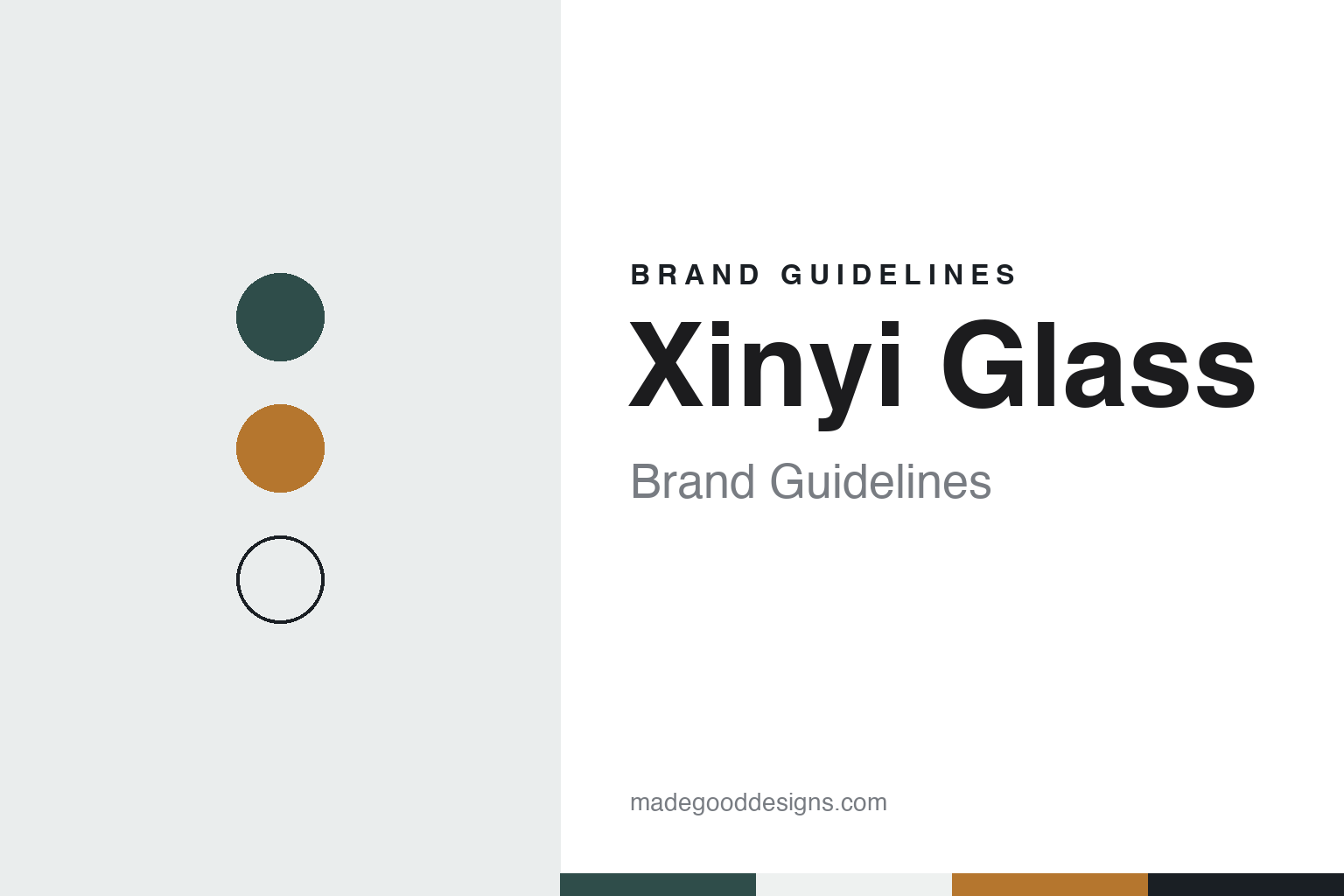
Xinyi Glass Brand Guidelines
A Hong Kong-run maker of float, building and automobile glass.
Aa
Two constants: a Xinyi green, white and amber palette and a technical sans register. Abstract homage — not a Xinyi Glass product or mark; no glass, logo or nameplate is reproduced.
Founded in 1988
A glass maker run from Hong Kong.
Xinyi Glass Holdings is a Hong Kong-headquartered maker of float glass, automobile glass and architectural glass, with most of its factories in mainland China. English Wikipedia dates its establishment to 1988 and names Lee Yin Yee as its founder and chairman; the company’s own boilerplate says it was established in Hong Kong. A company release from August 2026 describes the automobile glass business, the oldest of the three, as having an operating history of nearly 40 years.
The company joined the stock market in February 2005, listing on the Main Board of the Hong Kong Stock Exchange under the stock code 00868, the company says; English Wikipedia gives the same year. English Wikipedia dates its inclusion in the Hang Seng Index, Hong Kong’s main share index, to 6 September 2021. The company adds that it belongs to 47 Hang Seng indexes, among them the Hang Seng Composite Index and the HSI ESG Index, and to several MSCI indexes, including the MSCI All Country Far East Ex Japan Index.
In its 2026 boilerplate the group describes itself as one of the largest integrated makers of float, automobile and architectural glass in China and overseas. Two official recognitions appear there as well: its registered trademark was recognised as a “China Well-known Trademark” by the State Administration for Industry and Commerce in 2017, and its automobile glass brand was named a “China Top Brand” in 2007 by the General Administration of Quality Supervision, Inspection and Quarantine. English Wikipedia lists Ford, General Motors and Volkswagen among the customers of its automobile glass.
Colour
Three businesses, many plants.
Xinyi organises its work in three segments: float glass, architectural glass and automobile glass. The company calls its building products energy-saving architectural glass and its sheet products high-quality float glass, and it describes itself as an integrated manufacturer of all three. Chairman Lee Yin Yee said in the August 2026 release that the float and architectural segments had kept up their profitability through an industry downturn while the group went on adding capacity.
The automobile arm is the most international part of the group. The same release says its products are sold in more than 150 countries and regions across North and South America, Europe, Asia, Oceania, the Middle East and Africa, through its own sales network and regional teams, and the business covers the design, development, manufacture, delivery support and service of automobile glass and accessories. Its main market is replacement glass for cars already on the road, and it is expanding its supply to vehicle makers, which lets it take part in the development of new models. The company says that in 2025 the business ranked first by revenue in the global aftermarket for automobile glass.
Production is spread across what the company calls 15 production complexes in key economic zones in provinces across China, plus sites in Malacca, Malaysia, and East Java, Indonesia. In July 2023 an Indonesian minister said Xinyi had invested in East Java the previous year, Reuters reported in a story carried by The Business Times. The company says it held nearly 17 per cent of mainland China’s float-glass capacity in operation at the end of August 2026, and more than 10 per cent of global capacity.
The group is also tied to a solar business. Xinyi Glass is the single largest shareholder of Xinyi Solar Holdings, with 23.8 per cent of its shares, and directly holds 5.73 per cent of Xinyi Energy Holdings, according to the release; English Wikipedia names Lee Yin Yee as founder and chairman of Xinyi Solar as well.
Typography
Glass makers and their pages.
Glass makers sell mainly to builders, carmakers and bottlers rather than to shoppers, and their brand pages are written for those buyers. The material does much of the visual work. Many of the large producers fill their websites and annual reports with photographs of their own float lines, furnaces and forming machines, shot and published the way each company chooses, next to close-ups of finished sheets, windscreens and bottles.
Product pages tend to follow the three big markets. Architectural ranges cover clear and tinted float glass, coated glass for solar control and insulation, laminated glass and mirrors, each usually with a range name and a technical data sheet. Automotive pages describe windscreens, side and roof glass, and glass with heating, acoustic layers or head-up-display areas. Container makers show bottles and jars by capacity, colour and finish, often with catalogue pages of standard shapes for wine, beer, spirits and food.
Colour belongs to the catalogue as much as to the logo. Flat-glass makers publish swatches for body tints and reflective coatings, and packaging makers name their glass colours, such as flint, amber and green, and show the same bottle shape in each. Corporate pages carry a second kind of identity: maps of plants, lists of countries, ownership histories and stock-market listings, which matter in an industry where many groups have grown by buying or merging with other glassworks.
The guides in this group read those public materials: founding records, owners, plants and product families, as the companies and independent sources describe them. The colours and type samples shown here are our own interpretation, not official brand assets, and no product or mark is reproduced.
Aa
A technical sans for a listed manufacturer. (Specimen set in IBM Plex Sans, a sans STAND-IN; NOT the Xinyi Glass logo.)
Xinyi Glass
A spin-off in progress.
The group is now reshaping itself. On 31 August 2026 Xinyi Glass said its wholly owned subsidiary, Xinyi Automobile Glass Holdings, had filed a listing application with the Stock Exchange of Hong Kong, after the exchange confirmed that the group could go ahead with a spin-off of the automobile glass business. Under the plan, most of the new company’s shares would be distributed to Xinyi Glass shareholders, with further shares sold by the parent and issued by the new company. Each qualifying shareholder would receive the new shares pro rata and for nil consideration, the release says. On its estimate, the distributed shares would represent 80 per cent of the new company’s shares in issue, while the shares sold by the parent and those newly issued would make up 14 and 6 per cent of the expected offering. BNP Paribas Securities (Asia) is managing and sponsoring the offering. The spin-off was announced in August 2026 and had not been completed at the time of writing.
The chairman said in the release that the spin-off would not narrow the group’s business scope, but would let each unit sharpen its focus and give investors a clearer view of each business. The release presents the separation as a way to support the continued growth of the automobile glass business, given its scale and international reach.
For a design guide, Xinyi Glass shows how a manufacturer can present itself through its business segments, its listings and the official recognitions it names. Compare Fuyao, another Chinese automobile-glass maker, and Kibing, another Chinese glass group. For this guide we use a deep float green, ink, silica white and an amber with a technical sans, an unofficial interpretation; no product or logo is reproduced.
Explore & save
Keep Xinyi Glass’s identity on hand — save it to a board in the Made Good inspiration library.
Xinyi Glass identity set
Pin the Xinyi green, white and amber palette and the technical sans register to your own board.