Fuyao Brand Guidelines
The Fuqing windshield maker with factories in 13 countries.
Aa
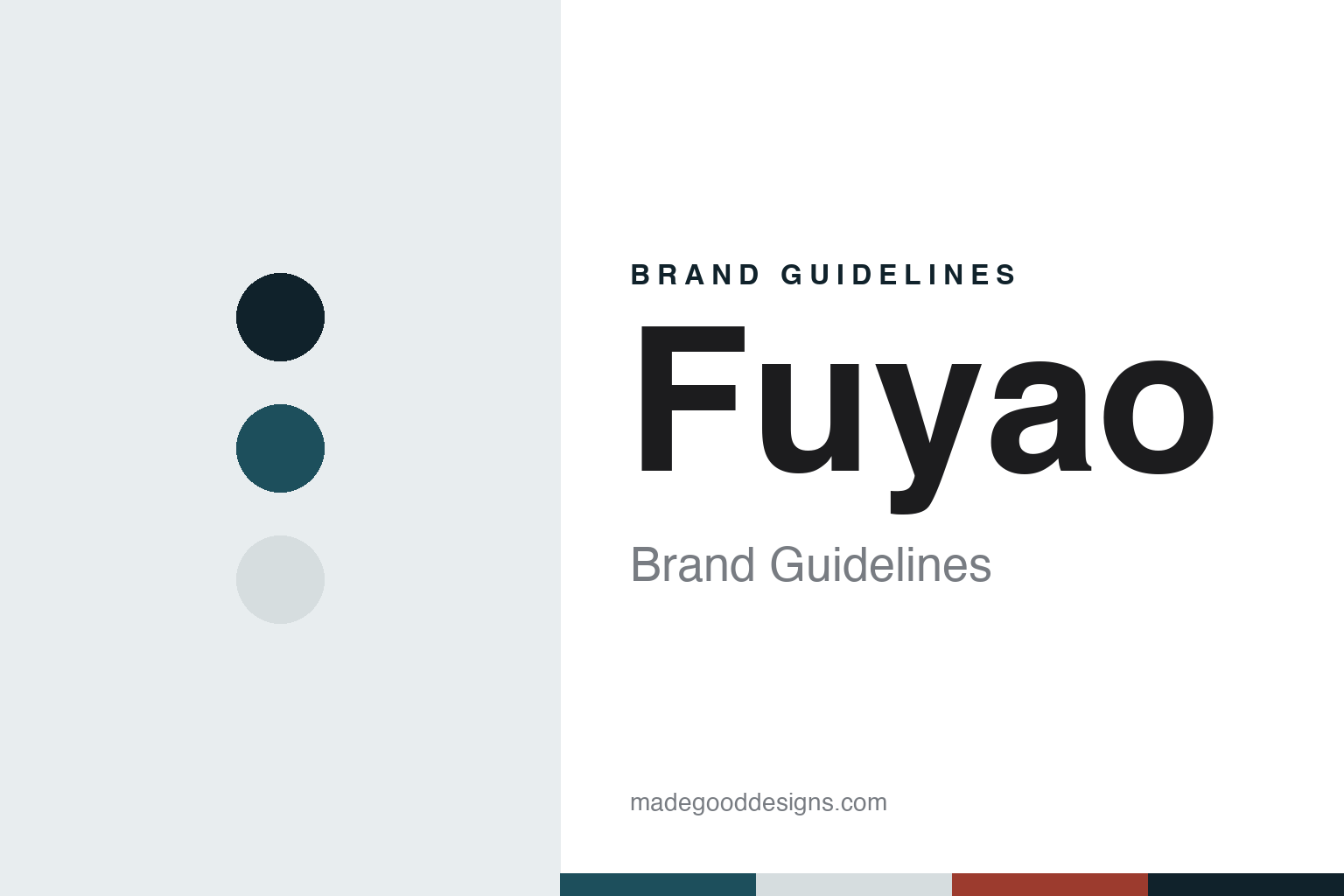
Two constants: a teal, ink and silver palette and an industrial sans register. Abstract homage — not a Fuyao product or mark; no glass, logo or nameplate is reproduced.
Fuqing
A township glass factory that became a listed group.
Fuyao is the trading name of Fuyao Glass Industry Group Co., Ltd., an automotive-glass maker headquartered in Fuqing, in Fujian province in south-east China. The company dates its origins to 1976, when, it says, Cho Tak Wong led the founding of the Fuqing Gaoshan special-shaped glass factory, a township enterprise it describes as its predecessor. Fuyao itself was formally incorporated in 1987. English Wikipedia says the founder, known in Mandarin as Cao Dewang, set up the company with several partners as a joint venture, after earlier taking over the management of a glass factory owned by a local government; the Chinese financial news service Yicai Global wrote in October 2025 that Cao was one of the founders of Fuyao Glass in 1987.
The name, English Wikipedia says, joins the first character of Fuqing (福, fú) to the word for “shine” (耀, yào). In the early years, it adds, there were few large buyers of new cars in China, so the company aimed at replacement glass for the many imported vehicles then on Chinese roads.
Ownership moved quickly in the first decade. Fuyao listed on the Shanghai Stock Exchange in 1993; the company says it was the first private enterprise to list on China’s A-share market. In 1996 it formed a joint venture with the French group Saint-Gobain, which took a majority stake; three years later Cao bought that stake back, according to English Wikipedia. Fuyao became an original-equipment supplier to General Motors in June 2006, and in 2015 its H shares were listed on the Hong Kong Stock Exchange, giving it what the company calls an “A+H” structure with one listing inside mainland China and one outside.
Leadership passed to a second generation in 2025. In mid-October that year the company announced that Cao Dewang had resigned as chairman as part of a governance restructuring, TechNode and Yicai Global reported; he stayed on the board with the title of lifetime honorary chairman, and his son Cao Hui, vice chairman since 2015 according to Yicai Global, was elected chairman. The company’s English website gives the two names as Cho Tak Wong and Tso Fai.
Colour
Windshields, sunroofs and trim for other people’s cars.
Fuyao describes itself as an industrial group covering the design, development, manufacture, supply and servicing of automotive glass and automotive aluminium parts and trim; English Wikipedia adds that it also makes float glass and construction glass. Its product pages are organised by function rather than by car model. One group covers head-up-display windshields, acoustic glass, heated glass and antenna glass. Another covers panoramic sunroofs, encapsulated glass and sliding-window assemblies, and the site also has pages for rail glass and a replacement-glass business.
The company says it now has production, sales and research bases in 13 countries, including China, the United States, Germany, Russia, South Korea and Japan, and operates in 18 provincial-level regions in China. Its global map lists float glass, automotive glass, aluminium parts and trim, aluminium refining, silica sand and the making of equipment, moulds and inspection fixtures among its activities. The company names Mercedes-Benz, BMW, Audi, Toyota and Volkswagen among the car brands that use its glass, and puts its own global market share at about 35 per cent on one page and about 34 per cent on another. TechNode gave about 34 per cent in October 2025, and Yicai Global described Fuyao as the largest supplier of automotive glass by market share.
The American business began in 2014. English Wikipedia says Fuyao chose the former General Motors assembly plant at Moraine, Ohio, a plan made public in January 2014, and that the same year it bought a float-glass plant at Mount Zion, Illinois; the Ohio plant entered full-scale production in October 2016. Yicai Global described the Ohio factory as a renovated abandoned site. Its first years of operation were filmed for the documentary American Factory, which premiered at the Sundance Film Festival in January 2019 and won an Academy Award in 2020 in the documentary-feature category, according to English Wikipedia and Yicai Global. English Wikipedia also lists further US sites in Greenville, South Carolina, and Detroit, Michigan, as of early 2020.
Recognition, as the company presents it, centres on manufacturing awards. Its site lists the China Quality Award and designations as a demonstration enterprise for intelligent manufacturing and as a “green factory,” and in May 2018 it reported a gold award in Jaguar Land Rover’s global supplier-excellence programme. The founder’s page also names the Phoenix Award, a glass-industry prize, among Cao Dewang’s honours.
Typography
How glass makers present themselves.
Glass makers sell mainly to builders, carmakers and bottlers rather than to shoppers, and their brand pages are written for those buyers. The material does much of the visual work. Many of the large producers fill their websites and annual reports with photographs of their own float lines, furnaces and forming machines, shot and published the way each company chooses, next to close-ups of finished sheets, windscreens and bottles.
Product pages tend to follow the three big markets. Architectural ranges cover clear and tinted float glass, coated glass for solar control and insulation, laminated glass and mirrors, each usually with a range name and a technical data sheet. Automotive pages describe windscreens, side and roof glass, and glass with heating, acoustic layers or head-up-display areas. Container makers show bottles and jars by capacity, colour and finish, often with catalogue pages of standard shapes for wine, beer, spirits and food.
Colour belongs to the catalogue as much as to the logo. Flat-glass makers publish swatches for body tints and reflective coatings, and packaging makers name their glass colours, such as flint, amber and green, and show the same bottle shape in each. Corporate pages carry a second kind of identity: maps of plants, lists of countries, ownership histories and stock-market listings, which matter in an industry where many groups have grown by buying or merging with other glassworks.
The guides in this group read those public materials: founding records, owners, plants and product families, as the companies and independent sources describe them. The colours and type samples shown here are our own interpretation, not official brand assets, and no product or mark is reproduced.
Aa
An industrial sans for a components maker. (Specimen set in Work Sans, a sans STAND-IN; NOT the Fuyao logo.)
Fuyao
A clear vision, in the company’s own words.
For a visual identity, the company’s own pages are the main record. The English site leads with automotive imagery and the line “A Clear Vision of Tomorrow,” and it lists its core values as “diligence, simplicity, learning and innovation.” Subsidiaries trade under regional sites, including one for the United States and one for Germany, and the replacement-glass business has its own link from the main menu. The palette in this guide is our own interpretation and is not taken from the logo.
The founder’s name is also attached to education. The company says that in 2010 he gave Fuyao shares to set up the Heren Charitable Foundation, and that Fuyao University of Science and Technology, which he proposed and the foundation funded, was approved by China’s Ministry of Education on 21 February 2025 as a new type of research university.
Fuyao’s story is told in numbers of countries and plants rather than in product names, which suits a supplier whose glass carries other companies’ badges. The company’s own pages stress independence and applied research, and the “A+H” pair of listings gives it two sets of public filings, in Shanghai and Hong Kong.
For a design guide, Fuyao shows how a supplier whose product sits in other makers’ cars presents itself through function pages, factory maps and scale. Compare Saint-Gobain, its joint-venture partner in the late 1990s, and AGC, the Japanese glass group. For this guide we use a deep teal, ink, a pale float-glass silver and a brick red with a sans, an unofficial interpretation; no product or logo is reproduced.
Explore & save
Keep Fuyao’s identity on hand — save it to a board in the Made Good inspiration library.
Fuyao identity set
Save the Fuyao teal, ink and float-silver palette and the industrial sans register to your own board.