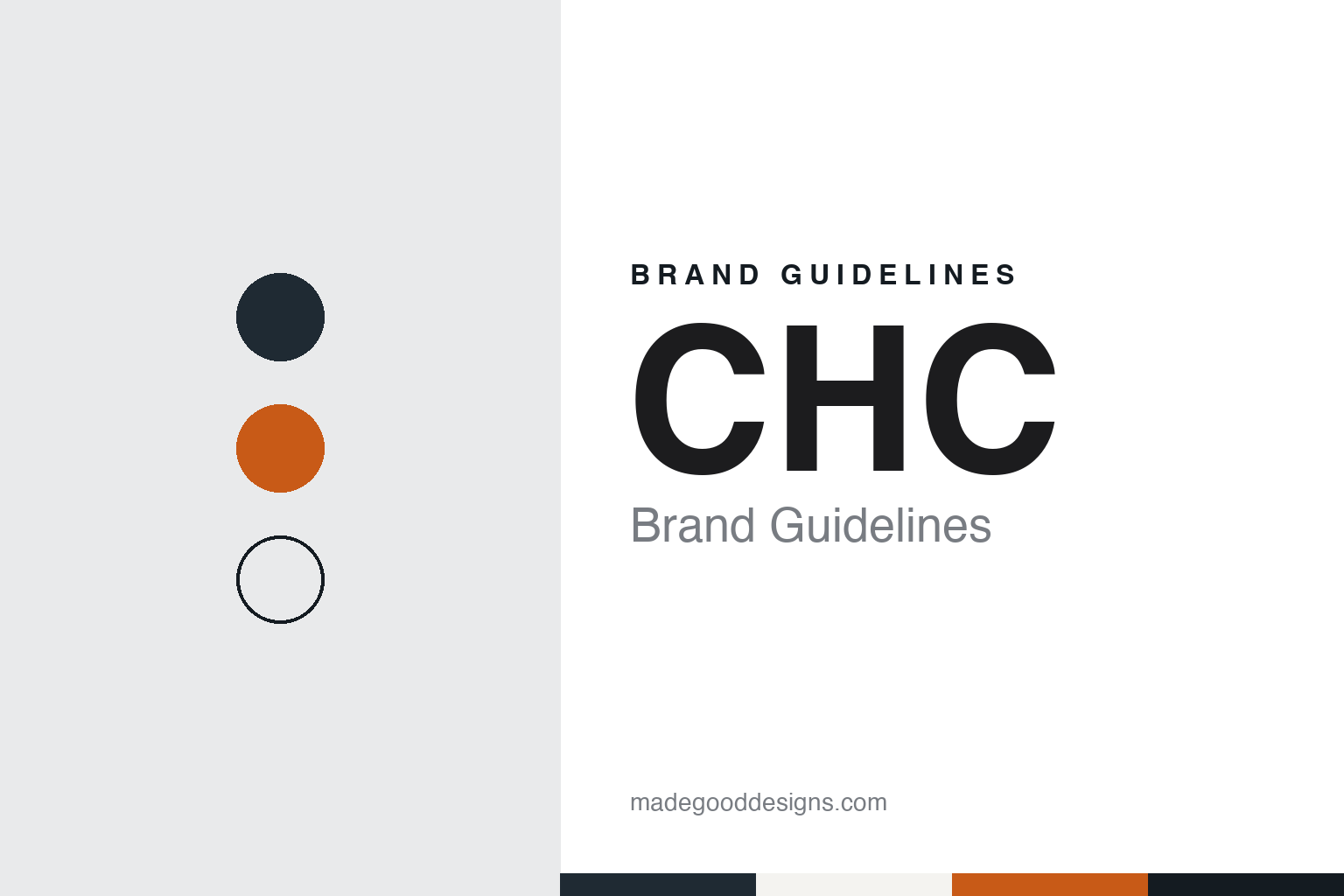
CHC Brand Guidelines
A 1987 merger that took its colour from a 1947 ancestor.
Aa
Two constants: a charcoal, slate and orange palette and a rounded grotesque register. Abstract homage — not a CHC livery or mark; no aircraft, hummingbird logo or nameplate is reproduced.
Okanagan to CHC
A Bell 47, three veterans and the Okanagan Valley.
CHC traces its roots to British Columbia. Its website says the company descends from Okanagan Air Services, founded in 1947 by Canadian Air Force veterans. English Wikipedia names them as the former RCAF instructors Carl Agar and Barney Bent, joined by the former RCAF engineer Alf Stringer; they had started a flying club at Penticton and moved it to Kelowna under the Okanagan name. Their first helicopter, a Bell 47-B3, was delivered on 9 August 1947 and was the first commercially licensed helicopter in British Columbia, Wikipedia says.
The early work was crop dusting, insect spraying and mountain survey flying for the government; Agar received the Trans-Canada Trophy in 1950 for that mountain work, and contracts followed from companies such as the Aluminum Company of Canada for remote construction. In the early 1950s the firm became Okanagan Helicopters Ltd, and through that decade it helped build and maintain the Mid-Canada Line of radar stations with Sikorsky S-55s and Bell 47s. In the 1970s it bought a string of smaller operators, set up an international division and moved to turbine types such as the Bell 212 and Sikorsky S-76, Wikipedia says.
The CHC name arrived in 1987. A group of investors led by the Newfoundland businessman Craig Dobbin, organised as the Canadian Holding Company, combined Dobbin’s Sealand Helicopters with Okanagan and Toronto Helicopters. Vertical described the deal in 2017 as a merger of Canada’s three largest instrument-flight and offshore oil-and-gas operators; Wikipedia adds Viking Helicopters to it. The operating business was first branded Canadian Helicopters, and the parent was renamed CHC Helicopter Corporation.
Colour
From Canada to the North Sea.
CHC grew by buying offshore operators abroad. Vertical reported that it took a stake in British International Helicopters, the former British Airways Helicopters, in the early 1990s, bought the Norwegian Helikopter Services Group in 1999 and acquired the Dutch operator Schreiner Aviation Group, with work in the North Sea, Africa and Asia, in 2004. Wikipedia says the Norwegian deal also brought in Bond Helicopters, Lloyd Helicopters of Australia and Court Helicopters of South Africa. To reduce its debt, Vertical said, CHC spun off its maintenance shops as Vector Aerospace in 1998 and its domestic Canadian bases as Canadian Helicopters in 2000.
In 2004 the company reorganised into two divisions — Helicopter Services for flying and Heli-One for maintenance, repair and overhaul — and moved its headquarters from St. John’s, Newfoundland, to Richmond, British Columbia, Wikipedia says. In February 2008 the private-equity firm First Reserve announced at the HAI Heli-Expo show that it was buying CHC, Vertical reported; the word “Corporation” was later dropped and the company became CHC Helicopter. A new management team based in Dallas took over in early 2015.
The company returned to the public market on 21 January 2014, listing on the New York Stock Exchange under the ticker HELI, Vertical reported. Oil prices fell sharply that summer, and the debt the company carried began to weigh on it. The NYSE suspended trading in the shares and delisted them on 1 February 2016, Wikipedia says, and on 5 May 2016 CHC filed for Chapter 11 protection in the United States.
Typography
How offshore operators present themselves.
Offshore helicopter operators sell a narrow service: moving crews and cargo between airports and installations at sea, and standing by for search and rescue. Their websites tend to follow the same plan. Bristow divides its work into offshore energy services, search and rescue, government services and advanced air mobility; CHC lists offshore transportation, search and rescue, emergency medical services, utility work and maintenance.
Colour carries much of the identity. Liveries vary from operator to operator, from navy to red and orange, and some choices carry history: when CHC came out of Chapter 11 in 2017 it changed its company colours to the orange of Okanagan Helicopters, one of its founding companies, Vertical reported. The photographs the companies publish tend to show helicopters over open sea or on helidecks, next to fleet pages arranged by type, from the Sikorsky S-92 to the Airbus H175 and the Leonardo AW139 and AW189.
Base maps are another constant. In the North Sea they run from Aberdeen, Norwich and Humberside to Stavanger and Den Helder; other networks reach the Gulf of Mexico, Brazil’s Santos Basin, West Africa, Australia and Southeast Asia. Contract news fills the press pages: crew-change deals with energy companies, coastguard search-and-rescue contracts such as those in the United Kingdom, Ireland and the Netherlands, and maintenance work, which CHC sells under its Heli-One name.
Many of these operators have also been reshaped by restructurings and mergers. CHC filed for Chapter 11 in 2016, Bristow’s US entities followed in 2019, and Bristow merged with Era Group in 2020, so investor pages, quarterly results and ticker symbols sit alongside the helicopters. This guide sets out what can be checked about each operator — who founded it, who owns it and where it flies — and marks clearly what rests only on the company’s own word.
Aa
A rounded grotesque for an operator that wears its founding company’s orange. (Specimen set in Barlow, a sans STAND-IN; NOT the CHC logo.)
CHC
Orange, a hummingbird and “Reach Beyond.”
CHC emerged from Chapter 11 in March 2017 after ten months. Vertical gave the date as 24 March and reported that the fleet had been cut to 137 aircraft after more than 80 leased helicopters were rejected, with the Sikorsky S-92 and Leonardo AW139 as core types; Wikipedia says key creditors took majority ownership. The company came out with a new look, launched just before HAI Heli-Expo in Dallas: a refreshed logo that kept its hummingbird, a new “Reach Beyond” positioning line and a change of company colours to the orange of Okanagan Helicopters, in the 70th anniversary year of that founding company, Vertical reported.
The deals since then have been mixed. In March 2021 CHC agreed to buy Babcock International’s offshore oil-and-gas aviation business in the UK, Denmark and Australia, around 30 aircraft, Vertical reported, and it completed the purchase in September 2021 while keeping the businesses separate during competition reviews. After an in-depth investigation, the UK Competition and Markets Authority required CHC in 2022 to sell the UK business, finding that the two were two of only four suppliers of those services in the UK. CHC agreed the sale of Offshore Helicopter Services UK to South Africa’s Ultimate Aviation Group in December 2022, and the sale was completed in April 2023. In August 2022 CHC Group LLC also announced a recapitalisation to cut its debt.
Today the company is headquartered in Irving, Texas, and incorporated in Newfoundland and Labrador, Wikipedia says. Its website lists offshore transportation for oil and gas and offshore wind, search and rescue, emergency medical services, utility work and Heli-One maintenance. In July 2026 Equinor extended CHC Helikopter Service’s personnel-transport and search-and-rescue work in central Norway to 2030, using S-92s from Kristiansund, Brønnøysund and the Heidrun field, CHC says. In March 2026 CHC said it had won its first carbon-capture contract, flying an Airbus H175 from Norwich for the Northern Endurance Partnership, and in September 2026 it said Petrobras had named CHC do Brasil its top air-logistics supplier in its 2026 supplier awards and given it a five-year Búzios crew-change contract starting in June 2027. Wikipedia says CHC served the Irish Coast Guard from 2005 to 2025.
For a design guide, CHC shows how a restructured company can take its colour from its oldest ancestor. Compare Bristow, another operator long established in the North Sea, and Equinor, one of its offshore customers in Norway. For this guide we use a charcoal, a slate and an orange with a sans, an unofficial interpretation; no product or logo is reproduced.
Explore & save
Keep CHC’s identity on hand — save it to a board in the Made Good inspiration library.
CHC identity set
Pin the CHC charcoal, slate and orange palette and the rounded grotesque register to your own board.