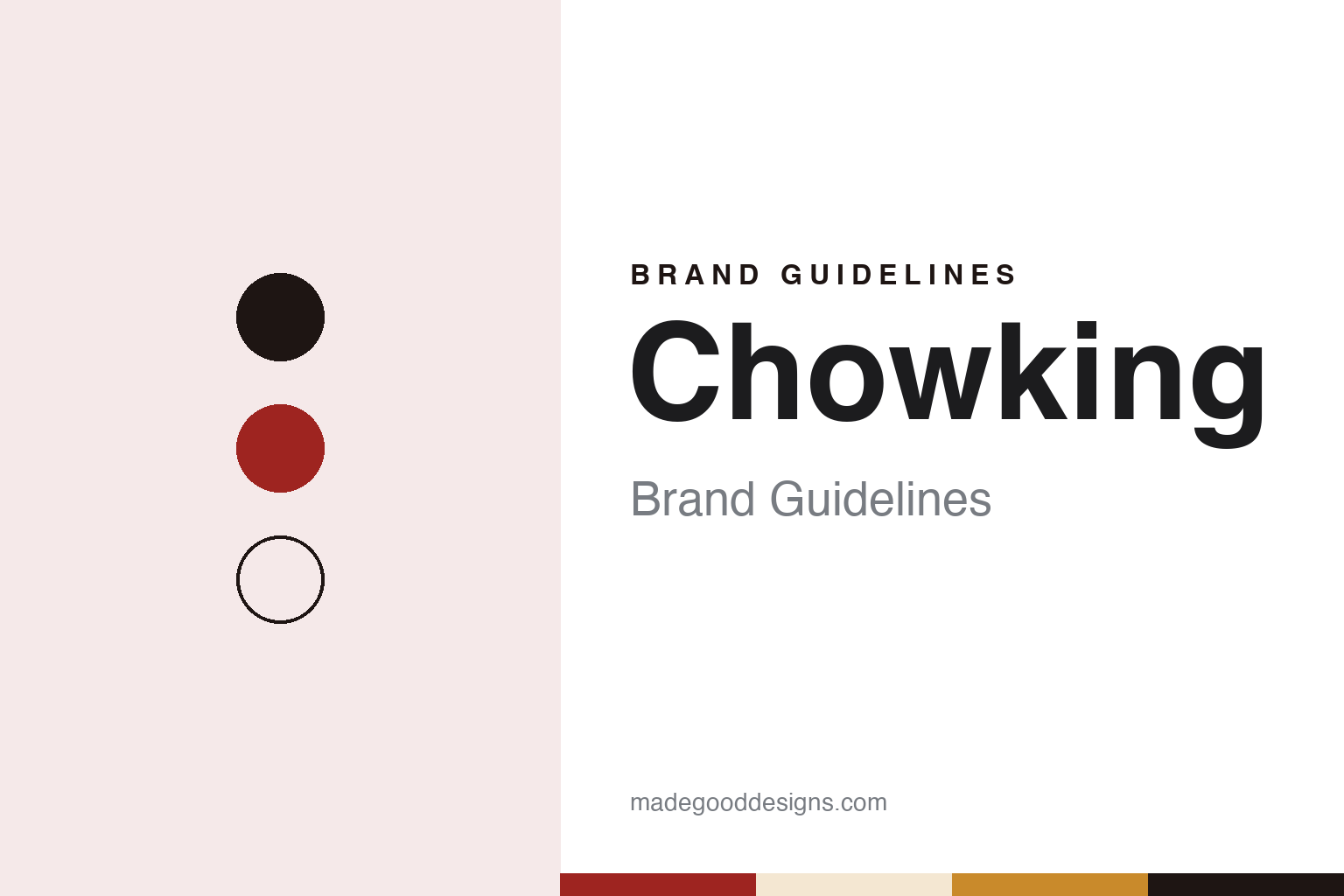
Chowking Brand Guidelines
The 1985 Makati Chinese-Filipino chain inside Jollibee.
Aa
Two constants: a Chowking lantern red and ginger gold palette and a Sturdy sans register. Abstract homage — not a Chowking product or mark; no dish, logo or sign is reproduced.
Ling Nam to Makati
A noodle-house manager and a fast-food format.
Chowking began in Makati in 1985. English Wikipedia says Chowking Food Corporation was incorporated on 19 February 1985 and that the first restaurant opened on 18 March 1985 on the ground floor of the Rotary Arcade in the Makati Commercial Center, a site now occupied by SM Makati. Its founder was Robert Kuan, who came from Ling Nam, a Chinese noodle house in Binondo. A 2007 food column in The Philippine Star says Ling Nam was established in 1950, partly owned by Kuan’s family, and that he worked there for eight years, through five branches, before leaving on the advice of his friend Henry Sy of SM.
The idea, as the same column describes it, was to bring traditional Chinese dishes into a new setting at a time when the fast-food trade was dominated by Western food and the old panciterias were going out of style. Kuan did not start alone. English Wikipedia names the principal investors as Kuan, Tony Tan Caktiong, the founder of Jollibee, and Wilson Chu, and says that after two years Kuan and Tan Caktiong bought out Chu’s shares, leaving each of them with half the company. The name, the same source says, comes from a Chinese word meaning “outstanding”; the brand’s Chinese name is 超群 (chāoqún).
The Star column describes a system built for consistency: dishes developed with chefs from Hong Kong, Philippine chefs trained to prepare them, and automation to keep the kitchens efficient. English Wikipedia says Chowking began franchising in 1989, with its first franchised store in Meycauayan, Bulacan, and had ten restaurants by the end of that year. A 1992 expansion took it beyond Luzon, to Cagayan de Oro in Mindanao and Bacolod in the Visayas; the chain had 21 locations at the end of 1992 and opened its hundredth in 1996, the same source says.
Colour
Rice bowls, noodles and a Jollibee parent.
Chowking joined the Jollibee group at the turn of the century. The 2007 Star column says that in November 1999 Chowking had 155 stores, three of them in the United States and three in the Middle East, when Kuan sold it to Jollibee, and quotes him explaining that “the price was good and it was time to let go.” English Wikipedia says the sale was agreed in late 1999 and completed in March 2000, when Jollibee Foods Corporation acquired Chowking Food Corporation from its holding company, Antares Holdings; it gives a slightly different count for that November, 162 branches.
Under Jollibee the subsidiaries were reorganised. In 2006, English Wikipedia says, Chowking was merged with Greenwich Pizza and Baker Fresh Foods Philippines into a company renamed Fresh N’ Famous Foods Inc., when Chowking had 342 stores in the Philippines. Its food is prepared in two commissaries in Muntinlupa, which also act as warehouses and distribution centres, according to the same source, which describes a modernisation of the noodle building and production lines between 2006 and 2008.
The menu is Chinese-Filipino rather than burgers. Jollibee Group’s brand page lists rice bowls, noodle soups, dim sum and desserts, and places Chowking among its “multi-country” brands, with sites for the Philippines, the United Arab Emirates, Saudi Arabia and the United States. English Wikipedia, citing the anthropologist Ty Matejowsky’s 2017 book Fast Food Globalization in the Provincial Philippines, names mami noodle soup, sweet siopao buns and the iced dessert halo-halo among its dishes, and reports his finding that Chowking’s main rivals in provincial towns were family-owned Chinese restaurants rather than other fast-food chains.
Abroad, the chain followed Filipino communities. English Wikipedia dates its first overseas restaurant to 1996, in San Diego, California, followed by two stores in Jakarta, and says Jollibee took control of the franchised Chowking USA business in 2011. In the Gulf, a 2009 business report in The Philippine Star described a franchise held by Tradeline, a Dubai trading group, which opened its first Chowking in April 2003. Its UAE stores were more spacious than those at home, seated up to 200 people for parties, and added Filipino home-style dishes such as bulalo and kare-kare to the noodles, dim sum and chicken; the franchisee had set up its own commissary and research team. English Wikipedia counts 19 stores in the UAE, five in Qatar and two in Oman in February 2014.
Typography
How Asian restaurant chains present themselves.
Asian restaurant chains tend to present themselves through what happens in the kitchen. Din Tai Fung’s own history page opens with the xiaolongbao and its count of 18 folds, and the Taipei Times traced that formula to the founder’s son working alongside the shop’s first dim sum chefs.
Names and shop fronts carry a lot of the identity. Tim Ho Wan’s Chinese name means “to add good luck,” English Wikipedia says, and Din Tai Fung’s joins the names of a former employer and an oil supplier, according to the company and the Taipei Times. Long-kept signs, such as the brushed board that Din Tai Fung says still hangs at its first restaurant on Xinyi Road, link a chain of many branches back to one room.
Dish naming is usually plain and descriptive: barbecue pork buns, steamed rice rolls, pan-fried turnip cake, soup dumplings. Groups can list signature dishes by name when they announce deals, as Jollibee Foods Corporation did for Tim Ho Wan in November 2024, GMA News reported. Guidebook recognition travels with a name too: Tim Ho Wan’s first shop in Mong Kok appeared with a star in the 2010 Michelin Guide, Gourmet Traveller reported in 2015, and that star still features in how the chain is introduced in press coverage.
The corporate side is published too. Company pages set out founders and founding years, parent groups describe their portfolios in stock exchange disclosures, and franchise partners appear in trade press when rights change hands. This guide sets out what can be checked about each brand — who founded it, who owns it and how it grew — and marks clearly what rests only on the company’s own word.
Aa
A sturdy sans for a quick-service sign. (Specimen set in Barlow, a sans STAND-IN; NOT the Chowking logo.)
Chowking
One of three core chains in a larger group.
Chowking’s identity has changed with the group around it. English Wikipedia says the brand was relaunched in August 2010 with a new logo and the Filipino tagline “Tikman ang Tagumpay,” which translates as “Taste success.” The relaunch came in the chain’s 25th year, a quarter of a century after the Makati opening, and by then it had passed through a founder, a joint owner and a group reorganisation.
Inside Jollibee Foods Corporation, Chowking is now one of three core Philippine chains. In October 2026 InsiderPH reported that Jollibee, Mang Inasal and Chowking together account for nearly 90 percent of the group’s Philippine systemwide sales, with Jollibee alone contributing about 62 percent. The same report said the group had identified more than 1,500 potential locations in the country where those three chains could open, about 71 percent of them outside Metro Manila, and that the company cautioned that not every location would become a restaurant. The group was then operating more than 3,500 stores in the Philippines, the report added.
For a design guide, Chowking shows how a Chinese-Filipino menu was packaged as fast food, spread through franchising and carried into a larger group without losing its own name. Compare its sister brands Jollibee and Mang Inasal, both owned by Jollibee Foods Corporation. For this guide we use a lantern red, ginger gold and a warm ink with a sans, an unofficial interpretation; no product or logo is reproduced.
Explore & save
Keep Chowking’s identity on hand — save it to a board in the Made Good inspiration library.
Chowking identity set
Pin the Chowking lantern red and ginger gold palette and the Sturdy sans register to your own board.