Jollibee Brand Guidelines
An ice cream parlour in 1975, a bee in a chef’s hat, a line in Manhattan in 2018.
Aa
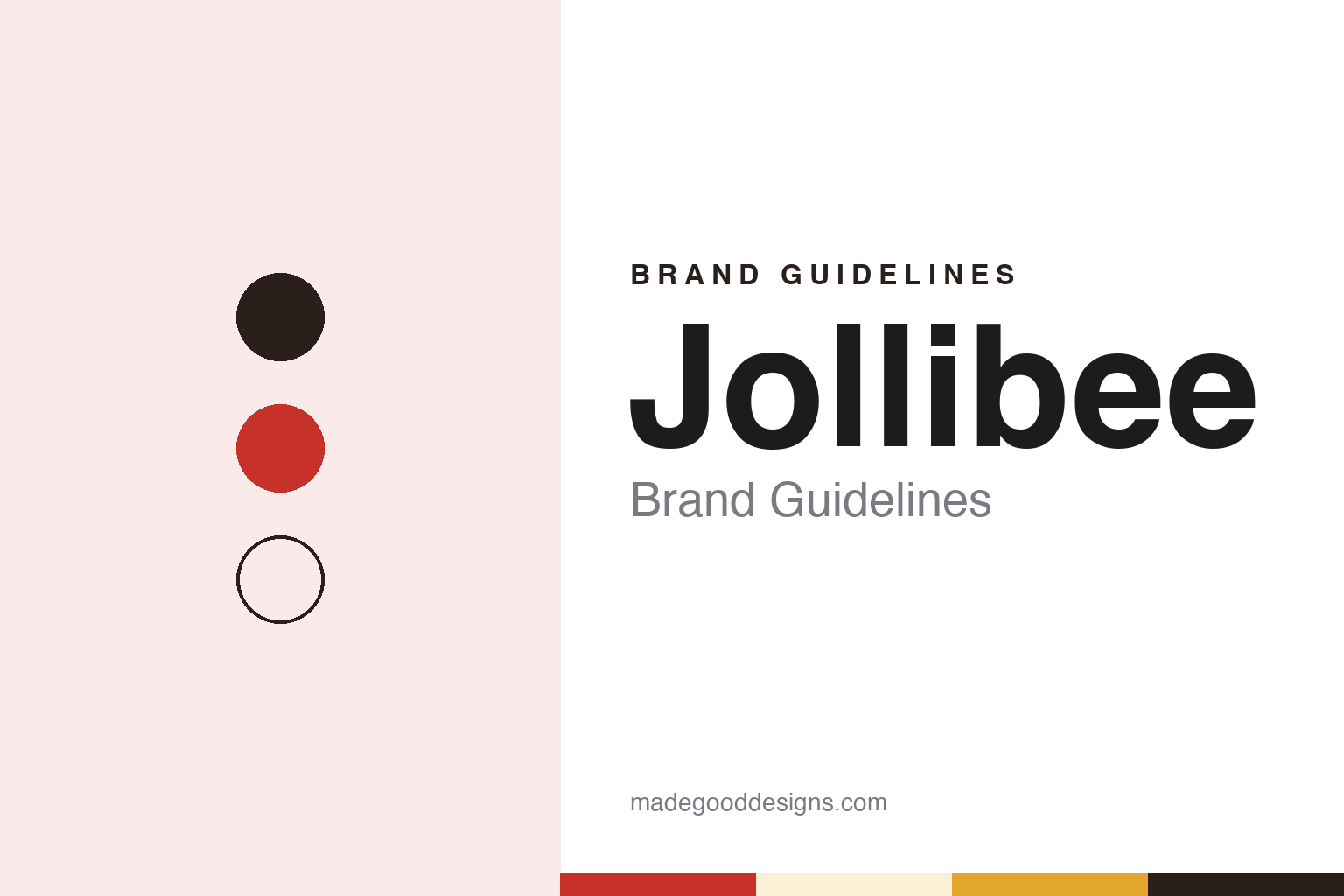
Two constants: a blazer red, honey gold and bun cream palette and a rounded friendly sans register. Abstract homage — not a Jollibee product or mark; no mascot, logo or meal is reproduced.
Cubao, 1975
An ice cream parlour that started selling hot meals.
Jollibee began as something else. In 1975, English Wikipedia says, Tony Tan Caktiong and his family opened a Magnolia ice cream parlour in Cubao, Quezon City, part of Metro Manila. The parlour started serving hot meals and sandwiches, and when those outsold the ice cream the family turned it into a fast-food restaurant. That became the first Jollibee in 1978. Rappler, in an August 2026 feature, gives the same outline: founded in 1975 as an ice-cream business by Tan Caktiong, now chairman of Jollibee Foods Corporation, and changed in 1978 into the fast-food brand.
The name itself was adjusted early. English Wikipedia says the chain was first spelled “Jolibe” before settling on Jollibee. Jollibee Foods Corporation was incorporated in January 1978, and by the end of that year there were seven branches in Metro Manila. The first franchised outlet opened in Santa Cruz, Manila, in 1979, and the company has worked as a franchisor since then.
The menu mixed American-style fast food with Filipino tastes. English Wikipedia names the Yumburger, a beef burger with a sweet mayonnaise dressing and one of the first things the chain sold; Chickenjoy, a fried chicken meal introduced in the 1980s and served with rice and gravy, fries or spaghetti; Jolly Spaghetti, with a sweet sauce and pieces of hot dog and ham; and the Burger Steak, added in 1995. Abroad, the chain adds local dishes, such as chili chicken in Vietnam and nasi lemak in Brunei, English Wikipedia says.
The company went public on the Philippine Stock Exchange in 1993, a date given by both English Wikipedia and Rappler, and is based today in Pasig, Metro Manila.
Colour
A group built around a bee.
Jollibee is the flagship of a much larger group. English Wikipedia lists the Philippine brands that Jollibee Foods Corporation bought as it grew: a majority of Greenwich pizza in 1994, Chowking in 2000, Red Ribbon in 2005 and Mang Inasal in 2010. Abroad the group added chains including Yonghe King in China, Highlands Coffee in Vietnam, Smashburger and The Coffee Bean & Tea Leaf in the United States, and Tim Ho Wan, the Hong Kong dim sum chain. Rappler reported in October 2026, from a company disclosure, that Jollibee, Mang Inasal and Chowking together made up nearly 90 per cent of the group’s Philippine system-wide sales, with Jollibee alone contributing 62 per cent. The same report gave the group 3,516 stores in the Philippines and 7,251 abroad as of the first half of 2026, across all its brands.
Jollibee went abroad early. English Wikipedia says the first overseas branch opened in Singapore in 1985, at the Katong Shopping Centre, and closed a year later; the chain returned to Singapore in 2013. A branch in Brunei followed in 1987. The first store in the United States opened in Daly City, California, in 1998, a date given by both English Wikipedia and Rappler, and the first in Europe opened in Milan in 2018, English Wikipedia says. The same source names Vietnam and the United States as its biggest markets outside the Philippines.
The North American growth drew attention. Rappler reported in August 2026 that the first Manhattan store opened in 2018 on Eighth Avenue near Times Square, as the chain’s 41st store in North America, and that Jollibee then had more than 100 stores in the region. Ty Matejowsky, an anthropology professor at the University of Central Florida, told Rappler that the chain grew by first serving places with large Filipino communities, such as the West Coast, before reaching a wider public; he pointed to Chickenjoy as a large part of its appeal to American diners, who also found Jolly Spaghetti, peach mango pie and palabok on the menu.
Typography
Asian restaurant chains and how they present themselves.
Asian restaurant chains tend to present themselves through what happens in the kitchen. Din Tai Fung’s own history page opens with the xiaolongbao and its count of 18 folds, and the Taipei Times traced that formula to the founder’s son working alongside the shop’s first dim sum chefs.
Names and shop fronts carry a lot of the identity. Tim Ho Wan’s Chinese name means “to add good luck,” English Wikipedia says, and Din Tai Fung’s joins the names of a former employer and an oil supplier, according to the company and the Taipei Times. Long-kept signs, such as the brushed board that Din Tai Fung says still hangs at its first restaurant on Xinyi Road, link a chain of many branches back to one room.
Dish naming is usually plain and descriptive: barbecue pork buns, steamed rice rolls, pan-fried turnip cake, soup dumplings. Groups can list signature dishes by name when they announce deals, as Jollibee Foods Corporation did for Tim Ho Wan in November 2024, GMA News reported. Guidebook recognition travels with a name too: Tim Ho Wan’s first shop in Mong Kok appeared with a star in the 2010 Michelin Guide, Gourmet Traveller reported in 2015, and that star still features in how the chain is introduced in press coverage.
The corporate side is published too. Company pages set out founders and founding years, parent groups describe their portfolios in stock exchange disclosures, and franchise partners appear in trade press when rights change hands. This guide sets out what can be checked about each brand — who founded it, who owns it and how it grew — and marks clearly what rests only on the company’s own word.
Aa
A rounded friendly sans — a bee in a red blazer and chef’s hat. (Specimen set in Baloo 2, a sans STAND-IN; NOT the Jollibee logo.)
Jollibee
The bee as a registered mark.
The brand’s centre is its mascot. English Wikipedia says the Jollibee character, introduced in 1980, is a large bee dressed in a red blazer, a shirt and a chef’s hat, and that the bee has appeared in the chain’s logo since 1978. The founder has compared the character to Filipino working people, a bee that is busy but cheerful. The mascot also became a television character: English Wikipedia says a children’s programme, Jollitown, ran from 2008 to 2013, with the bee alongside other characters created by the chain.
In 2025 the bee gained legal standing of its own. Asia IP reported in September 2025 that on 10 August 2025 the Intellectual Property Office of the Philippines declared the Jollibee logo and the full image of the Jollibee character to be well-known marks, the first entries in a register created under rules the office issued in February 2025, which took effect that April. Under those rules, the report explains, a well-known mark is judged by its recognition among the relevant public, the length and reach of its use and promotion, and its reputation. English Wikipedia describes the registered logo as the chain’s “stacked” logo, and notes that Jollibee Foods Corporation uses a separate corporate logo, updated in 2025.
The corporate structure is also changing. The Manila Times reported on 2 September 2026 that the company had chosen Hong Kong to list Jollibee Foods Corporation International, a new company set up to hold its business outside the Philippines once the proposed separation is completed. Rappler reported in October 2026 that Hong Kong had been chosen instead of the United States, as first planned, that the Philippine business would stay listed in Manila, and that the company had said on 20 October that reports of a target date were premature. The separation was proposed in 2026; it had not been completed at the time of writing, and remains subject to restructuring, market conditions and regulatory approval.
For a design guide, Jollibee shows how a mascot can carry a fast-food brand across countries, from a Quezon City parlour to Manhattan, with the character doing the work a wordmark does elsewhere. Compare Chowking and Mang Inasal, two sister brands in the same group. For this guide we use a blazer red, honey gold and bun cream with a rounded sans, an unofficial interpretation; no product or logo is reproduced.
Explore & save
Keep Jollibee’s identity on hand — save it to a board in the Made Good inspiration library.
Jollibee identity set
Pin the Jollibee blazer red, honey gold and bun cream palette and the rounded friendly sans register to your own board.