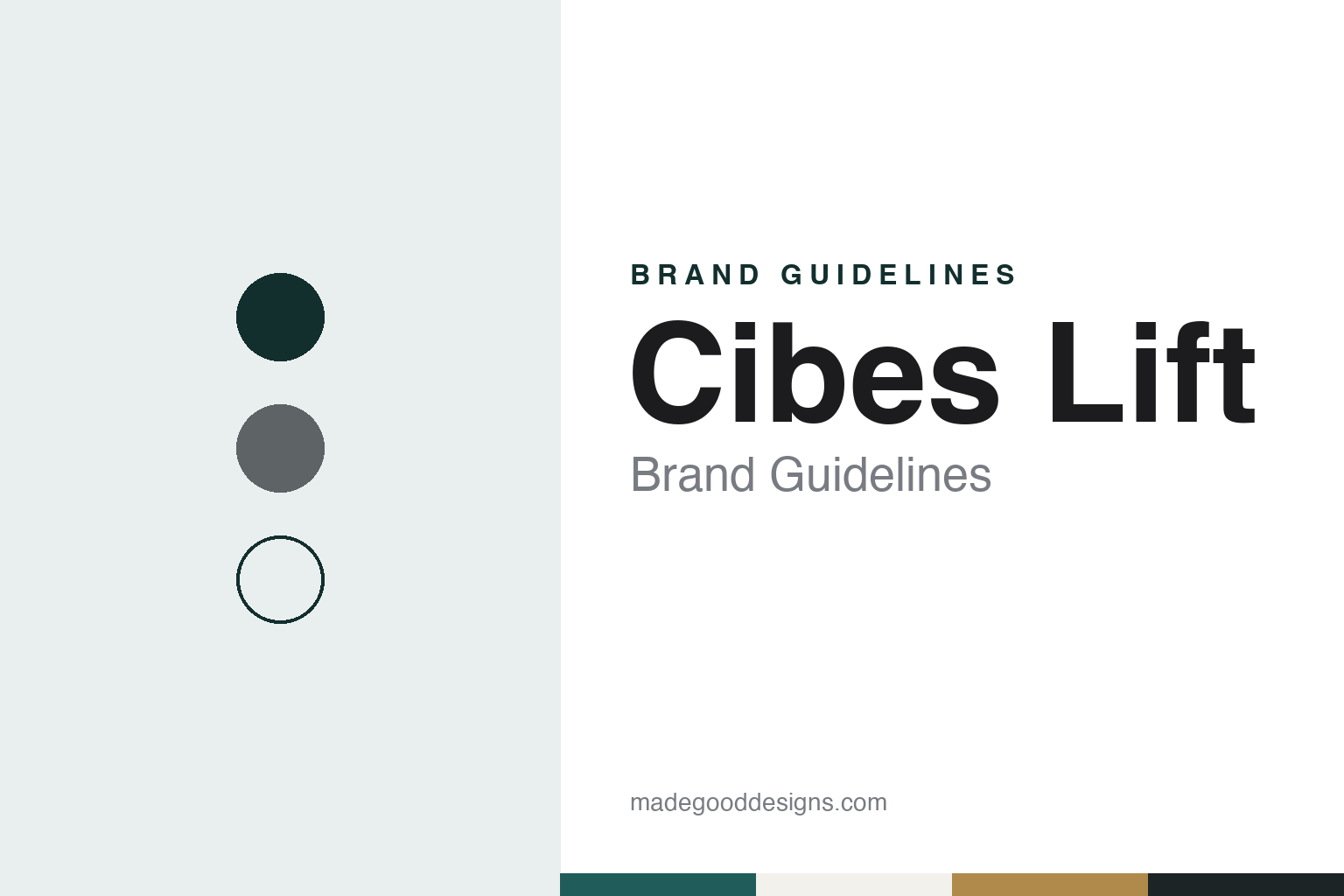
Cibes Lift Brand Guidelines
A 1947 Stockholm brand built around the screw-driven lift.
Aa
Two constants: a teal, granite and birch palette and an engineering sans register. Abstract homage — not a Cibes product or mark; no lift, logo or nameplate is reproduced.
Elektroborg
An engineer, a Stockholm company and a brand name.
Cibes began in 1947 as a brand inside Elektroborg AB, a Stockholm company set up by the civil engineer Bertil Svedberg, according to the history published by Cibes Lift Group. English Wikipedia says that in the 1950s Svedberg began making chain-driven hoists with a lift car in Solna, at first about 30 a year and still under the Elektroborg name; the group’s own timeline calls them small-scale chain-driven construction elevators. The group says its first products were lifting equipment and goods lifts, and that its focus later moved to passenger lifts and a modular lift concept. Svedberg was active in the company for almost 40 years, it says.
The turn towards homes came in the 1960s. Cibes Lift Group says demand for affordable lifts in private homes and residential buildings grew in Sweden, and that in the mid-1960s it launched a hydraulic platform lift for home adaptation, installed outdoors in stairwells and at entrances. English Wikipedia describes a collaboration from the mid-1960s with Stenfors Industries, which made a lift table with guardrails under contract, while Elektroborg handled its sales and product development through the 1970s.
That work produced the mechanism Cibes still builds around. The group says that in the early 1970s it launched a lift driven by screws and nuts, the forerunner of its present B-lift models; English Wikipedia describes the design as a lift car driven by a screw rod and built on a tripod with legs. In the 1980s, the group says, development produced a low-speed lift with its own shaft walls, the A-lift, and the first sales outside Sweden, to neighbouring Scandinavian countries. English Wikipedia dates platform-lift development and production at Järbo to 1986 and the start of exports to Finland and Norway to 1989.
Colour
R12, Nalka and a string of local brands.
In 1991 the company Cibes Elevator AB was created, now named Cibes Lift AB, English Wikipedia says. The group dates the launch of its A5000 lift to 1992 and says the model has been developed continuously since. English Wikipedia says the A5000 was certified for the European market in 1995, the year Sweden joined the European Union, and that export sales in Europe then picked up; the group dates its first lift in China, at the Macau Museum, to the same year, and its first low-speed lift exports beyond Scandinavia to 1997. In 1999 Cibes was among the founders of the European Platform and Stairlift Association (EPSA), set up with 24 other lift makers to work on harmonised rules for platform lifts and stairlifts, according to English Wikipedia.
Ownership changed twice. Cibes Lift Group says the Swedish investment company R12 bought Cibes in 2003. In June 2017 Industrinyheter reported that R12 had sold Cibes, based in Gävle, to the investment company Nalka, which said it would keep its focus on product development and closeness to customers; a Cibes press release dated 9 June 2017 gives the same account. In November 2026 Nalka’s own list of investments showed Cibes Lift Group as a current holding, bought in 2017.
Under both owners the group grew by buying companies. Its first acquisition, it says, was Axess4All in the UK in 2005; Kalea Lifts in Sweden and Aesy Liften in the Netherlands followed in 2008, and in 2009 NTD Lifts, a company that former Cibes employees had started in the 1980s. Later purchases listed by the group include AMSLIFT in Finland in 2018, and in 2022 both Bella Elevator, maker of the Symmetry lifts, in the United States and Apex Lifts in London. In 2008, English Wikipedia says, Cibes received the Hermes Export Prize from the Swedish Chamber of Commerce and the Swedish Fund for Export Development.
Typography
How the category presents itself.
Home-lift and stairlift makers sell machines that end up in private hallways and living rooms, and two Swedish makers, Aritco and Cibes, present them that way. Aritco names its range around the home, with the HomeLift, HomeLift Compact and HomeLift Access, and credits the Swedish designer Alexander Lervik for several models; Cibes Lift Group says its customers choose from colour, material and function options picked by local design teams.
Naming often begins as engineering shorthand. Cibes still uses letter-and-number models such as the A5000, launched in 1992, and groups its lifts as A-lifts, with their own shaft walls, and B-lifts, which the company traces to a screw-and-nut design of the early 1970s. Aritco moved from numbered models, from the Aritco 7000 of 1995 to the Aritco 9000 cabin lift of 2013, to the named HomeLift and PublicLift lines from 2016 onwards.
Both companies describe selling largely through partners. Cibes Lift Group says it works through more than 270 certified distributors as well as its own offices in 20 countries; Aritco says it sells in 60 countries through more than 170 distributors, and that it set up a global network of installation and service partners in 2014. Cibes has also bought local lift companies and kept several of their names, such as Kalea, Aesy Liften and Apex Lifts.
Corporate pages fill in the rest: who owns the company and where the lifts are made. Cibes names its factories in Gävle, Jiaxing and the United States and a components unit in Gdańsk, and its owner, the investment company Nalka, lists it as a holding. Aritco describes its factory in Veddesta, outside Stockholm, and its place in Innovalift, a business area of Investment AB Latour. This guide sets out what can be checked for each brand, and marks what rests on the company’s own word.
Aa
An engineering sans for a maker of screw-driven lifts. (Specimen set in Work Sans, a sans STAND-IN; NOT the Cibes logo.)
Cibes Lift Group
Gävle, Jiaxing and Gdańsk.
Production has moved over the decades. Cibes opened a new factory in Gävle in 2012, with 10,000 square metres of production space that brought its Swedish manufacturing and development under one roof, the group says; in May 2015 a Cibes press release said production of Kalea Lifts’ home-adaptation products would move there from Gothenburg. In 2020 a second factory with its own research and development centre opened in Jiaxing, China, for Asian markets, and the 2022 purchase of Bella Elevator added production in the United States. In 2024 a unit in Gdańsk, Poland, began making components and packaging parts for the Swedish and American plants, according to the group and English Wikipedia.
Cibes Lift Group, headquartered in Gävle, describes itself today as a lift and elevator manufacturer with about 2,000 employees, its own presence in 20 countries and a network of more than 270 distributors, figures it gives for 2025. Its brand page lists the Cibes name alongside local brands, among them Kalea, Aesy Liften, Cibes Symmetry and Apex Lifts. On design, the group says its three regional research and development teams exchange ideas, that its lifts can be upgraded over time, and that customers choose from colour, material and function options picked by local design teams.
For a design guide, Cibes shows how a maker built around one mechanism, the screw-driven low-speed lift, can keep a 1940s engineer’s brand name while growing through local brands and regional factories. Compare Aritco, another Swedish home-lift maker, founded near Stockholm in 1995, and Stiltz. For this guide we use a deep teal, a granite grey and a birch white with a sans, an unofficial interpretation; no product or logo is reproduced.
Explore & save
Keep Cibes Lift’s identity on hand — save it to a board in the Made Good inspiration library.
Cibes Lift identity set
Save the Cibes teal, granite and birch palette and the engineering sans register for your own reference.