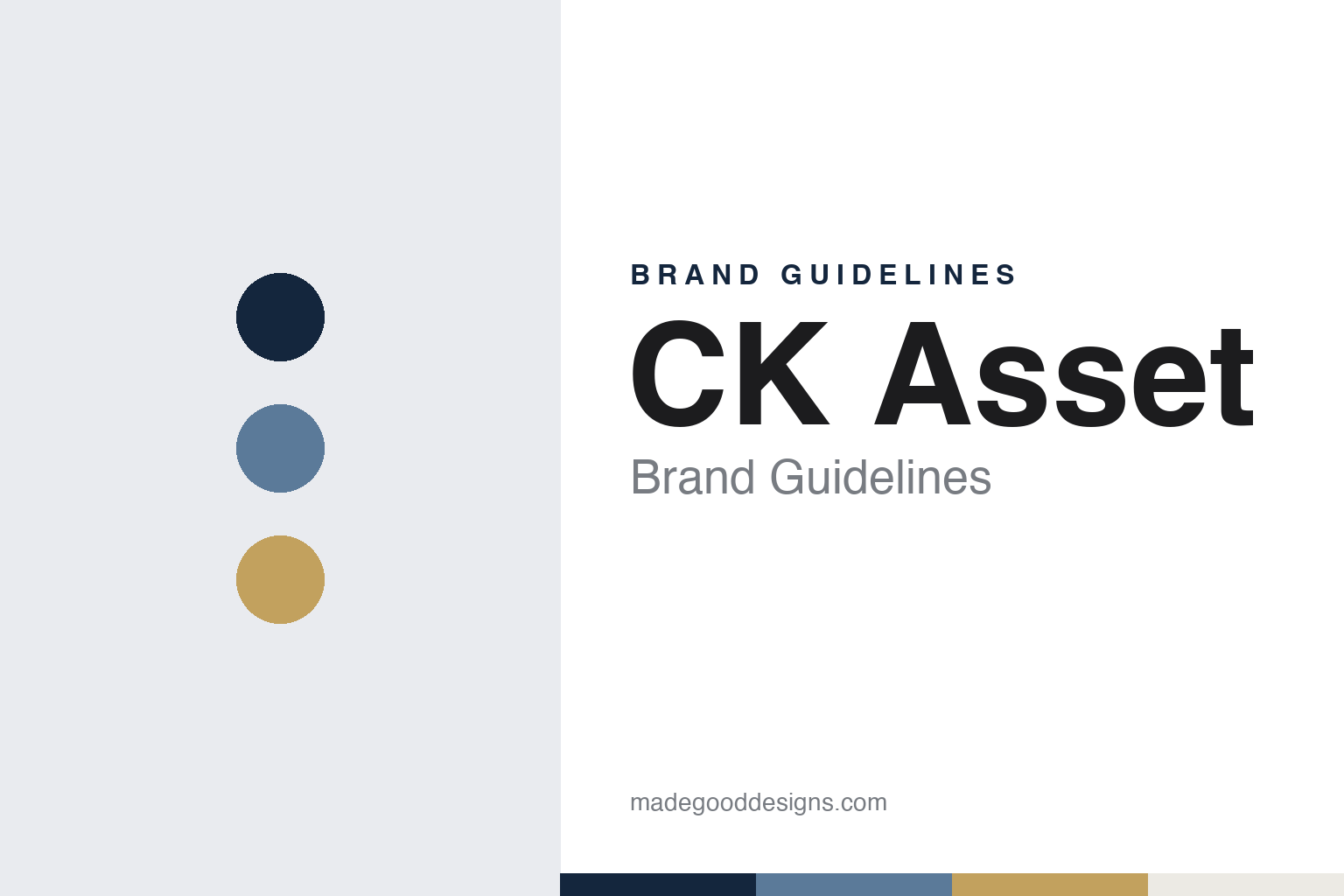
CK Asset Brand Guidelines
Cheung Kong’s property arm, listed on its own since 2015.
Aa
Two constants: a harbour navy, slate blue and muted gold palette and a corporate sans register. Abstract homage — not a CK Asset mark; no logo, building or hotel sign is reproduced.
Cheung Kong
A plastics firm named after the Yangtze.
CK Asset is the property arm of the business that Li Ka-shing started in Hong Kong in 1950. The company’s own biography of him says he founded Cheung Kong Industries that year to make plastics, and named it after the Yangtze River, a great river that gathers countless streams and tributaries, as a picture of combined effort. English Wikipedia says Cheung Kong (Holdings) Limited was established in 1971 and listed in Hong Kong in 1972; the company says Cheung Kong went on to acquire Hutchison Whampoa in 1979 and Hongkong Electric, now Power Assets, in 1985.
Cheung Kong grew into one of the two dominant builders of new private homes in the city. English Wikipedia, citing Hong Kong’s Consumer Council, says Cheung Kong and Sun Hung Kai Properties together accounted for about 70 per cent of that market in 2010, and links the concentration to the government’s practice of auctioning land in large blocks.
The present company is much younger. In January 2015 Li Ka-shing confirmed a reorganisation that, according to English Wikipedia, merged Cheung Kong and Hutchison Whampoa under a new holding company, CK Hutchison Holdings, and moved the group’s property assets into a separate listed company, Cheung Kong Property Holdings. That company began trading on 3 June 2015, the day Hutchison Whampoa was delisted, and became a constituent of the Hang Seng Index straight after the restructuring. It was later renamed CK Asset Holdings. English Wikipedia describes it as registered in the Cayman Islands, with its headquarters and principal place of business in Hong Kong.
Leadership changed in 2018. Li Ka-shing stepped down as chairman and became senior advisor to both CK Asset and CK Hutchison on 10 May 2018, the company says, and English Wikipedia lists his elder son Victor Li as chairman from 2018. The mobile networks inherited from Hutchison Whampoa sit with CK Hutchison; CK Asset’s side of the group is property, hotels and a set of infrastructure investments.
Colour
Towers, hotels, pubs and pipes.
The company describes itself as “a leading multinational conglomerate” and as one of the largest property developers in Hong Kong, with an extensive portfolio in mainland China and a significant presence in Singapore and the United Kingdom. Its website divides the property business into Hong Kong, mainland and overseas sections, each with pages for sales, leasing, current developments and completed developments, alongside property management companies such as Citybase and Goodwell. It also holds units in three listed real estate investment trusts: Hui Xian REIT, Fortune REIT and Prosperity REIT.
Hotels form a recognisable family of names. The company’s Hong Kong hotel pages list the Harbour Grand and Harbour Plaza hotels, among them Harbour Grand Kowloon and Harbour Plaza Metropolis, together with Hotel Alexandra, Kowloon Harbourfront Hotel and serviced suites under the FAMITEL name. Each is shown with its Chinese name, and the characters 海逸 run through both the Harbour Plaza and Harbour Grand names.
Overseas, the developer markets homes to buyers far from the site. In October 2024 the Bangkok Post carried a release on the launch of Powerhouse at Chelsea Waterfront in London to South East Asian buyers at a press event in Bangkok: apartments inside the walls of a converted riverside industrial landmark on the Thames, beside the 37-storey Tower West, presented by staff of Hutchison Property Group on CK Asset’s behalf.
A step well beyond property came in 2019, when CK Asset agreed to buy the British brewer and pub company Greene King. Bisnow reported in August 2019 that analysts saw the deal as much about the pubs’ property as about beer, and that CK had bought the London headquarters building of UBS the year before. The company now lists Greene King as a wholly owned subsidiary, an integrated brewer and pub retailer with pubs, restaurants and hotels across England, Wales and Scotland. Its infrastructure holdings include stakes in Northumbrian Water, the sub-metering group ista, Canada’s Reliance Home Comfort and the energy businesses of CK William Group in Australia, the United Kingdom, the United States and Canada, according to its website.
Typography
How developers present themselves.
Property developers in Asia and the Gulf sell places more than products, and their identities are built to be read at the scale of a city. The material to compare is public: corporate websites, project microsites, investor pages and the annual and sustainability reports that listed developers publish each year. In those pages, look at how much work the photography does — towers at dusk, harbour and skyline views, architects’ renderings labelled “artist’s impression”, as on Henderson Land’s brand site — and at how the corporate wordmark, in navy, green, gold or black, is placed against it.
Names are part of the design. Hong Kong developers present themselves in English and Chinese, with short forms that differ between the two languages; Henderson Land, for example, is 恒基兆業地產 in full and 恒地 for short, according to Chinese Wikipedia. In the Gulf the pairing to watch is English and Arabic; in the Philippines, English and Filipino. Hotels, malls and residential estates usually carry names of their own, so a group such as CK Asset sits behind a family of hotel names rather than putting its own name on every door.
The structure of a developer’s website is a portrait of the business. Pages are commonly divided by residential, office, retail and hotel portfolios, by city or country, and by projects for sale, for lease, under construction and completed. Landmark malls and mixed-use districts get their own sites and campaigns, and the newest schemes, such as Henderson Land’s Central Yards on the Hong Kong harbourfront, are introduced with long lists of named architects and landscape designers.
Sustainability is now a standard chapter. Developers name their programmes, publish environmental, social and governance reports beside their annual results, and use shorthand such as Henderson Land’s G.I.V.E. to make a strategy memorable. This guide sets out what can be checked about each company — who founded it, who controls it and what it builds — and marks clearly what rests only on the company’s own word.
Aa
A corporate sans for an investor-facing holding company. (Specimen set in Libre Franklin, a sans STAND-IN; NOT the CK Asset logo.)
CK Asset
A quiet holding company behind many named places.
CK Asset’s public face is corporate rather than consumer. Its website is built around investor relations — announcements, financial reports, an estimated project completion schedule, risk factors and sustainability reports — in English, traditional Chinese and simplified Chinese. The names the public meets are the developments, hotels and pubs, each carrying its own identity, while the CK prefix ties the company to CK Hutchison and to CK Life Sciences, another member of the former Cheung Kong group named by English Wikipedia.
On sustainability, the company says it aims to integrate environmental, social and governance principles into its investment decisions, to build “an ethical corporate culture at all levels” and to “advance its transition to carbon neutrality”. It publishes sustainability policies and reports beside its annual and interim results, and its group structure links out to the three REITs’ own websites.
For a design guide, CK Asset shows how a holding company can sit behind many separately named places — a family of harbour hotels, residential estates, a London riverside conversion and a chain of British pubs — while keeping its own identity quiet and investor-facing. Compare CK Hutchison, its sister company from the same 2015 reorganisation, and Sun Hung Kai Properties, another large Hong Kong developer. For this guide we use a harbour navy, a slate blue and a muted gold with a sans, an unofficial interpretation; no product or logo is reproduced.
Explore & save
Keep CK Asset’s identity on hand — save it to a board in the Made Good inspiration library.
CK Asset identity set
Pin the CK Asset harbour navy, slate blue and muted gold palette and the corporate sans register to your own board.