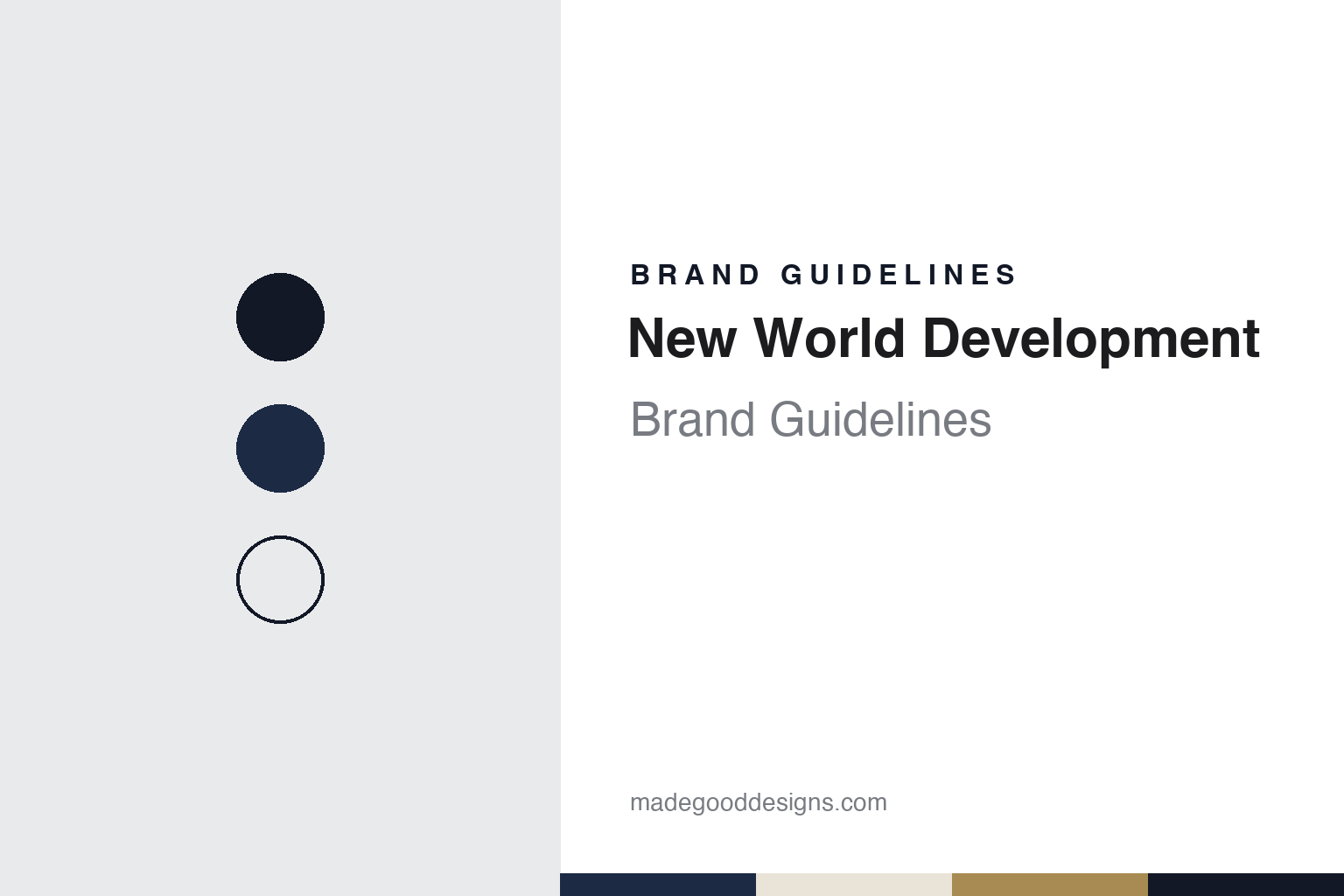
New World Development Brand Guidelines
The Hong Kong developer that built a second brand around art.
Aa
Two constants: a harbour navy, stone and brass palette and a gallery serif register. Abstract homage — not a New World Development building, sign or mark; no logo or artwork is reproduced.
New World Centre
A 1970 company and a harbourfront complex.
New World Development was established in Hong Kong on 29 May 1970, English Wikipedia says, and names Cheng Yu-tung as its founder. The company’s own timeline records that Ho Sin Hang was elected chairman, Cheng was appointed director and general manager, and Chow Tai Fook Enterprises was the largest shareholder from the start. The shares were listed on the Hong Kong stock exchange in 1972; Wikipedia gives the listing date as 23 November, while the company’s timeline places it in October.
The early projects set a pattern of building large complexes and keeping them. In 1973 the company bought control of Hip Hing Construction and began building a commercial project on the old Holt’s Wharf site in Tsim Sha Tsui; the first phase of that New World Centre, with a New World hotel inside, was completed in December 1978, the company says. In 1976 it moved its head office into the American International Tower in Central, which was renamed New World Tower on 1 January 1980 and is still named as the headquarters on Wikipedia. Housing came early too: City One Shatin, a residential estate of 53 towers in the New Territories, was completed in 1975, according to the company.
In 1982 Cheng succeeded Ho as chairman. Two years later the company signed an agreement with the Hong Kong Trade Development Council to develop and manage the Hong Kong Convention and Exhibition Centre on the Wan Chai waterfront; it opened in 1988, and the Grand Hyatt and Renaissance Harbour View hotels beside it opened in 1989, according to the company. Henry Cheng became managing director in 1989 and has been chairman since March 2012, Wikipedia says.
Colour
K11, Victoria Dockside and a vocabulary of its own.
The group spread across the mainland from the late 1980s. The company dates its first mainland property project, Fortuna Garden in Guangzhou, to 1991; New World China Land was formed in 1999 to hold those projects and is now wholly owned. Over the years the group also took in infrastructure, ferries and buses, department stores and hotels. Its hotel arm bought Rosewood Hotels & Resorts in 2011 and took the Rosewood Hotel Group name in 2013, the company says, and Wikipedia now lists Rosewood as a former subsidiary. New World Department Store China, listed in Hong Kong in 2007, remains a listed company within the group.
The brand that changed the group’s public face was K11. The first K11 art mall opened in Hong Kong in 2009, a shopping centre with art on display that the company presents as the first of its kind, and a K11 Design Store followed in 2010. In 2017 the company announced Victoria Dockside, an art and design district on the Tsim Sha Tsui harbourfront; its first phase, the K11 Atelier office tower, opened in 2017 and 2018, and the museum-retail complex K11 MUSEA opened in August 2019. On the mainland, K11 ECOAST in Shenzhen began a phased opening in April 2025, which the company calls K11’s first flagship there, and a K11 Art Mall opened in Hanxi, Guangzhou, in September 2025.
Around K11 the company built a vocabulary of its own. It calls its brand vision “The Artisanal Movement”, and Wikipedia lists five elements behind it: imagination, bespoke, craftsmanship, heritage and contemporary. Homes are sold under collection names set in capital letters in the company’s listings, such as the PAVILIA developments, including The Pavilia Farm and State Pavilia, and recent launches such as Austin Bohemian and Grand Austin Bohemian near West Kowloon.
Typography
Design and documentation.
Property developers in Asia and the Gulf sell places more than products, and their identities are built to be read at the scale of a city. The material to compare is public: corporate websites, project microsites, investor pages and the annual and sustainability reports that listed developers publish each year. In those pages, look at how much work the photography does — towers at dusk, harbour and skyline views, architects’ renderings labelled “artist’s impression”, as on Henderson Land’s brand site — and at how the corporate wordmark, in navy, green, gold or black, is placed against it.
Names are part of the design. Hong Kong developers present themselves in English and Chinese, with short forms that differ between the two languages; Henderson Land, for example, is 恒基兆業地產 in full and 恒地 for short, according to Chinese Wikipedia. In the Gulf the pairing to watch is English and Arabic; in the Philippines, English and Filipino. Hotels, malls and residential estates usually carry names of their own, so a group such as CK Asset sits behind a family of hotel names rather than putting its own name on every door.
The structure of a developer’s website is a portrait of the business. Pages are commonly divided by residential, office, retail and hotel portfolios, by city or country, and by projects for sale, for lease, under construction and completed. Landmark malls and mixed-use districts get their own sites and campaigns, and the newest schemes, such as Henderson Land’s Central Yards on the Hong Kong harbourfront, are introduced with long lists of named architects and landscape designers.
Sustainability is now a standard chapter. Developers name their programmes, publish environmental, social and governance reports beside their annual results, and use shorthand such as Henderson Land’s G.I.V.E. to make a strategy memorable. This guide sets out what can be checked about each company — who founded it, who controls it and what it builds — and marks clearly what rests only on the company’s own word.
Aa
A gallery serif — a register for an art-mall developer. (Specimen set in Cormorant Garamond, a serif STAND-IN; NOT the New World Development logo.)
New World Development
Disposals, refinancing and an airport deal.
Recent years have been about selling assets and refinancing. The company completed the disposal of NWS Holdings in November 2023, the sale of its interest in the D·PARK mall in April 2024 and the disposal of its Kai Tak Sports Park interest in November 2024, according to its timeline. Adrian Cheng, who had led the K11 brand, stepped down as chief executive in September 2024, and in December 2024 the company was removed from the Hang Seng Index, Wikipedia says; Echo Huang has been chief executive since November 2024.
In June 2025 the company postponed coupon payments on two perpetual bonds, according to a Hong Kong exchange filing reported by Forbes on 2 June 2025, and later that month it says it completed a new bank facility. In late September 2026 it announced an agreement with the Airport Authority over its 11 Skies retail and office complex at Hong Kong’s airport, under which the authority would take over the complex and gain an option to buy shares from Chow Tai Fook Enterprises, The Star reported on 14 October 2026, citing Bloomberg; agreed in September 2026, it was not completed at the time of writing. New World says its core business remains property development and investment in Greater China, especially the Greater Bay Area.
For a design guide, New World Development shows a developer running a culture-led second brand beside its corporate name, from K11’s galleries and malls to capitalised residential collection names. Compare Sun Hung Kai Properties and CK Asset. For this guide we use harbour navy, warm stone and a muted brass with a serif, an unofficial interpretation; no product or logo is reproduced.
Explore & save
Keep New World Development’s identity on hand — save it to a board in the Made Good inspiration library.
New World Development identity set
Pin the New World Development harbour navy, stone and brass palette and the gallery serif register to your own board.